Cold Starts, Batteries & Jump Starters
What Size Jump Starter Do I Need?
Match the pack to the engine displacement its maker publishes, not to the peak-amps number on the front. Those two figures do not move together, and one of them has no test behind it.
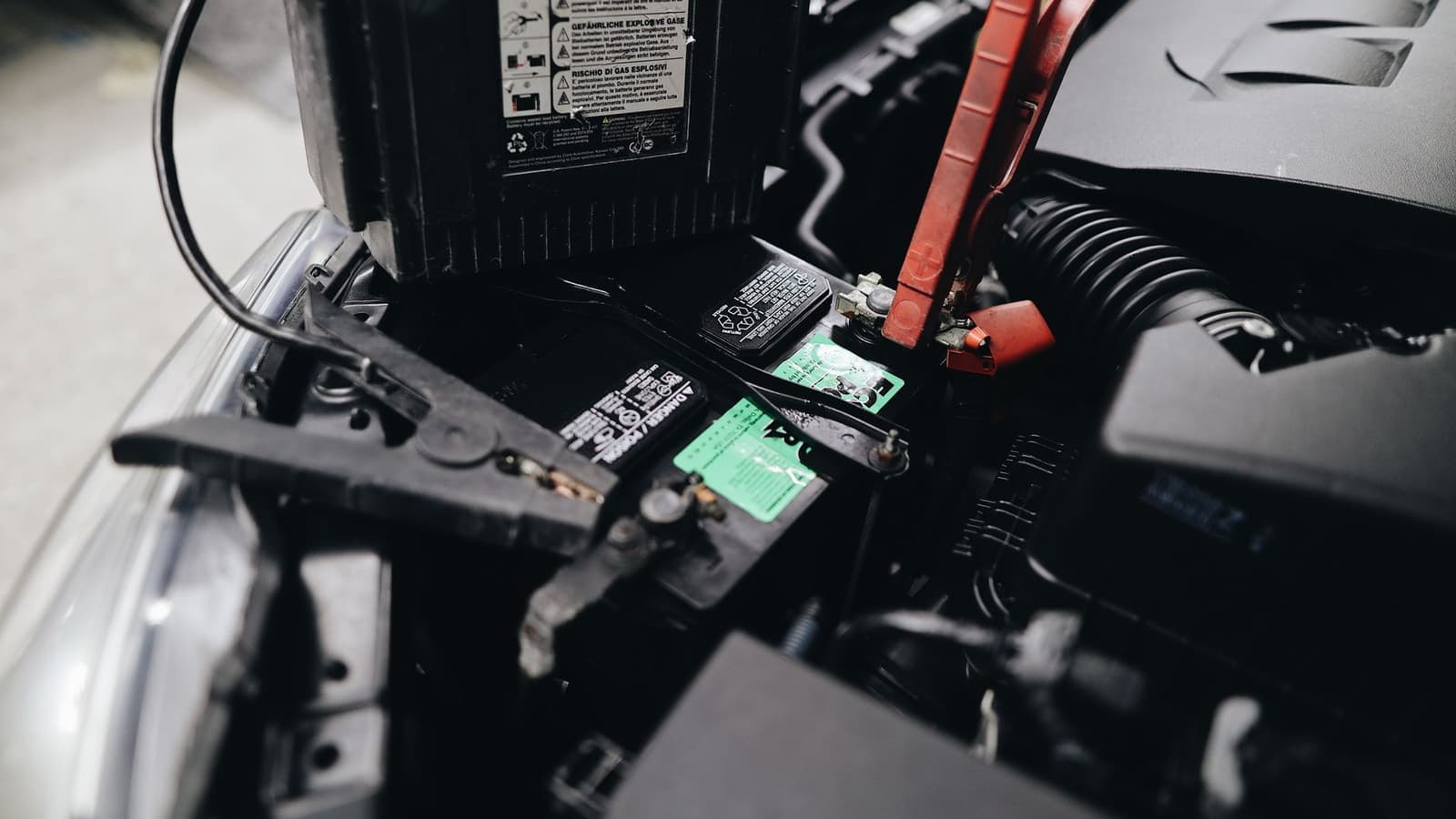
For nearly every gas car on the road, a pack rated by its maker to 6.0L gasoline is enough, and the NOCO Boost GB40 is the cleanest example of one - 1000 peak amps, up to 6.0L gas and 3.0L diesel. Go up a size if your engine is bigger than that rating or if it is a diesel, because the diesel ceiling is always far lower than the gas one. Ignore peak amps entirely: it is the number that does not predict a start.
Almost every shopper arrives at this category with the wrong question. "How many amps do I need?" sounds like the right one, and it is the figure printed largest on every box. It is also the figure with nothing behind it.
Why peak amps is the wrong number
A battery's cold cranking amps rating is defined: the current a 12V battery delivers for thirty seconds at 0F while holding at least 7.2 volts. That is a specified test at a specified temperature, which is why the battery roundup ranks on it.
Peak amps on a lithium jump pack is not that. We pulled the live listing for every pack on this site and not one of them publishes a test method, a duration or a temperature behind its peak figure. There is no standard, so the number is not comparable between two brands, and a maker that wants a bigger one can simply print it.
You do not have to take that on trust, because the packs themselves give the game away. Lined up against the one figure makers do stand behind, the peak numbers go in a different direction:
Read the bolded row against the one above it. The Weego publishes more peak amps than the NOCO GB70 and rates a smaller gas engine and a diesel engine less than half the size. And the GOOLOO GT4000S claims double the Weego's peak amps while rating an engine nearly twice as big again. If peak amps measured starting capability, those rows could not look like that.
The one genuinely useful exception is also in that table: the Weego is the only pack we have found that publishes cranking amps - 440 CA against its 2100 peak. Cranking amps is a sustained figure rather than an instantaneous one, and it is roughly a fifth of the headline. That ratio is a good thing to carry around in your head.
The number to size on, and where to find yours
Every pack worth buying publishes a maximum engine displacement in liters, usually two of them - one for gasoline and a much lower one for diesel. That figure is the maker telling you, in writing, what it expects the pack to start. It is the specification to shop on.
Your engine size is on the trunk badge on a lot of cars, in the first page of the owner manual on all of them, and in the vehicle details on your registration in most states. If you know the car as a "2.0 turbo" or a "3.5 V6", you already have it: 2.0L and 3.5L.
Notice how much lower the diesel column runs. That is not conservatism, it is physics: a diesel has no spark, it relies on compression heat to ignite fuel, and the compression ratio is roughly double a gas engine's. The starter has to turn that over fast enough to build ignition temperature, in cold oil. A pack rated 8.0L gas being rated 6.0L diesel is the same pack describing two different jobs. Jump starters for SUVs and trucks goes further into the truck end of this.
How we judged the sizes below
Three criteria, in this order, and nothing else:
- Does it publish an engine rating at all? A pack that publishes no displacement figure cannot be sized, which is why the Stanley is not a pick here despite a big peak number. "Up to V8" is a cylinder count, and a 6.7L diesel V8 is a different request from a 5.0L gas V8.
- Is the rating a sensible margin above your engine? Buy the size that covers your car with room, not the size that exactly equals it. Lithium delivers less current cold, and the published ratings do not say at what temperature they were set.
- Does it publish starts per charge? This is the quiet one that matters. A first attempt that fails is the normal case on a very flat battery, and a pack with 20 starts in it has margin for a second and third try. A pack that publishes nothing there is asking you to guess.
Not a criterion: peak amps. Not a criterion: the number of "safety protections" a listing counts, which is a self-reported tally with no third party involved.
Sizing up is not free, which is why this is a real decision
The obvious move is to buy the biggest pack and stop thinking. There are three costs to that, and all three are on the listings:
- Weight and bulk. The GB40 is 2.4 lb. The GB50 is 3.33 lb. The GB70 is 4.41 lb. A glovebox pack lives in the heated cabin; a trunk pack lives outside, in the coldest part of the vehicle, which is precisely where lithium performs worst.
- Recharge time. 3 hours for the GB40, 5 for the GB50, 6 for the GB70, per NOCO. The bigger pack you drained on a Monday morning is not ready for Monday evening.
- Money. The gap between the small and large ends of one brand's line is most of the price of a second pack - and a pack sized for your engine plus a maintainer prevents more no-starts than a bigger pack rescues.
Do notbuy on peak amps because the price is similar
Two packs at the same price can publish 2100A and 2000A peak and rate 7.0L and 8.5L gas respectively. The peak figures tell you the two are equivalent. The engine ratings tell you they are not. When the two disagree, the engine rating is the one the maker will stand behind.
One adjustment for the temperature you will actually use it at
None of these published ratings name a test temperature, and lithium cells deliver less current cold - which is the awkward fact at the center of this whole category. The practical response is not to buy a bigger pack; it is to keep the pack warm. A pack in the glovebox has spent the night at cabin temperature. The same pack in the trunk has spent it outside.
That is a reason to favor a pack you will actually carry inside the car, which argues for the smallest one that clears your engine rating with margin. Lithium vs lead-acid jump starters has the chemistry, and car batteries in cold weather has what the cold is doing to the battery you are trying to rescue.
The short version
Find your engine displacement. Buy a pack whose published gasoline rating is comfortably above it - 6.0L covers the large majority of cars - and if it is a diesel, shop the diesel column instead, which is always the lower of the two. Prefer a pack that also publishes starts per charge. Then put it in the glovebox, not the trunk, and test the battery so you never need it.
What to buy, and what to skip
We haven't tested these
No lab, no borrowed units, no free samples. What we did do: pull every published spec into one table and work out what the numbers mean on a cold morning. Everything below traces to a published spec sheet, a manual, or a standard we can point you at - and if a figure isn't published, we say so instead of estimating it. The full method is here.
Heads up: we earn a commission if you buy through the links on this page, at no extra cost to you. It never changes a ranking - here is how we pick and how the site is funded.
1. Up to 6.0L gas / 3.0L diesel
NOCO Boost GB40 12V 1000A UltraSafe Portable Lithium Jump Starter
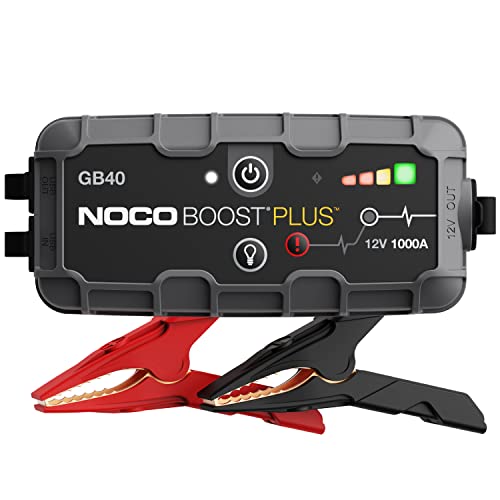
The sizing benchmark for the whole category, because NOCO prints the engine displacement each model covers on the box: 1000 peak amps, up to 6.0L gas and 3.0L diesel, 20 starts per charge. Half the peak amps of packs that cover a smaller engine, which is the entire argument against shopping on peak amps.
Best for: Most cars, once you size on the engine rating
What the maker publishes
- Peak amps
- 1000A
- Gas engines
- Up to 6.0L, per NOCO
- Diesel engines
- Up to 3.0L, per NOCO
- Starts per charge
- Up to 20, per NOCO
- Weight
- 2.4 lb
- Recharge time
- 3 hours, per NOCO
- Protection
- Spark-proof and reverse polarity, per NOCO
- Housing
- IP65 rated
- Warranty
- 1-year limited
- Operating temperature range
- Not published by the maker
What works
- Publishes both engine ceilings and the number of starts per charge, which together are the only figures in this category you can check against your own car
- IP65 and a 2.4 lb body make it the size that genuinely stays in the glovebox, where a lithium pack belongs in winter
- Spark-proof and reverse-polarity protection matter most exactly where the terminals are awkward - a fuse-box jump point or a battery under a seat
What doesn't
- 3.0L diesel is a car-diesel ceiling, not a truck one, and the gas figure stops short of a V8
- No published operating temperature range, which is the spec that would tell you what 1000A becomes at 10F
- Costs more than packs printing four times the peak amps - you are paying for the published rating, not the headline
Skip this if: your engine is over 6.0L gas or 3.0L diesel. Size up rather than hoping; that is what the published rating is for.
2. Up to 7.0L gas / 4.5L diesel
NOCO Boost GB50 12V 1500A UltraSafe Jump Starter
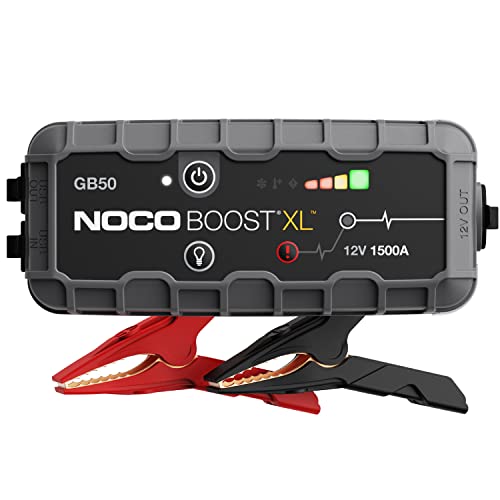
The middle rung: 1500 peak amps, 7.0L gas and 4.5L diesel, 30 starts per charge. The step up from the GB40 buys you a diesel ceiling 1.5L higher, which is the only reason to pay the difference.
Best for: A V6 or a small diesel
What the maker publishes
- Peak amps
- 1500A
- Gas engines
- Up to 7.0L, per NOCO
- Diesel engines
- Up to 4.5L, per NOCO
- Starts per charge
- Up to 30, per NOCO
- Weight
- 3.33 lb
- Recharge time
- 5 hours, per NOCO
- Protection
- Spark-proof and reverse polarity, per NOCO
- Housing
- IP65 rated
- Warranty
- 1-year limited
- Operating temperature range
- Not published by the maker
What works
- The diesel ceiling is the real upgrade over the GB40 - 4.5L covers most car and light-van diesels sold here
- 30 starts per charge is reserve you will never use in one morning and will appreciate across a winter of not checking it
- Same spark-proof clamps and IP65 housing as the rest of the line, so nothing is given up for the extra capacity
What doesn't
- A 5-hour recharge is slow enough that a pack you drained on Monday is not ready Monday evening
- 3.33 lb and noticeably thicker than the GB40 - this is a trunk or door-pocket pack, not a glovebox one
- Priced close to packs that publish a bigger gas ceiling, so it only makes sense if the diesel figure is what you need
Skip this if: you drive a gas car under 6.0L. The GB40 publishes everything you need for less money.
3. Up to 8.0L gas / 6.0L diesel, cheapest route
GOOLOO GP2000 Portable Car Battery Jump Starter, 2000A

8.0L gas and 6.0L diesel published, at a price that undercuts every other pack with those numbers by a wide margin. If the diesel figure is what you are shopping for, this is the cheapest honest route to it.
Best for: Diesel on a budget
What the maker publishes
- Peak amps
- 2000A
- Gas engines
- Up to 8.0L, per the maker
- Diesel engines
- Up to 6.0L, per the maker
- Weight
- 1.2 lb
- Size
- 7.4 x 3.9 x 1.5 in
- Protections
- 10, with all-metal clamps
- Operating range
- -4 to 140 F, per the maker
- Jumps per charge
- Not published by the maker
What works
- A 6.0L diesel ceiling at this price is the single best spec-per-dollar figure in this list
- 1.2 lb and barely thicker than a phone, so the cabin-storage rule is easy to follow
- All-metal clamps rather than the plastic-bodied clamps that crack after a couple of winters
What doesn't
- No published jumps-per-charge figure, so you cannot tell how much reserve is left after one start
- The -4 to 140 F figure is an operating window, not a cold-cranking test - it says the pack will work at -4 F, not how much current it still delivers there
- A less established name than NOCO, and an 18 month warranty on a device you may not test for years
Skip this if: you want the longest track record rather than the best numbers. NOCO has been doing this longer.
4. Up to 12.0L gas / 10.0L diesel
GOOLOO GT4000S 12V 4000A Peak Jump Starter with 100W Two-Way Fast Charging

Publishes the most complete engine rating of any pack we have found live - gasoline to 12.0L and diesel to 10.0L - and recharges itself from flat in about 1.2 hours, which is the spec that decides whether the pack is ready the second time you need it. Treat the 4000A peak figure as marketing; the displacement numbers are the useful ones.
Best for: Most drivers, and the only pack here with a diesel figure this big
What the maker publishes
- Peak amps
- 4000A, per the maker
- Gas engines
- Up to 12.0L, per the maker
- Diesel engines
- Up to 10.0L, per the maker
- Recharge time
- 1.2 hours from empty with the included 100W charger
- Screen
- 3.2 in status display
- Operating range
- -4F to 140F; charge between 14F and 113F, per the maker
- Other outputs
- Three USB ports, 15V/10A DC output, 400-lumen flashlight
- Standby
- Stated 24 months between charges
What works
- The published diesel figure is the highest of any pack on this site, and a diesel number is the one most makers quietly leave out
- A 1.2-hour recharge changes what the pack is for - a pack that takes all evening to refill is a one-shot device
- The 3.2 in screen shows state of charge before you need it, which is the failure nobody plans for: a pack that has self-discharged in the trunk
What doesn't
- 4000A peak has no standardized test behind it, so it is not comparable between brands - only the displacement ratings are
- Its own listing says to charge between 14F and 113F, so a pack left in a freezing trunk cannot be topped up where it sits
- Bigger and heavier than a glovebox pack, and the 100W charger is another thing to keep with it
Skip this if: you want something that lives in the glovebox. This is a trunk pack, and the smaller lithium options are half the size.
5. The only one publishing cranking amps
Weego 44s 2100A 12V Lithium Car Battery Jump Starter

The only pack we have found that publishes cranking amps as well as peak amps - 440 CA against 2100 peak - which is the figure that actually predicts a start. It also publishes a weight under one pound and engine ratings of 7L gas and 3.5L diesel, so you can check it against your own car rather than trusting a headline number.
Best for: Most cars, and a glovebox
What the maker publishes
- Peak amps
- 2100A
- Cranking amps
- 440 CA, per the maker
- Gas engines
- Up to 7L, per the maker
- Diesel engines
- Up to 3.5L, per the maker
- Weight
- Under 1 lb, per the maker
- Charge retention
- Holds a charge for months, per the maker
- Protection
- Anti-spark, reverse polarity and surge protection
- Build
- Stated to resist water, dust and dirt
What works
- Publishing a cranking amps figure is almost unheard of in this category, and cranking amps is the number that decides whether a cold engine turns - peak amps has no standard behind it at all
- Under a pound means it genuinely lives in the glovebox, which is inside the heated cabin - and where a lithium pack is stored matters more than any number on the box
- Holding a charge for months addresses the real failure of these packs, which is reaching for one in January and finding it flat
What doesn't
- 3.5L diesel is a car-and-van ceiling, not a truck one, and the gas figure of 7L is mid-pack rather than generous
- Priced right at the top of the sub-$100 bracket, which buys fewer amps than the cheap packs claim
- Lithium still delivers least current when it is cold, so the published figures assume a pack that has not been sitting in a freezing trunk
Skip this if: you drive a diesel pickup. The 3.5L diesel ceiling is the number that matters and it is not close.
Questions people actually ask
What size jump starter do I need for my car?
Match the pack's published engine rating to your engine's displacement. For most gasoline cars - four-cylinder and V6 engines from about 1.4L to 3.6L - a pack rated to 6.0L gasoline is ample, which is roughly the 1000 peak amp class. Buy on the published liter rating, not the peak amps figure.
How many amps do I need to jump start a car?
Peak amps is the wrong figure to shop on: no maker publishes the test method, duration or temperature behind it, so it is not comparable between brands. On the live listings we read, a 1000A pack and a 2100A pack both rate engines around 6.0L to 7.0L gas. Use the published engine displacement rating instead.
Is a bigger jump starter always better?
No. A bigger pack weighs more, so it ends up in the cold trunk rather than the warm glovebox, and lithium delivers less current when it is cold. It also takes longer to recharge - 6 hours for a 2000A pack against 3 hours for a 1000A one, per NOCO. Buy the smallest pack that clears your engine rating with margin.
Why is the diesel rating so much lower than the gas rating?
A diesel has no spark plugs and relies on compression heat to ignite fuel, at roughly double a gasoline engine's compression ratio. The starter has to turn it over fast enough to build that heat, through cold oil. That is why a pack rated 8.0L gasoline is typically rated only 6.0L diesel - the same pack describing a harder job.
What does cranking amps mean on a jump starter?
It is a sustained current figure rather than an instantaneous one, and it is the figure that predicts whether an engine turns. Almost no jump pack publishes it. The one on this site that does publishes 440 cranking amps against 2100 peak amps - about a fifth of the headline number.
What size jump starter do I need for a V8 truck?
Look for a published rating of 7.0L to 8.0L gasoline for a gas V8, and 6.0L diesel or higher for a diesel pickup. The diesel figure is the one that decides it, and several packs that publish a gas rating quietly omit a diesel one.
Sources
- Amazon listing - NOCO Boost GB40 1000A jump starter
- Amazon listing - NOCO Boost GB50 1500A jump starter
- Amazon listing - NOCO Boost GB70 2000A jump starter
- Amazon listing - GOOLOO GP2000 2000A jump starter
- Amazon listing - GOOLOO GT4000S 4000A jump starter
- Amazon listing - Weego 44s 2100A lithium jump starter
- Amazon listing - HULKMAN Alpha85 2000A jump starter
- Amazon listing - AstroAI S8 1500A jump starter
- Amazon listing - Stanley LJ25FC 2500A lithium jump starter