Cold Starts, Batteries & Jump Starters
The Best Jump Starters for Cold Weather
Every one of these is a lithium pack, and lithium delivers least current when it is cold. That is not a reason to avoid them - it is a reason to know where to keep one.
Heads up: we earn a commission if you buy through the links on this page, at no extra cost to you. It never changes a ranking - here is how we pick and how the site is funded.
Quick picks
The short answer, before the detail. Tap any row to jump to that write-up, or go straight to the listing to check today's price.
| # | Product | Best for | Price |
|---|---|---|---|
| 1 |  GOOLOO GT4000SPublishes the most complete engine rating of any pack we have found live - gasoline to 12.0L and diesel to 10.0L - and recharges itself from flat in about 1.2 hours, which is the spec that decides whether the pack is ready the second time you need it. Treat the 4000A peak figure as marketing; the displacement numbers are the useful ones. | Best overall | $99.99 - Check on Amazon-29% |
| 2 |  Weego 44sThe only pack we have found that publishes cranking amps as well as peak amps - 440 CA against 2100 peak - which is the figure that actually predicts a start. It also publishes a weight under one pound and engine ratings of 7L gas and 3.5L diesel, so you can check it against your own car rather than trusting a headline number. | Best compact | $99.99 - Check on Amazon |
| 3 |  HULKMAN Alpha85A 3.3 in screen showing charge state and error codes. At 6am in the dark, a device that tells you why it is refusing to do anything is worth the extra bulk. | Best display | $119.99 - Check on Amazon-40% |
| 4 |  Stanley LJ25FC2500 peak amps from a brand most people already trust, and the only pack here that states which battery chemistries it supports - AGM, gel and wet. What it does not publish is an engine displacement, so the V8 claim is the whole of the guidance you get. | Best for big gas engines | $112.40 - Check on Amazon-10% |
| 5 | 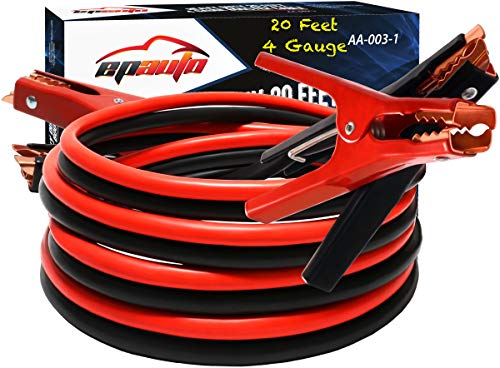 EPAuto 4 AWG, 20 ftCables have no battery to go flat and no cells to lose current in the cold. Their weakness is that they require a second car, and at 6am in an empty lot there is not one. | The no-battery option | $25.97 - Check on Amazon |
A jump starter is a battery you carry so that a dead battery does not end your morning. The specification everybody compares is peak amps, and it is worth understanding what that number is and is not before you spend anything on it.
Peak amps, and what it actually means
Peak amps is the maximum current a pack can deliver for a very short burst. It is not the same thing as cold cranking amps, which is a defined, standardized measurement made at 0F over thirty seconds. Peak amps has no equivalent standard, which means it is not directly comparable between manufacturers and it is not a cold-weather figure.
The number that is genuinely useful is the published engine rating - up to 6.0L gas and 3.0L diesel, up to 12.0L and 10.0L, and so on. That figure is the manufacturer telling you what they will stand behind, and it is what we rank on.
Note the last column. Exactly one of these publishes an operating temperature range on its listing, which for products sold specifically for cold mornings is a conspicuous absence - and that one also says to charge the pack between 14F and 113F, so a pack living in a freezing trunk cannot be topped up where it sits. Check the manual for the pack you buy before you rely on it at 0F.
The lithium problem, stated plainly
Lithium cells deliver less current at low temperature. A pack stored in a cold trunk has been sitting at outside temperature all night and is at its weakest on exactly the morning you bought it for. Store it in the cabin, not the trunk.
This is the same physics that makes a phone die at 20 percent on a cold day, and it is the single most important thing to know about this product category. Nobody selling these leads with it.
It is not a reason to buy something else. Lithium packs are small enough to keep in a glovebox, they hold charge for months, and they work. It is a reason to keep the pack where the car is warmest and to charge it at the start of the season.
Some packs now include a pre-heat function that warms the cells before attempting a jump. Where a maker publishes that, it is worth having. The trade-off against lead-acid packs and plain cables is in lithium vs lead-acid.
How much pack do you actually need
- Four-cylinder commuter car: the Weego 44s. It is the smallest and lightest here at under a pound, and it is the only one that publishes cranking amps - 440 CA - alongside a 7L gas rating that covers a four-cylinder with room to spare.
- V6 or small V8, or you live somewhere genuinely cold: the GT4000S. Headroom matters more in cold, because thick oil and a weak battery both eat current at once.
- Diesel: the GT4000S or the Alpha85. A cold diesel is the hardest crank in ordinary use, and the Stanley publishes no diesel rating at all - which on a pack that otherwise quotes a V8 ceiling is the maker declining to answer.
- You always have somebody to ask: heavy-gauge cables, and keep the money. They have no battery to go flat and no cold derating.
Using one safely
- Check the pack is charged BEFORE you need it. Charge it in October and again mid-season - a pack at 30 percent in the cold may not have enough left.
- Turn off the ignition and all accessories on the dead car.
- Red clamp to the positive terminal, black clamp to the negative terminal or to an unpainted metal ground point on the engine block.
- Switch the pack on. Modern units will refuse to deliver current until they detect a correct connection, which is what spark-proof and reverse-polarity protection mean.
- Crank for no more than a few seconds at a time, and wait between attempts. Continuous cranking overheats the starter motor.
- Once it starts, remove the clamps in reverse order and drive for at least twenty minutes so the alternator can put charge back.
Do notjump a battery that is frozen, cracked or leaking
A discharged battery can freeze, and a frozen battery can rupture under charging current. If the case is bulging, split or visibly leaking, or the battery has been sitting flat in deep cold, do not connect anything to it. That one is a tow, not a jump.
A jump start is not a repair
A jump gets you moving. It does not fix whatever flattened the battery, and if the battery is old the same thing happens tomorrow. The two usual causes are a battery at the end of its life and something in the car drawing current while it sleeps.
If you are jumping the same car more than once, the battery is the actual purchase, and why cars do not start in the cold explains what is going on underneath.
The picks, one at a time
We haven't tested these
No lab, no borrowed units, no free samples. What we did do: pull every published spec into one table and work out what the numbers mean on a cold morning. Everything below traces to a published spec sheet, a manual, or a standard we can point you at - and if a figure isn't published, we say so instead of estimating it. The full method is here.
1. Best overall
GOOLOO GT4000S 12V 4000A Peak Jump Starter with 100W Two-Way Fast Charging
Publishes the most complete engine rating of any pack we have found live - gasoline to 12.0L and diesel to 10.0L - and recharges itself from flat in about 1.2 hours, which is the spec that decides whether the pack is ready the second time you need it. Treat the 4000A peak figure as marketing; the displacement numbers are the useful ones.
Best for: Most drivers, and the only pack here with a diesel figure this big
What the maker publishes
- Peak amps
- 4000A, per the maker
- Gas engines
- Up to 12.0L, per the maker
- Diesel engines
- Up to 10.0L, per the maker
- Recharge time
- 1.2 hours from empty with the included 100W charger
- Screen
- 3.2 in status display
- Operating range
- -4F to 140F; charge between 14F and 113F, per the maker
- Other outputs
- Three USB ports, 15V/10A DC output, 400-lumen flashlight
- Standby
- Stated 24 months between charges
What works
- The published diesel figure is the highest of any pack on this site, and a diesel number is the one most makers quietly leave out
- A 1.2-hour recharge changes what the pack is for - a pack that takes all evening to refill is a one-shot device
- The 3.2 in screen shows state of charge before you need it, which is the failure nobody plans for: a pack that has self-discharged in the trunk
What doesn't
- 4000A peak has no standardized test behind it, so it is not comparable between brands - only the displacement ratings are
- Its own listing says to charge between 14F and 113F, so a pack left in a freezing trunk cannot be topped up where it sits
- Bigger and heavier than a glovebox pack, and the 100W charger is another thing to keep with it
Skip this if: you want something that lives in the glovebox. This is a trunk pack, and the smaller lithium options are half the size.
2. Best compact
Weego 44s 2100A 12V Lithium Car Battery Jump Starter
The only pack we have found that publishes cranking amps as well as peak amps - 440 CA against 2100 peak - which is the figure that actually predicts a start. It also publishes a weight under one pound and engine ratings of 7L gas and 3.5L diesel, so you can check it against your own car rather than trusting a headline number.
Best for: Most cars, and a glovebox
What the maker publishes
- Peak amps
- 2100A
- Cranking amps
- 440 CA, per the maker
- Gas engines
- Up to 7L, per the maker
- Diesel engines
- Up to 3.5L, per the maker
- Weight
- Under 1 lb, per the maker
- Charge retention
- Holds a charge for months, per the maker
- Protection
- Anti-spark, reverse polarity and surge protection
- Build
- Stated to resist water, dust and dirt
What works
- Publishing a cranking amps figure is almost unheard of in this category, and cranking amps is the number that decides whether a cold engine turns - peak amps has no standard behind it at all
- Under a pound means it genuinely lives in the glovebox, which is inside the heated cabin - and where a lithium pack is stored matters more than any number on the box
- Holding a charge for months addresses the real failure of these packs, which is reaching for one in January and finding it flat
What doesn't
- 3.5L diesel is a car-and-van ceiling, not a truck one, and the gas figure of 7L is mid-pack rather than generous
- Priced right at the top of the sub-$100 bracket, which buys fewer amps than the cheap packs claim
- Lithium still delivers least current when it is cold, so the published figures assume a pack that has not been sitting in a freezing trunk
Skip this if: you drive a diesel pickup. The 3.5L diesel ceiling is the number that matters and it is not close.
3. Best display
HULKMAN Alpha85 Portable Jump Starter, 2000A
A 3.3 in screen showing charge state and error codes. At 6am in the dark, a device that tells you why it is refusing to do anything is worth the extra bulk.
Best for: Seeing what is going on
What the maker publishes
- Peak current
- 2000A
- Engine rating
- Up to 8.5L gas, 6.0L diesel
- Jump starts per charge
- Up to 60, per HULKMAN
- Display
- 3.3 in screen for status, battery level and errors
- Operating temperature range
- Not published by the maker
What works
- The screen removes the guesswork that makes jump starters frustrating - it tells you whether the clamps are wrong or the pack is flat
- 60 jumps per charge is the highest published figure here
- 8.5L gas rating covers anything you are likely to be standing next to
What doesn't
- A screen is another thing to fail, and cold LCDs get sluggish
- No published operating temperature range on the listing
Skip this if: you want the smallest thing that works. NOCO makes a smaller pack and you will be more likely to keep it in the car.
4. Best for big gas engines
Stanley LJ25FC 2500 Amp Lithium Jump Starter with Case
2500 peak amps from a brand most people already trust, and the only pack here that states which battery chemistries it supports - AGM, gel and wet. What it does not publish is an engine displacement, so the V8 claim is the whole of the guidance you get.
Best for: Big gas engines
What the maker publishes
- Peak amps
- 2500A
- Engine guidance
- Cars and trucks up to V8, per the maker
- Engine displacement rating
- Not published by the maker
- Battery types
- AGM, gel and wet 12V lead-acid
- Outputs
- USB-A 15W, USB-C PD 30W, power in and out
- Clamps
- Powder-coated metal
- Light
- LED work light
- Included
- Carry case
What works
- Naming the battery chemistries it supports is unusual and useful - an AGM battery is not a drop-in equivalent of a flooded one for charging or starting
- USB-C Power Delivery at 30W means it is genuinely useful as a power bank rather than nominally useful
- Reverse-polarity protection and metal clamps on a pack at this price, in a case that keeps the cables with it
What doesn't
- Publishes no engine displacement at all - up to V8 is a cylinder count, and a 6.7L diesel V8 is a completely different ask from a 5.0L gas V8
- No diesel guidance of any kind, which on a page where the diesel number is the decisive spec is the reason it is not the top pick
- Peak amps without a published test method is not a comparable figure
Skip this if: you drive a diesel. Buy the pack that publishes a diesel displacement instead of inferring one.
5. The no-battery option
EPAuto 4 Gauge x 20 Ft Heavy Duty Booster Cables
Cables have no battery to go flat and no cells to lose current in the cold. Their weakness is that they require a second car, and at 6am in an empty lot there is not one.
Best for: Never needing a charge
What the maker publishes
- Gauge
- 4 AWG - lower number is thicker; 2 AWG is the step up for a truck
- Length
- 20 ft, which is inside the useful 16 to 25 ft range
- Cold performance
- Copper does not lose capacity in cold; PVC insulation stiffens
- Charge required
- None
- Requires
- A second running vehicle
What works
- Nothing to charge, nothing to maintain, and no cold-weather derating on the conductor itself
- Far cheaper than any lithium pack
- Will still work in ten years, sitting in the same trunk
What doesn't
- Useless without a second vehicle and a willing driver
- Thin cheap cables are genuinely dangerous - they get hot and they will not carry cranking current
- Insulation stiffens in deep cold and the cables become unwieldy
Skip this if: you park alone or commute at odd hours. That is exactly the situation cables cannot solve, and it is the reason jump packs exist.
Questions people actually ask
What is the best portable jump starter for cold weather?
For most gas cars, a 1000A pack with a published engine rating well above your engine size. What matters more than the model is where you keep it - lithium cells deliver less current when cold, so a pack in the glovebox beats a bigger one in the trunk.
Do jump starters work in cold weather?
Yes, with reduced output. Lithium cells deliver less current at low temperature, which is why storage matters: a pack that spent the night in the cabin performs noticeably better than one that spent it in the trunk.
How many amps do I need in a jump starter?
Compare the published engine rating rather than peak amps. Peak amps has no standardized test behind it and is not comparable between brands, whereas a rating of up to 6.0L gas or 3.0L diesel is the manufacturer stating what they will stand behind.
Where should I store a jump starter in winter?
In the cabin - a glovebox or under a seat - rather than the trunk. Cabin temperatures are milder overnight, and a warmer lithium pack delivers meaningfully more current on the morning you actually need it.
Can a jump starter damage my car?
Modern packs with spark-proof connections and reverse-polarity protection will refuse to deliver current until they see a correct connection, which removes most of the risk. What you should never do is connect anything to a battery that is frozen, bulging or leaking.
Sources
Read next
- Jump starter vs jumper cables
- Lithium vs lead-acid jump starters
- Why cars do not start in the cold
- The best car batteries for winter
- Winter emergency kits
- Jump starters for SUVs and trucks
- The best jump starters under $100
- HULKMAN Alpha85 review
- What size jump starter do I need?
- HULKMAN Alpha85 vs NOCO Boost GB70