Car Doors Frozen Shut
Yanking the handle is what tears the rubber seal off the door. Press first, then pull steadily - and here is what to do about the lock while you are at it.
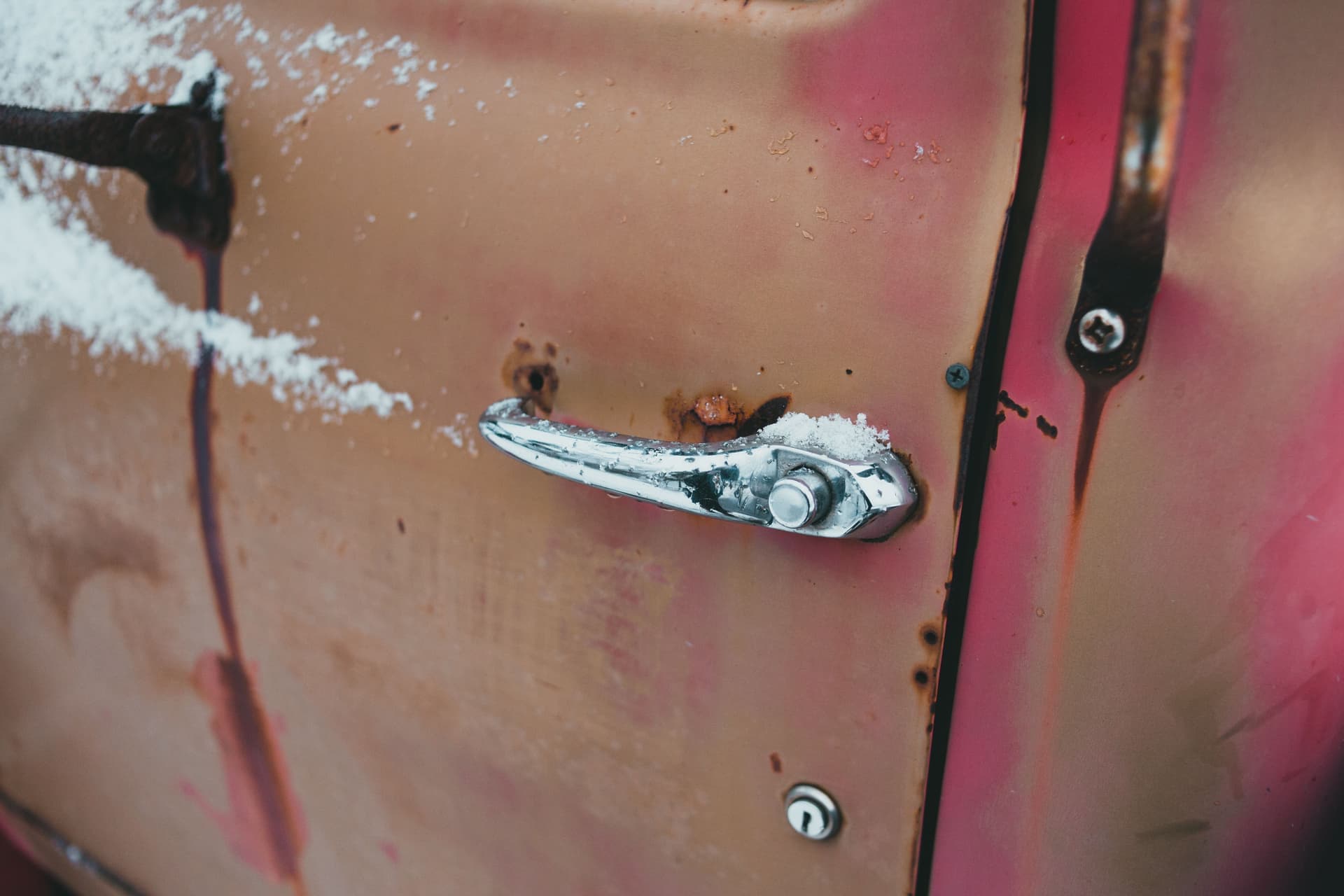
Press firmly on the door with your palm to break the ice seal around the rubber, then pull the handle steadily. Do not yank - yanking tears the weatherstrip off the door, which costs far more than the five minutes of patience it would have taken.
Why a door freezes shut
A car door seals against the body with a rubber weatherstrip. Water runs into that gap - rain, snowmelt, spray from a car wash - and sits there. When it freezes, the rubber is bonded to the painted body around the entire door opening.
The rubber is the weak link in that bond. Pull hard enough and the ice holds, and what gives way is the weatherstrip tearing free of its channel. Once that happens the door whistles, leaks, and needs a new seal.
Opening it, in order
- Try the other doors first. Doors freeze individually and the passenger side is often fine. Get in, start the car, and let the interior heat work on the frozen one from the inside. This costs ten seconds and solves it more often than people expect.
- Press on the door. Palm flat, firm pressure inward along the edge, working around the frame. You are cracking the ice bond mechanically. You will often hear it let go.
- Then pull the handle steadily. Steady increasing force, not a jerk. If it does not come, stop.
- Work along the seal with warm hands or de-icer. Gloved hands pressing along the seal line, or de-icer sprayed into the gap between door and body.
- Try again with pressure and a steady pull. Repeat rather than escalate.
Do notyank a frozen door handle
The ice bond is often stronger than the weatherstrip is attached, so what gives way is the rubber tearing out of its channel. On some cars you can also break the handle itself, which on a modern door is not a five-minute part. Press first, always.
If it is the lock rather than the door
A different problem with a different fix. A lock cylinder is a small cavity with no drainage, so a small amount of water freezes the pins solid.
- Use a lock de-icer with a fine nozzle into the keyway. Thirty seconds and it is usually done.
- Without one, warm the key - a gloved hand, a hand warmer, or carefully with a lighter on the metal blade only - and insert it slowly. Withdraw, rewarm, repeat.
- Never force a key that will not turn. A snapped key inside a frozen cylinder is a locksmith and a new key cut from the VIN.
- WD-40 will free it, and it also washes out the lock's proper lubricant. Use it once in an emergency and re-lubricate afterwards.
The full version, including where to keep lock de-icer so it is not inside the car it would open, is in the frozen door lock guide.
Three things not to do
The ninety-second fix, done in October
This is one of the few problems on this site with a genuinely complete prevention, and almost nobody does it.
- On a dry day in October, wipe every door, trunk and hatch seal clean and let it dry completely.
- Apply a silicone rubber conditioner to the rubber with a cloth. On the rubber only - not the paint.
- Reapply through the season per the bottle, especially on the doors you use every day.
- While you have the bottle out, do the trunk and hatch seals too. A frozen trunk is the same problem and it always happens when your hands are full.
Silicone leaves a film water cannot sit on, so there is nothing there to freeze. It also slows the perishing of the rubber, which is worth having regardless of the weather.
Two related preventions worth doing at the same time
- Lubricate the locks with graphite or PTFE so water cannot sit on the internals, and find your car's hidden mechanical keyhole while it is dry and light.
- Do not drive around with a wet cabin. Wet floor mats put moisture into the air, and that moisture ends up as ice on the inside of the windshield - see defrosting and defogging, and winter floor mats for the trays that hold it instead of soaking it up.
The whole overnight routine, including the glass and the wipers, is in how to prevent frost overnight.
What to buy, and what to skip
We haven't tested these
No lab, no borrowed units, no free samples. What we did do: pull every published spec into one table and work out what the numbers mean on a cold morning. Everything below traces to a published spec sheet, a manual, or a standard we can point you at - and if a figure isn't published, we say so instead of estimating it. The full method is here.
Heads up: we earn a commission if you buy through the links on this page, at no extra cost to you. It never changes a ranking - here is how we pick and how the site is funded.
1. The actual fix
Silicone Rubber Seal Conditioner
The actual fix for doors freezing shut. Water sits on a bare rubber seal and freezes it to the body; a silicone film stops the water sitting there in the first place.
Best for: Doors that freeze shut
What the maker publishes
- Type
- Silicone treatment for rubber weatherstrip
- Applied to
- Door, trunk and hatch seals
- When to apply
- Before the first freeze, on a dry seal
- Reapplication
- Per the product instructions, typically through the season
- Rated temperature
- Not published by the maker
What works
- Treats the cause rather than the symptom - a seal that sheds water cannot freeze to the body
- One bottle does every door on several cars
- Also slows the perishing of rubber seals generally
What doesn't
- Must be applied before the freeze, on a dry seal, which means doing it in October rather than in January
- Silicone overspray on glass is a smeary nuisance to remove
Skip this if: your doors are already frozen shut this morning. This is a prevention product; today you need warm hands and patience.
2. For the lock
Blaster Sprayer Lock De-Icer, 3 oz

A 3 oz sprayer sized for a keyhole rather than a windshield. The catch is obvious once you say it out loud: keep it anywhere except inside the car it unlocks.
Best for: A frozen door lock
What the maker publishes
- Type
- Lock de-icer spray
- Size
- 3 oz - pocket sized, which is the point
- Where to store it
- Pocket, bag or house - never in the locked car
- Active ingredient
- See the product label and SDS
- Rated temperature
- Not published by the maker
What works
- Sized for a keyway, unlike a windshield de-icer that will not get inside a lock cylinder
- Small enough to keep on a keyring or in a coat pocket, which is the only place it works
- Cheap, and a frozen lock has very few other answers
What doesn't
- Useless if it is locked in the car, which is where most people leave it
- Repeated flushing carries away lock lubricant, so re-lubricate the cylinder afterwards
- Most keyless cars have a hidden mechanical keyhole - find yours before you need it
Skip this if: you can park where the lock does not freeze. Prevention with a lock lubricant beats a cure you cannot reach.
3. For everything else frozen
Prestone AS242 Windshield De-Icer, 11 oz Aerosol
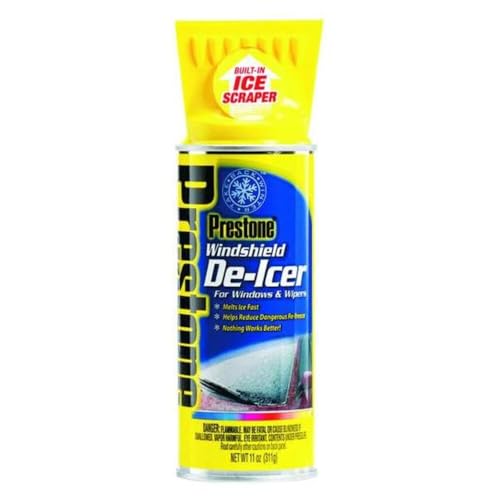
The default de-icer. Small enough to keep in a door pocket, and the cap is a scraper, which means the can and the tool are the same object you are already holding.
Best for: The can that lives in the car
What the maker publishes
- Size
- 11 oz aerosol
- Applicator
- Aerosol spray, scraper cap
- Maker claim
- Melts ice fast and helps reduce refreeze
- Active ingredient
- See the product label and SDS
- Rated melt temperature
- Not published by the maker
What works
- Fits a door pocket, which is where a de-icer has to live to be any use at 7am
- The scraper cap removes the second-tool problem entirely
- Aerosol reaches a wiper cowl and a mirror face better than a trigger bottle does
What doesn't
- 11 oz does not go far on a fully iced windshield - this is a frost can, not a storm can
- Prestone does not publish a rated melt temperature on the listing, so cold-limit claims are not something we can verify for you
Skip this if: you are clearing a whole iced car rather than a patch. Buy the 32 oz trigger bottle and keep this one for the lock and the mirrors.
Questions people actually ask
How do I open a car door that is frozen shut?
Press firmly on the door with your palm around the frame to crack the ice bond, then pull the handle steadily rather than yanking it. Try the other doors first - they freeze individually and the passenger side is often fine.
What happens if you yank a frozen car door?
The ice bond is often stronger than the weatherstrip's attachment, so the rubber seal tears out of its channel. After that the door whistles and leaks and needs a new seal, which costs considerably more than five minutes of patience.
How do I keep my car doors from freezing shut?
Treat the rubber door seals with a silicone conditioner on a dry day in the fall. Silicone leaves a film water cannot sit on, so nothing freezes the rubber to the body. Reapply through the season, especially on doors you use daily.
Can I use hot water to open a frozen car door?
It works for about ten minutes and then the water refreezes deeper in the seal channel and inside the lock, leaving the door harder to open than before. Use pressure, patience and de-icer instead.
Why do only some of my car doors freeze shut?
Doors freeze individually depending on how much water got into each seal and how exposed each side of the car is. That is why trying the other doors first is worth ten seconds - the passenger side is often perfectly fine.