How to Remove Ice From a Windshield
Four minutes with the right sequence, fifteen without it. Here is the order, what to do if you have nothing, and the three things that crack the glass.
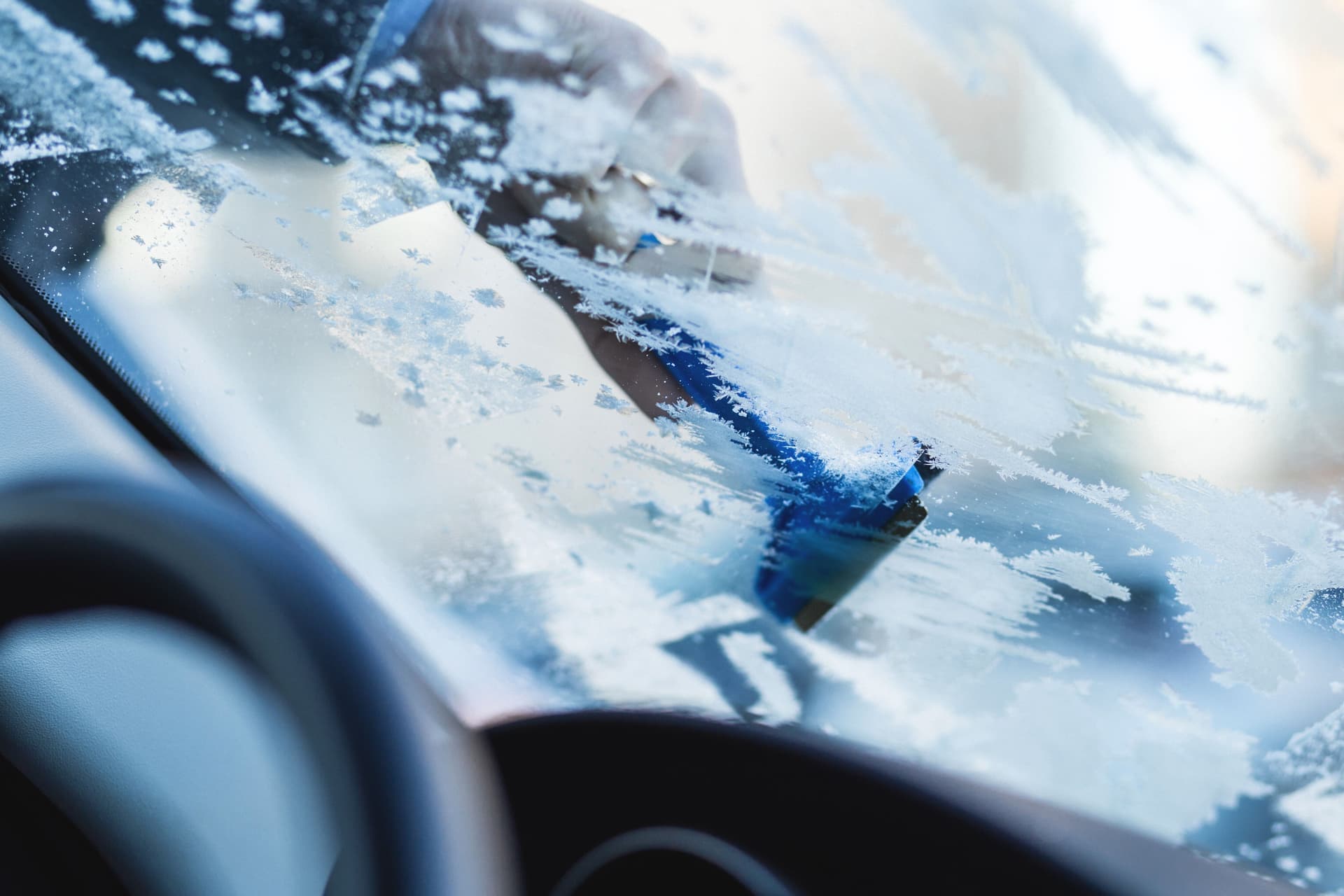
Start the engine with the defroster on full. While it warms, clear the roof and hood. Spray de-icer across the top of the windshield and wait thirty seconds. Then scrape - the ice should release rather than need chipping. Free the wipers before switching them on.
The sequence, in order
- Check the exhaust pipe is clear of snow, then start the engine. Defroster on full, air conditioning on if the car has it. The A/C is not a mistake - it dries the air, which clears interior fog faster.
- Clear the roof and hood while the engine warms. This is free time and most people waste it sitting inside. It also has to happen first: roof snow slides onto the windshield the moment you brake.
- Spray de-icer across the TOP of the windshield. Let gravity carry it down rather than covering the whole surface directly - it uses far less product.
- Wait thirty seconds. The step everybody skips and the step that does the work. Chemistry needs contact time.
- Scrape, holding the blade at a shallow angle. The ice should release in sheets. If it is skating rather than cutting, spray again and wait rather than pressing harder.
- Do the side windows, the rear window and the mirrors. A cleared windshield alone is not a cleared car.
- Free the wipers by hand before switching them on. Lift each blade and check it is not bonded.
About four minutes on a badly iced car. Scraping alone can take fifteen and is where paint and trim get damaged, because the moment you start leaning on a blade is the moment something slips.
Without a scraper
A very common search, so here is the honest ranking of what actually works.
Do notpour hot water on a frozen windshield
Rapid temperature change puts the glass under thermal stress, and any existing chip becomes a crack that crosses your eyeline. It is also self-defeating: the water runs down, refreezes within minutes, and now there is more ice than you started with, including inside the wiper cowl. This is the most common expensive mistake in winter motoring.
If the ice is on the inside
Different problem entirely, and no amount of scraping outside helps. Ice on the interior surface means moisture is getting trapped in the cabin: wet floor mats, a blocked cabin drain, a leaking door or windshield seal, or simply a lot of wet clothing and breath in a car that never dries out.
Clear it with the defroster and a soft cloth, never a blade - and never scrape any interior glass, because on a rear window the heating elements are printed on the inside surface and a scraper breaks the circuit permanently.
The causes and the fixes are in defrosting and defogging your windows.
Never lever a frozen wiper
A blade frozen to the glass tears when you pull it, and switching the wipers on with a bonded blade can strip the linkage or blow the fuse - leaving you with no wipers at all on exactly the day you need them.
Free them with the defroster and de-icer, check by hand, and then switch on. The prevention is in stop wipers freezing to the windshield.
Clear the whole car, not a porthole
Clearing a small hole in the windshield and driving is the most common winter driving mistake. You cannot see to the sides, you cannot see out of the mirrors, and the snow on the roof is still there - which becomes a hazard to the car behind you at speed and is an offense in a number of states.
The fastest order for the whole car is in how to clear a snow-covered car.
So this does not happen tomorrow
A windshield cover fitted on dry glass takes ten seconds and means there is nothing to remove in the morning. It is the highest-return purchase on this entire site, and it also keeps the wipers free if the design covers them.
The cover picks are here. If you would rather not fit one every night, keep a small can of de-icer in the door pocket instead - and the two approaches are compared in cover vs de-icer.
What to buy, and what to skip
We haven't tested these
No lab, no borrowed units, no free samples. What we did do: pull every published spec into one table and work out what the numbers mean on a cold morning. Everything below traces to a published spec sheet, a manual, or a standard we can point you at - and if a figure isn't published, we say so instead of estimating it. The full method is here.
Heads up: we earn a commission if you buy through the links on this page, at no extra cost to you. It never changes a ranking - here is how we pick and how the site is funded.
1. The fast answer
Prestone AS242 Windshield De-Icer, 11 oz Aerosol
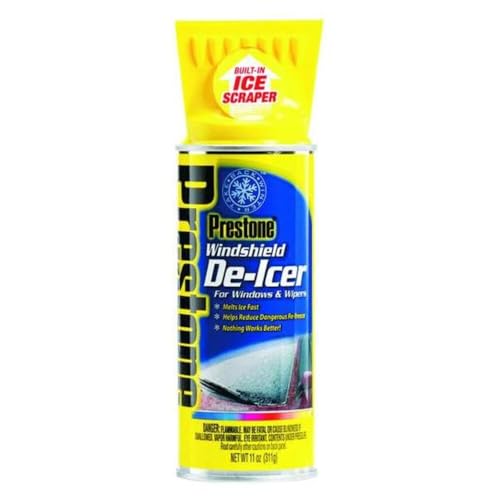
The default de-icer. Small enough to keep in a door pocket, and the cap is a scraper, which means the can and the tool are the same object you are already holding.
Best for: The can that lives in the car
What the maker publishes
- Size
- 11 oz aerosol
- Applicator
- Aerosol spray, scraper cap
- Maker claim
- Melts ice fast and helps reduce refreeze
- Active ingredient
- See the product label and SDS
- Rated melt temperature
- Not published by the maker
What works
- Fits a door pocket, which is where a de-icer has to live to be any use at 7am
- The scraper cap removes the second-tool problem entirely
- Aerosol reaches a wiper cowl and a mirror face better than a trigger bottle does
What doesn't
- 11 oz does not go far on a fully iced windshield - this is a frost can, not a storm can
- Prestone does not publish a rated melt temperature on the listing, so cold-limit claims are not something we can verify for you
Skip this if: you are clearing a whole iced car rather than a patch. Buy the 32 oz trigger bottle and keep this one for the lock and the mirrors.
2. The tool for the job
AstroAI 27 in 2-in-1 Detachable Snow Brush and Ice Scraper
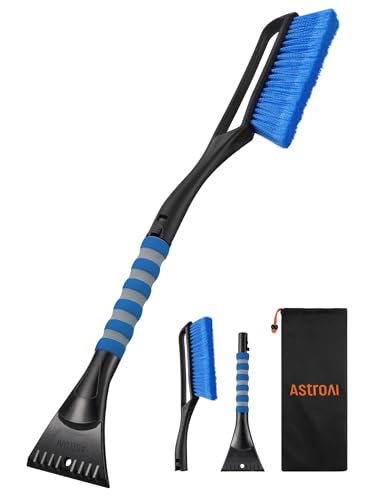
Publishes the three measurements that decide whether a brush suits your car - 27 in overall, an 8.66 in head and a 4.5 in blade - and it comes apart at a push-button buckle so the two halves fit a trunk or a door pocket. Split-end bristles are the detail that matters: they move snow without dragging grit across the paint.
Best for: Most cars
What the maker publishes
- Overall length
- 27 in
- Brush head
- 8.66 in, 4 rows of split-end PP bristles
- Scraper blade
- 4.5 in
- Shaft
- High-strength ABS
- Storage
- Detaches at a push-button buckle; storage bag included
- Extends
- No - fixed length
- Suits
- Cars, SUVs and trucks, per the maker
What works
- Publishing the head width and blade width lets you match the tool to the car instead of guessing from a photograph
- Split-end treated bristles are the honest answer to the scratch question - they flex rather than driving grit into clearcoat
- Detaching into two pieces solves the real problem with a 27 in brush, which is where it lives when it is not January
What doesn't
- Fixed length, so a tall SUV roof or a van still needs a reach you do not have here
- A 4.5 in blade is a normal-car blade - it will clear a windshield, slowly, rather than attack a thick sheet
- Plastic shaft and buckle are the parts that fail first on any detachable brush, and the listing publishes no warranty term
Skip this if: you park under trees or drive something tall. An extendable brush is the right tool for a roof you cannot reach.
3. So there is no ice tomorrow
FrostGuard Deluxe Full-Coverage Windshield Cover, XL, 41 x 68 in

The one cover here that prints its dimensions on the listing, and the only one that covers the wipers and the side mirrors as part of the same product. Security panels tuck inside the doors so it cannot be lifted off the glass.
Best for: Almost everyone who parks outside
What the maker publishes
- Size
- 41 x 68 in, published by the maker
- Covers
- Windshield, wiper blades and side mirrors
- Material
- Polyester, per the maker
- Anchoring
- Fit-Fast straps plus security panels that shut in the doors
- Fits
- Described as ideal for SUVs and trucks of most makes
- Warranty
- One year, per the maker
- Rated temperature
- Not published by the maker
What works
- A published measurement is the single most useful thing in this category, and most competitors give you a vehicle list instead
- Wiper and mirror coverage in one product removes the two jobs a plain windshield cover leaves you
- Security panels inside the doors are what stop a cover leaving in the wind or with a passer-by
What doesn't
- At 41 x 68 in it is generous for a compact car - measure your glass before assuming bigger is better
- Polyester holds water, so it wants somewhere to dry rather than going straight into the trunk
- No published cold-temperature rating
Skip this if: you park in a garage. This solves an outdoor problem and nothing else.
Questions people actually ask
How do I remove ice from a windshield fast?
Engine and defroster on full, clear the roof and hood while it warms, spray de-icer across the top of the glass, wait thirty seconds, then scrape. The waiting is what makes it fast - a blade against bonded ice without chemistry just skates across it.
How do I remove ice from a windshield without a scraper?
De-icer spray plus the defroster is the intended method and needs no scraper at all. The defroster alone works given ten minutes. A plastic spatula or a spray of isopropyl alcohol and water will also do it. Never use hot water or anything metal.
Is it bad to pour hot water on a windshield?
Yes. Thermal stress turns an existing chip into a crack across your eyeline, and the water refreezes within minutes so you end up worse off - including ice inside the wiper cowl. It is the most common expensive mistake in winter motoring.
How do I remove ice from a windshield without damaging it?
Use a clean plastic scraper on the exterior glass, at a shallow angle, after de-icer has had thirty seconds to work. Never press harder when the blade is skating, never use anything metal, and never scrape the inside of any window.
Why is there ice on the inside of my windshield?
Moisture trapped in the cabin, condensing on cold glass and freezing there. The usual causes are wet floor mats, a blocked cabin drain or a leaking seal. Clear it with the defroster and a cloth, and fix the source rather than the symptom.