How to Clear a Snow-Covered Car, Fast
There is a right order, and doing it in the wrong one means clearing the windshield twice. Four minutes, start to finish, with the right tool.

Start the engine and set the defroster to full, then clear in this order: roof, hood and trunk, then all the windows, then the lights and the exhaust. Roof first, always - anything you clear before the roof gets covered again when the roof comes down.
The order, step by step
- Start the engine and put the defroster on full, with air conditioning on if you have it. The engine takes a few minutes to make heat, so this is time you get for free while you work outside. The air conditioning is not a mistake: it dries the air, which clears interior fog faster.
- Clear the roof first. Push the snow off the sides, not forward over the windshield. On a tall vehicle use an extendable brush rather than climbing on the sill or reaching over the door.
- Clear the hood and the trunk. Hood snow blows up onto the windshield at speed. Trunk snow blows off onto whoever is behind you.
- Clear all the glass, including the rear window and the side windows. Now, not before - because now nothing above it is going to shed onto it.
- Free the wipers before you switch them on. Lift each blade and check it is not bonded to the glass. Running a frozen wiper tears the rubber off it.
- Clear the mirrors, headlights, tail lights and the license plate. Snow-covered tail lights are the reason a lot of winter rear-end collisions happen.
- Check the exhaust pipe is clear. Thirty seconds, and it is the one step on this list that is about carbon monoxide rather than convenience.
Why roof first is not a preference
Clear the windshield first and you will clear it twice, because the moment the roof comes down some of it lands on the glass. That is the practical reason.
The legal reason is heavier. Snow leaving a moving vehicle is a hazard to everyone behind, and a number of states have specific offenses covering it - some for obstructed vision, some for an unsecured load. A slab of roof snow at 60 mph does not melt on the way to the car behind you.
The porthole problem
Clearing a small hole in the windshield and driving is the single most common winter driving mistake, and it fails in three ways at once: you cannot see to the sides, you cannot see out of the mirrors, and the snow on the roof is still there.
It happens because people are late, which is why the real answer to this page is not technique - it is a windshield cover, put on the night before. Ten seconds then, four minutes saved every morning after.
What to have in your hand
- A brush long enough for your roof. This is the whole job on a snowy morning. See extendable vs fixed.
- A wide head. Head width decides how many passes the roof takes, and the roof is the biggest surface on the car.
- Gloves that survive being wet. The reason people stop halfway is cold hands, not a bad brush.
- De-icer for the glass underneath. Snow comes off with a brush. The ice bonded under it does not - that is what the can is for.
Do notrun the engine with a blocked exhaust
If the tailpipe is buried in snow, exhaust gas has nowhere to go and can find its way into the cabin. Carbon monoxide has no smell and the first symptom is drowsiness. Clear the pipe before you sit in a running car, and clear it again if you have been sitting still while it snows.
How long it should take
Four minutes is the number to beat, and the tool is what gets you there. The picks are in the scraper and brush roundup.
What to buy, and what to skip
We haven't tested these
No lab, no borrowed units, no free samples. What we did do: pull every published spec into one table and work out what the numbers mean on a cold morning. Everything below traces to a published spec sheet, a manual, or a standard we can point you at - and if a figure isn't published, we say so instead of estimating it. The full method is here.
Heads up: we earn a commission if you buy through the links on this page, at no extra cost to you. It never changes a ranking - here is how we pick and how the site is funded.
1. For a tall roof
SEAAES Extendable Snow Brush and Ice Scraper, 45 in

The reach tool. A 45 in pole and a pivoting head are what clear a roof, and a roof full of snow is what slides down onto your windshield at the first stop sign.
Best for: Reaching an SUV roof
What the maker publishes
- Extended length
- 45 in
- Scraper blade
- 5.2 in wide, foam grip
- Brush head
- Pivots 360 degrees
- Bristle material
- Not published by the maker
- Rated temperature
- Not published by the maker
What works
- The extension is the entire point on a tall vehicle: you clear the roof from the ground instead of standing on the sill
- A 5.2 in blade takes fewer passes across a windshield than the 3 in blade on a typical glovebox scraper
- The pivoting head lets you pull snow down the glass rather than push it sideways into the wiper cowl
What doesn't
- Long-handled tools live in the trunk, so this is the tool you do not have when you are parked somewhere else
- No published bristle material and no cold rating, so how the plastic behaves at 0F is not something the maker will tell you
Skip this if: you drive a low sedan and park in a garage. A 45 in pole is a lot of trunk for a roof you can already reach.
2. For moving volume
Mallory 532 Cool-Force 26 in Snowbrush with Ice Scraper, 2 Pack
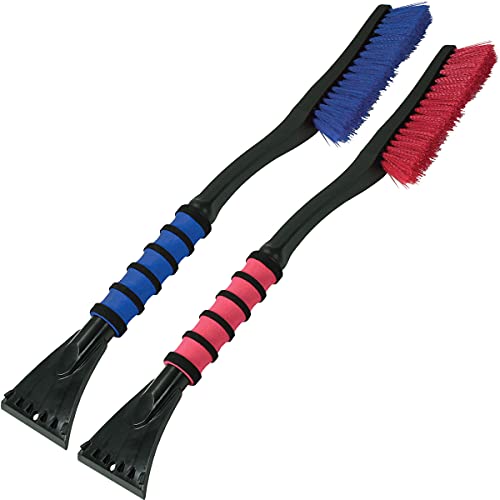
Four rows of plush bristles move more snow per stroke than a thin brush, and it arrives as a pair - which is the honest answer to the second car. Fixed length, so it is a sweeping tool rather than a reaching one.
Best for: Deep, light snow
What the maker publishes
- Type
- Fixed-length snowbrush with chisel scraper
- Length
- 26 in
- Extends
- No
- Scraper blade
- 4 in chisel
- Bristles
- Four rows, plush
- Quantity
- 2 brushes
- Warranty
- 90 days, per the maker
What works
- Four rows of bristles clear a wider path per stroke, which is what shortens the time you stand outside
- The 4 in chisel blade is published, so you know what you are getting rather than guessing from a photo
- Two in the box means the second car is solved in the same purchase
What doesn't
- Fixed 26 in, so a tall roof is out of reach - this is a car brush, not a truck brush
- A plush brush is gentle but slow on wet, heavy snow that has started to set
- 90 days is a short warranty for a tool that lives outside
Skip this if: you mostly deal with frost rather than snow. A brush is the wrong tool for a thin layer of ice.
3. For a normal car
AstroAI 27 in 2-in-1 Detachable Snow Brush and Ice Scraper
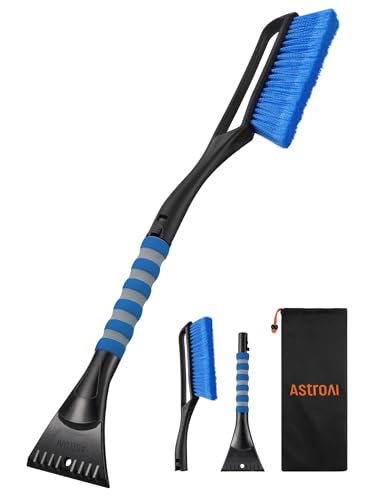
Publishes the three measurements that decide whether a brush suits your car - 27 in overall, an 8.66 in head and a 4.5 in blade - and it comes apart at a push-button buckle so the two halves fit a trunk or a door pocket. Split-end bristles are the detail that matters: they move snow without dragging grit across the paint.
Best for: Most cars
What the maker publishes
- Overall length
- 27 in
- Brush head
- 8.66 in, 4 rows of split-end PP bristles
- Scraper blade
- 4.5 in
- Shaft
- High-strength ABS
- Storage
- Detaches at a push-button buckle; storage bag included
- Extends
- No - fixed length
- Suits
- Cars, SUVs and trucks, per the maker
What works
- Publishing the head width and blade width lets you match the tool to the car instead of guessing from a photograph
- Split-end treated bristles are the honest answer to the scratch question - they flex rather than driving grit into clearcoat
- Detaching into two pieces solves the real problem with a 27 in brush, which is where it lives when it is not January
What doesn't
- Fixed length, so a tall SUV roof or a van still needs a reach you do not have here
- A 4.5 in blade is a normal-car blade - it will clear a windshield, slowly, rather than attack a thick sheet
- Plastic shaft and buckle are the parts that fail first on any detachable brush, and the listing publishes no warranty term
Skip this if: you park under trees or drive something tall. An extendable brush is the right tool for a roof you cannot reach.
Questions people actually ask
Do I have to clear snow off the roof of my car?
Yes, and in several states it is a legal requirement rather than good manners. Snow leaving a moving vehicle is a hazard to traffic behind, and roof snow also slides forward onto your own windshield the first time you brake hard.
What order should I clear snow off a car?
Engine and defroster on first, then roof, then hood and trunk, then all the glass, then wipers, lights, plate and exhaust. Roof before glass matters, because anything you clear before the roof gets covered again when the roof comes down.
Should I start the car before clearing the snow?
Yes. The engine needs a few minutes to produce heat for the defroster, and that time is free while you work outside. Check the exhaust pipe is clear of snow first, because a blocked tailpipe can push exhaust gas into the cabin.
How long should it take to clear a snow-covered car?
About four minutes for a mid-size car under six inches of snow, if you have a brush that reaches your roof. Without one it takes long enough that most people give up and drive with a cleared porthole instead.
What is the fastest way to clear snow off a car roof?
An extendable brush with a wide head, pushing the snow off the sides rather than forward over the windshield. Head width is what decides the number of passes, and the roof is the largest surface on the car.