The Best Ice Scrapers and Snow Brushes
Seven tools, compared on the three things that decide how long you stand outside: how far they reach, how wide the blade is, and what touches your paint.
Heads up: we earn a commission if you buy through the links on this page, at no extra cost to you. It never changes a ranking - here is how we pick and how the site is funded.
Quick picks
The short answer, before the detail. Tap any row to jump to that write-up, or go straight to the listing to check today's price.
| # | Product | Best for | Price |
|---|---|---|---|
| 1 | 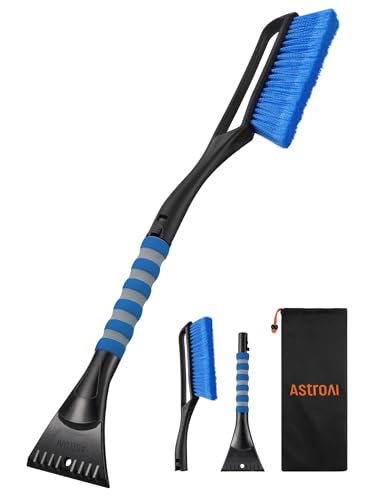 AstroAI 27 in 2-in-1Publishes the three measurements that decide whether a brush suits your car - 27 in overall, an 8.66 in head and a 4.5 in blade - and it comes apart at a push-button buckle so the two halves fit a trunk or a door pocket. Split-end bristles are the detail that matters: they move snow without dragging grit across the paint. | Best overall | $15.29 - Check on Amazon-15% |
| 2 |  SEAAES 45 in extendableThe reach tool. A 45 in pole and a pivoting head are what clear a roof, and a roof full of snow is what slides down onto your windshield at the first stop sign. | Best for SUVs | $22.99 - Check on Amazon-23% |
| 3 |  Hopkins SubZero 16621A short two-ended scraper: a straight blade for frost, a chipper for the ice a blade skates over. This is the one you keep in the car you did not plan to be scraping. | Best for the door pocket | $10.80 - Check on Amazon |
| 4 | 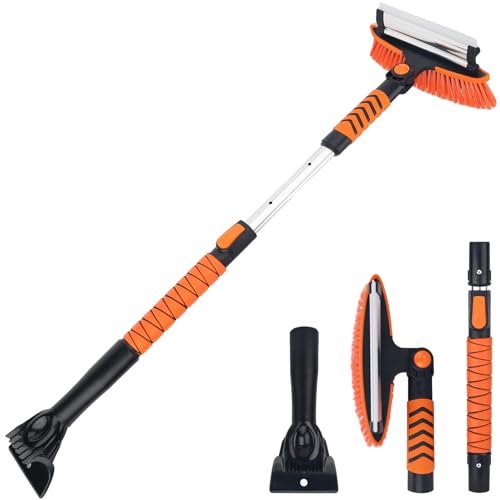 KeFanta 3-in-1 42 inThe rubber blade is the reason to buy this one. Wet snow packs into bristles and turns a brush into a mop; a squeegee edge pushes the same snow off in one stroke. | Best for wet snow | $21.99 - Check on Amazon |
| 5 |  HEEYA extendableExtends 23 to 33 in, so it stows shorter than the 45 in poles while still reaching further than a fixed brush. A sensible middle when trunk space is the constraint. | Best for small trunks | $17.99 - Check on Amazon-10% |
| 6 | 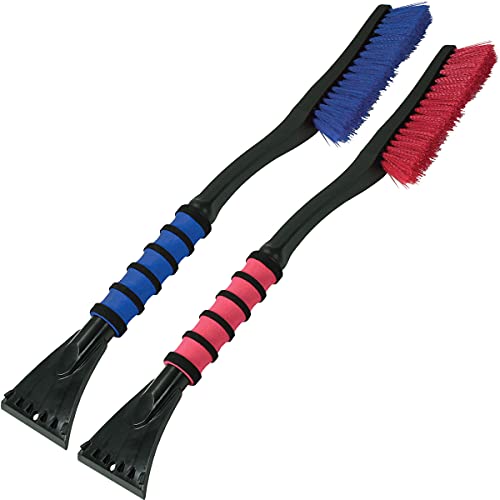 Mallory 532 Cool-ForceFour rows of plush bristles move more snow per stroke than a thin brush, and it arrives as a pair - which is the honest answer to the second car. Fixed length, so it is a sweeping tool rather than a reaching one. | Best for deep snow | $31.58 - Check on Amazon |
| 7 |  Hopkins 16721 BearA clawed face breaks ice a flat blade slides across. It is also the fastest way to mark trim if your hand slips, so treat it as the specialist rather than the default. | Skip this one | $10.99 - Check on Amazon |
Buying a scraper is a five-minute decision that people spend twenty minutes on, because the listings are almost entirely adjectives. Heavy duty. Ergonomic. No-scratch. Almost none of them publish a bristle material, a blade material or a temperature rating, so brand-against-brand comparison does not get you anywhere useful.
What does get you somewhere is answering three questions about your own car, in order. Then the shortlist writes itself.
The three questions that decide it
- Can you reach the middle of your own roof? If yes, a fixed-length brush is fine and cheaper. If no - which means most SUVs, crossovers and pickups - you need a telescoping pole, and it is not optional. A roof left full of snow slides forward onto the windshield at the first hard brake.
- How wide is the blade? A glovebox scraper is around 3 in. The wide ones are past 5 in. On a full windshield that is roughly forty percent fewer passes. It is the most useful number in the category and it is the one most makers omit.
- Where does the tool live? A 45 in pole lives in the trunk, which means it is not with you when you are parked at work. A short scraper lives in the door. Most people who park outside end up owning both, and that is a sensible outcome rather than a failure of planning.
What the makers actually publish
This is the table we wanted before we bought anything, and it took reading seven listings to build. The empty-looking cells are the point: they are not gaps in our research, they are figures the manufacturer does not publish.
Seven products, exactly one published bristle material, and three published blade widths. That is the state of the category, and it is why we lead with what you can measure about your own car instead of what the box claims.
The paint question, because it is the one you are actually asking
Three separate autocomplete variants exist for scrapers and brushes that will not scratch. It is the dominant fear here and no roundup we read leads with it.
A plastic blade cannot scratch glass - glass is far harder than the plastic. What marks a car is grit dragged across paint by a brush, or a blade used on a painted panel. Keep the blade on glass, push snow off paint rather than dragging it, and knock the brush out before you start.
The longer version, including what to do when ice has bonded and a brush will not shift it, is in will an ice scraper scratch your paint.
What we left out
- Cordless electric scrapers. They exist, they work on thin even frost, and they are slower than a person with a plastic blade on anything else - plus they have a battery that has been sitting in a cold car all night. Full argument in electric vs manual.
- Credit cards, CD cases and spatulas. They work, badly, once. They are what you use when you own nothing, and the entire point of this page is that owning a scraper costs less than a coffee.
- Anything with a claimed temperature rating we could not find on the listing. If we cannot see where the number came from, it does not go in the table.
Do notpour hot water on a frozen windshield
Rapid temperature change puts the glass under thermal stress, and any existing chip becomes a crack that crosses your eyeline. It is also a short-lived fix: the water refreezes and you are worse off than before. Use a de-icer or the defroster instead - see how to remove ice from a windshield.
The short version
Most people should buy the fixed-length 27 in AstroAI and a cheap short scraper for the door pocket, and stop thinking about it. If you drive anything tall, swap the fixed brush for the 45 in SEAAES and accept the trunk space. If your snow is usually wet and heavy, the KeFanta rubber blade is the one that will not turn into a mop.
And keep a can of de-icer for the mornings when the ice has bonded, because that is the job a blade genuinely cannot do - the de-icer picks are here.
The picks, one at a time
We haven't tested these
No lab, no borrowed units, no free samples. What we did do: pull every published spec into one table and work out what the numbers mean on a cold morning. Everything below traces to a published spec sheet, a manual, or a standard we can point you at - and if a figure isn't published, we say so instead of estimating it. The full method is here.
1. Best overall
AstroAI 27 in 2-in-1 Detachable Snow Brush and Ice Scraper
Publishes the three measurements that decide whether a brush suits your car - 27 in overall, an 8.66 in head and a 4.5 in blade - and it comes apart at a push-button buckle so the two halves fit a trunk or a door pocket. Split-end bristles are the detail that matters: they move snow without dragging grit across the paint.
Best for: Most cars
What the maker publishes
- Overall length
- 27 in
- Brush head
- 8.66 in, 4 rows of split-end PP bristles
- Scraper blade
- 4.5 in
- Shaft
- High-strength ABS
- Storage
- Detaches at a push-button buckle; storage bag included
- Extends
- No - fixed length
- Suits
- Cars, SUVs and trucks, per the maker
What works
- Publishing the head width and blade width lets you match the tool to the car instead of guessing from a photograph
- Split-end treated bristles are the honest answer to the scratch question - they flex rather than driving grit into clearcoat
- Detaching into two pieces solves the real problem with a 27 in brush, which is where it lives when it is not January
What doesn't
- Fixed length, so a tall SUV roof or a van still needs a reach you do not have here
- A 4.5 in blade is a normal-car blade - it will clear a windshield, slowly, rather than attack a thick sheet
- Plastic shaft and buckle are the parts that fail first on any detachable brush, and the listing publishes no warranty term
Skip this if: you park under trees or drive something tall. An extendable brush is the right tool for a roof you cannot reach.
2. Best for SUVs
SEAAES Extendable Snow Brush and Ice Scraper, 45 in
The reach tool. A 45 in pole and a pivoting head are what clear a roof, and a roof full of snow is what slides down onto your windshield at the first stop sign.
Best for: Reaching an SUV roof
What the maker publishes
- Extended length
- 45 in
- Scraper blade
- 5.2 in wide, foam grip
- Brush head
- Pivots 360 degrees
- Bristle material
- Not published by the maker
- Rated temperature
- Not published by the maker
What works
- The extension is the entire point on a tall vehicle: you clear the roof from the ground instead of standing on the sill
- A 5.2 in blade takes fewer passes across a windshield than the 3 in blade on a typical glovebox scraper
- The pivoting head lets you pull snow down the glass rather than push it sideways into the wiper cowl
What doesn't
- Long-handled tools live in the trunk, so this is the tool you do not have when you are parked somewhere else
- No published bristle material and no cold rating, so how the plastic behaves at 0F is not something the maker will tell you
Skip this if: you drive a low sedan and park in a garage. A 45 in pole is a lot of trunk for a roof you can already reach.
3. Best for the door pocket
Hopkins SubZero 16621 Ice Crusher Ice Scraper
A short two-ended scraper: a straight blade for frost, a chipper for the ice a blade skates over. This is the one you keep in the car you did not plan to be scraping.
Best for: The door-pocket scraper
What the maker publishes
- Type
- Handheld scraper, no brush
- Working ends
- Frost blade one end, ice chipper the other
- Grip
- Oval foam
- Length
- About 11 in per the listing
- Blade material
- Not published by the maker
What works
- Short enough to live in a door pocket, which is the only place a scraper is reliably useful
- The chipper end does something a flat blade cannot: it breaks a bonded sheet instead of riding over it
- Cheap enough to keep one in every vehicle, which is the honest answer to most scraper questions
What doesn't
- No brush, so it does nothing about the six inches of snow sitting on top of the ice
- Short handle means your hand is on the glass and your sleeve is in the snow
- A chipper is the part of a scraper most likely to mark trim if you slip
Skip this if: you routinely deal with real snow depth rather than overnight frost. This clears glass; it will not clear a car.
4. Best for wet snow
KeFanta 3-in-1 Heavy Duty Extendable Snow Broom and Ice Scraper, 42 in
The rubber blade is the reason to buy this one. Wet snow packs into bristles and turns a brush into a mop; a squeegee edge pushes the same snow off in one stroke.
Best for: Heavy wet snow
What the maker publishes
- Adjustable length
- 34 in to 42 in
- Working heads
- Double-layer bristles, rubber blade, ice scraper
- Handle
- Padded grip
- Blade material
- Not published by the maker
- Rated temperature
- Not published by the maker
What works
- Three working surfaces on one shaft means one tool in the trunk instead of three
- The rubber blade is the right tool for heavy wet snow, which is most of what falls near the freezing line
- 34 in collapsed is short enough to actually fit behind a seat
What doesn't
- Three heads on one pole is three things to break, and the pivot always goes first
- No published blade or bristle material, so paint safety comes down to your technique rather than the tool
Skip this if: your snow is usually dry and powdery. A plain brush clears that faster and the extra hardware is dead weight.
5. Best for small trunks
HEEYA Extendable Snow Brush and Ice Scraper, 12.6 in Head
Extends 23 to 33 in, so it stows shorter than the 45 in poles while still reaching further than a fixed brush. A sensible middle when trunk space is the constraint.
Best for: A small trunk
What the maker publishes
- Extended length
- 23 in to 33 in
- Brush head
- 12.6 in, rotates 270 degrees
- Bristle material
- Not published by the maker
- Blade material
- Not published by the maker
- Rated temperature
- Not published by the maker
What works
- 23 in collapsed genuinely fits a small trunk or the space behind a seat
- 270 degrees of head rotation gets the brush flat on glass and flat on a roof without changing your grip
- 12.6 in is a real head width, not a token one
What doesn't
- 33 in extended is short of what a full-size truck roof needs
- A rotating head is another joint that can freeze in position after a wet day
Skip this if: you own a pickup or a three-row SUV. Buy the 45 in tool and give up the trunk space.
6. Best for deep snow
Mallory 532 Cool-Force 26 in Snowbrush with Ice Scraper, 2 Pack
Four rows of plush bristles move more snow per stroke than a thin brush, and it arrives as a pair - which is the honest answer to the second car. Fixed length, so it is a sweeping tool rather than a reaching one.
Best for: Deep, light snow
What the maker publishes
- Type
- Fixed-length snowbrush with chisel scraper
- Length
- 26 in
- Extends
- No
- Scraper blade
- 4 in chisel
- Bristles
- Four rows, plush
- Quantity
- 2 brushes
- Warranty
- 90 days, per the maker
What works
- Four rows of bristles clear a wider path per stroke, which is what shortens the time you stand outside
- The 4 in chisel blade is published, so you know what you are getting rather than guessing from a photo
- Two in the box means the second car is solved in the same purchase
What doesn't
- Fixed 26 in, so a tall roof is out of reach - this is a car brush, not a truck brush
- A plush brush is gentle but slow on wet, heavy snow that has started to set
- 90 days is a short warranty for a tool that lives outside
Skip this if: you mostly deal with frost rather than snow. A brush is the wrong tool for a thin layer of ice.
7. Skip this one
Hopkins 16721 Bear Ice Scraper
A clawed face breaks ice a flat blade slides across. It is also the fastest way to mark trim if your hand slips, so treat it as the specialist rather than the default.
Best for: Ice bonded on for days
What the maker publishes
- Type
- Handheld scraper with claw face
- Brush
- None
- Blade material
- Not published by the maker
- Length
- Not published by the maker
- Rated temperature
- Not published by the maker
What works
- Genuinely effective on thick bonded ice, the one job a flat blade is bad at
- Small and cheap enough to be a second scraper rather than your only one
What doesn't
- A claw concentrates force on a small area, which is exactly what puts a mark in trim when you slip
- No brush and no reach
- Nothing about the material is published, so you are trusting technique rather than the tool
Skip this if: you are worried about paint. Aim a de-icer at bonded ice instead and let the chemistry do the work.
Questions people actually ask
Will an ice scraper scratch my windshield?
No. Automotive glass is significantly harder than the plastic these blades are made from, so a clean plastic blade cannot mark it. What can mark glass is grit trapped under the blade, so knock the scraper out before you start and do not use it on a gritty roof first.
What is the best snow brush that will not scratch car paint?
The brush matters less than the technique. Grit does the damage, not bristles. Push snow off panels rather than dragging the brush along them, keep the scraper blade on glass only, and knock the brush clean if it has been on a dirty driveway.
How long should an extendable snow brush be?
Long enough to reach the middle of your roof from beside the car. For a sedan a fixed brush is usually enough. For an SUV, crossover or pickup, look for 40 in or more extended, and check the collapsed length fits where you plan to store it.
Do I need both a scraper and a brush?
You need both functions, though they are often on one tool. The brush moves snow, the blade removes bonded frost, and neither does the other job well. A combination tool covers both; a bare scraper leaves you pushing snow off with your sleeve.
Can you use an ice scraper on a heated windshield?
Yes on the outside glass surface - the heating elements are laminated inside or printed on the inner face, so an exterior plastic blade does not reach them. Never scrape the inside of any rear or heated window, where the printed elements are exposed and easily broken.
Sources
- Amazon listing - SEAAES 45 in extendable snow brush
- Amazon listing - KeFanta 3-in-1 42 in snow broom
- Amazon listing - Hopkins SubZero 16621 Ice Crusher
- Amazon listing - AstroAI 27 in 2-in-1 snow brush and ice scraper
- Amazon listing - Mallory 532 Cool-Force 26 in snowbrush, 2 pack
- Amazon listing - HEEYA extendable snow scraper
- Amazon listing - Hopkins 16721 Bear scraper
Read next
- Will an ice scraper scratch your paint?
- Extendable vs fixed snow brush
- Electric vs manual ice scrapers
- How to clear a snow-covered car, fast
- The best de-icer sprays
- Windshield covers, so you skip this entirely
- Ice scrapers for SUVs and trucks
- Snow brushes that will not scratch
- Brass vs plastic ice scrapers
- The best ice scraper mitts