Electric vs Manual Ice Scrapers
Cordless electric scrapers are a real product with a real use case. It is narrower than the marketing suggests, and the battery is the reason.

For most people, no. A cordless electric scraper clears thin even frost about as fast as a plastic blade and is slower on anything thicker. It also runs on a battery that has been sitting in a cold car overnight, which is exactly when lithium cells deliver least.
What an electric scraper actually is
It is a handheld unit with a rotating or vibrating plastic head, powered by a rechargeable battery or a 12V cigarette-lighter lead. The head does the repetitive motion that your arm would otherwise do. That is the whole idea, and on paper it is a good one.
In practice the limit is force, not motion. Removing bonded ice takes pressure into the glass as well as movement across it, and a small motor supplies far less pressure than a forearm. On thick ice the head skitters and you end up leaning on it - at which point you are doing the work anyway, through a heavier tool.
The battery problem, stated plainly
Lithium cells deliver less current at low temperature. That is the same physics that makes a phone die at 20 percent in the cold, and it applies to a scraper that lives in a car overnight.
So the tool you bought specifically for freezing mornings is at its weakest on freezing mornings. You can work around it by keeping the unit indoors and carrying it out, which is fine at home and useless at 5pm in a work car park. The corded 12V versions dodge the problem entirely and add a cable you have to run out of a door you have to open first.
Where electric genuinely wins
- Limited grip or strength. This is the real use case and it is not a small one. If arthritis, an injury or anything else makes ten minutes of scraping genuinely painful, a powered head doing the repetitive motion is worth every penny of the price difference.
- Large glass areas with light frost. A van windshield with an even layer of overnight frost is where the powered head keeps up.
- People who will not otherwise clear the whole car. A tool you enjoy using is a tool you use properly, and a fully cleared car is safer than a well-cleared porthole.
Side by side
What to do with the money instead
If the goal is spending less time scraping - which it is - the highest-return purchase is not a powered scraper. It is a windshield cover, because ten seconds the night before removes the job entirely rather than speeding it up. Second is a can of de-icer, which handles bonded ice in a way no mechanical tool does.
Both cost a fraction of an electric scraper. The cover picks are here and the de-icer picks are here.
The verdict
Buy an electric scraper if the physical effort is the problem you are solving. That is a genuine reason and it is the one the category should be sold on. Buy a plastic blade, a brush and a cover if the problem is time, because they solve it better and cheaper.
What to buy, and what to skip
We haven't tested these
No lab, no borrowed units, no free samples. What we did do: pull every published spec into one table and work out what the numbers mean on a cold morning. Everything below traces to a published spec sheet, a manual, or a standard we can point you at - and if a figure isn't published, we say so instead of estimating it. The full method is here.
Heads up: we earn a commission if you buy through the links on this page, at no extra cost to you. It never changes a ranking - here is how we pick and how the site is funded.
1. Buy this instead
AstroAI 27 in 2-in-1 Detachable Snow Brush and Ice Scraper
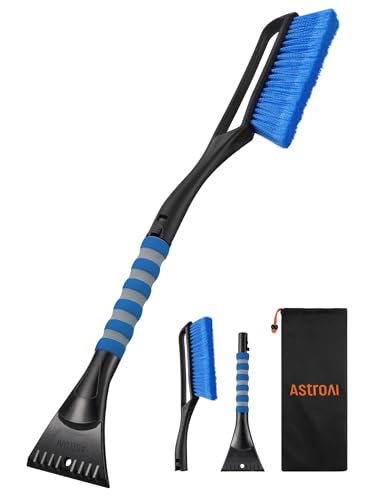
Publishes the three measurements that decide whether a brush suits your car - 27 in overall, an 8.66 in head and a 4.5 in blade - and it comes apart at a push-button buckle so the two halves fit a trunk or a door pocket. Split-end bristles are the detail that matters: they move snow without dragging grit across the paint.
Best for: Most cars
What the maker publishes
- Overall length
- 27 in
- Brush head
- 8.66 in, 4 rows of split-end PP bristles
- Scraper blade
- 4.5 in
- Shaft
- High-strength ABS
- Storage
- Detaches at a push-button buckle; storage bag included
- Extends
- No - fixed length
- Suits
- Cars, SUVs and trucks, per the maker
What works
- Publishing the head width and blade width lets you match the tool to the car instead of guessing from a photograph
- Split-end treated bristles are the honest answer to the scratch question - they flex rather than driving grit into clearcoat
- Detaching into two pieces solves the real problem with a 27 in brush, which is where it lives when it is not January
What doesn't
- Fixed length, so a tall SUV roof or a van still needs a reach you do not have here
- A 4.5 in blade is a normal-car blade - it will clear a windshield, slowly, rather than attack a thick sheet
- Plastic shaft and buckle are the parts that fail first on any detachable brush, and the listing publishes no warranty term
Skip this if: you park under trees or drive something tall. An extendable brush is the right tool for a roof you cannot reach.
2. And this for the door
Hopkins SubZero 16621 Ice Crusher Ice Scraper

A short two-ended scraper: a straight blade for frost, a chipper for the ice a blade skates over. This is the one you keep in the car you did not plan to be scraping.
Best for: The door-pocket scraper
What the maker publishes
- Type
- Handheld scraper, no brush
- Working ends
- Frost blade one end, ice chipper the other
- Grip
- Oval foam
- Length
- About 11 in per the listing
- Blade material
- Not published by the maker
What works
- Short enough to live in a door pocket, which is the only place a scraper is reliably useful
- The chipper end does something a flat blade cannot: it breaks a bonded sheet instead of riding over it
- Cheap enough to keep one in every vehicle, which is the honest answer to most scraper questions
What doesn't
- No brush, so it does nothing about the six inches of snow sitting on top of the ice
- Short handle means your hand is on the glass and your sleeve is in the snow
- A chipper is the part of a scraper most likely to mark trim if you slip
Skip this if: you routinely deal with real snow depth rather than overnight frost. This clears glass; it will not clear a car.
3. The actual shortcut
Prestone AS242 Windshield De-Icer, 11 oz Aerosol
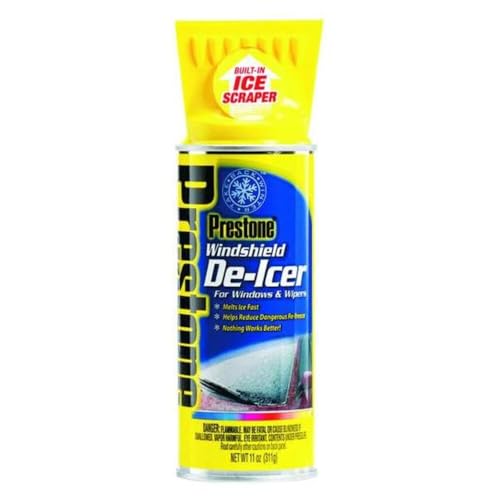
The default de-icer. Small enough to keep in a door pocket, and the cap is a scraper, which means the can and the tool are the same object you are already holding.
Best for: The can that lives in the car
What the maker publishes
- Size
- 11 oz aerosol
- Applicator
- Aerosol spray, scraper cap
- Maker claim
- Melts ice fast and helps reduce refreeze
- Active ingredient
- See the product label and SDS
- Rated melt temperature
- Not published by the maker
What works
- Fits a door pocket, which is where a de-icer has to live to be any use at 7am
- The scraper cap removes the second-tool problem entirely
- Aerosol reaches a wiper cowl and a mirror face better than a trigger bottle does
What doesn't
- 11 oz does not go far on a fully iced windshield - this is a frost can, not a storm can
- Prestone does not publish a rated melt temperature on the listing, so cold-limit claims are not something we can verify for you
Skip this if: you are clearing a whole iced car rather than a patch. Buy the 32 oz trigger bottle and keep this one for the lock and the mirrors.
Questions people actually ask
Do electric ice scrapers actually work?
On thin, even frost, yes. On thick bonded ice they struggle, because removing that takes pressure into the glass as well as motion across it, and a small motor supplies far less pressure than a forearm does.
Why does my cordless ice scraper die so fast in the cold?
Lithium cells deliver less current at low temperature, and a scraper stored in the car has been at outside temperature all night. Keeping the unit indoors and carrying it out helps at home but does nothing when you are parked elsewhere.
Is a 12V electric scraper better than a cordless one?
It sidesteps the cold-battery problem, because it draws from the car. The trade is a cable you have to run out of the vehicle, which means opening a door and working around a lead while you clear the glass.
What is the fastest way to clear a frozen windshield?
Start the engine and put the defroster on full while you clear the roof and the other windows, then spray de-icer on the windshield and let it work for thirty seconds before you touch it with a blade. The waiting is what makes it fast.