DIY Chip Repair vs a Professional
A kit is the right answer for a small chip you can treat today. It is the wrong answer if your insurance already covers the repair - and the kits themselves tell you where their limits are.
Buy a kit if the damage is a small chip or bullseye within the ceiling the kit publishes - about 1 to 1.25 inches across, or a crack under 12 inches - and you can treat it in the next day or two. Call a professional first if you carry comprehensive coverage, because insurers commonly waive the deductible on a repairable chip: Progressive says a crack that is repairable and under six inches long is repaired without a deductible. Free beats twelve dollars.
That is the decision in one paragraph and most pages on this subject never get to it, because they are either selling a kit or selling a repair. The honest version requires saying out loud that the best outcome is often the one where you buy nothing.
Check the insurance before you check the price
Glass repair is the one corner of auto insurance where claiming is usually painless. Progressive publishes that with comprehensive coverage "you can get a cracked windshield repaired without paying a deductible" where the crack is "repairable and less than 6 inches long".
The logic is on the insurer's side, not yours: a repair costs them a fraction of a replacement, so they would rather pay for the repair now than the glass later. Which means the five minutes it takes to check your policy is the highest-value five minutes on this page.
Three things to be clear about:
- Repair and replacement are different claims. A deductible waiver on a repair does not usually extend to a replacement. If the damage is past repairing, the deductible generally applies again.
- Terms vary by insurer and by state. Some states go further and bar a deductible on covered windshield work entirely. Read your own policy; do not read an article about someone else's.
- If your deductible is larger than a repair would cost, do not claim. Progressive's own guidance is that filing makes sense when the cost exceeds the deductible. For a small chip, that is frequently not the case - and that is exactly where a twelve-dollar kit wins.
The kits publish their own limits - use them
This is the part that makes the decision objective rather than a judgment call. Every kit on the shelf publishes a maximum damage size, and they do not all publish the same one.
Two of those rows are unusually candid and both are worth reading twice.
Rain-X states its kit repairs laminated windshields "up to first layer of windshield glass". A windshield is two glass layers bonded to a plastic interlayer; a resin injected from outside addresses the outer layer. That is an honest description of what any DIY kit does, printed by the only maker willing to print it.
And GlasWeld - the professional resin - says on its own listing that it is "optimized for injector-based repairs" requiring "proper vacuum and pressure cycles" and UV curing lights, and is explicitly "not a standalone DIY squeeze-bottle repair". That is the professional-versus-DIY line drawn by a manufacturer rather than by us: the difference is vacuum, controlled pressure cycles and controlled curing, not a better resin.
How we judged the kits
- Published size ceiling. The only spec that tells you whether the product can do your job. Bigger is better only because more damage falls inside it.
- Completeness of the kit. A resin with no pedestal, syringe, curing strip or blade is a component, not a repair.
- Pressure control. The failure mode in DIY glass repair is pressure - Rain-X warns twice on its own listing that pressing too hard "can extend the crack rather than repair it". A kit that controls the pressure mechanically is doing the hard part for you.
- Cure requirements. Sunlight curing in 15 minutes is a usable instruction in October. A kit needing UV lamps is not a kit.
The Permatex wins on the first three: the largest published ceiling at 1.25 inches, every component in the box, and a spring-lock syringe that - per the listing - "controls pressure automatically, so resin flows exactly where it's needed". That last point addresses the exact failure the Rain-X listing warns about.
Why this is a winter page, and why speed matters
A chip is a stress concentration in a sheet of glass that is about to be put under more thermal stress than at any other time of year. Cold glass, then a blast of hot defroster air on the inside, is a steep temperature gradient across a pane with a flaw in it. That is how a chip you have been ignoring since August becomes a crack across the driver's view in December. Defrosting and defogging your windows has the correct way to warm glass, which matters more once you know there is a chip in it.
Contamination is the other clock. Rain-X states repairs "should be made as soon as possible after the damage occurs and before the break has had a chance to be contaminated by dirt or water". Water in a chip that then freezes is both a contaminant and a wedge. In winter, a chip repaired this week genuinely is a different job from the same chip repaired next month.
Do notpour hot water on a windshield with a chip in it
It is the fastest way to turn a repairable chip into a replacement. Thermal shock across a flawed pane is what cracks it, and the pane is already cold. If the glass is iced, use a de-icer spray and a scraper - how to remove ice from a windshield has the sequence.
When a professional is the only right answer
- The damage is bigger than the kits' published ceilings. Over about 1.25 inches round, or a crack longer than the kit states.
- It is in the driver's primary viewing area. A DIY repair leaves some distortion. Every kit here promises to "minimize the appearance" rather than to remove it, and directly in your line of sight is the wrong place to accept that.
- The car has a camera behind the glass. Lane-keeping and emergency-braking systems look through the windshield, usually through a specific zone near the mirror. Damage or distortion there is a calibration question, not a cosmetic one.
- Your comprehensive coverage waives the deductible. There is no prize for doing it yourself when the alternative is free and warranted.
The short version
Check your policy first. If a repair is covered without a deductible, that is the better repair and it costs nothing. If it is not covered, or the deductible makes claiming pointless, measure the damage against the ceiling the kit publishes and buy the kit whose ceiling your damage fits inside - the Permatex covers the most ground. Do it within days rather than weeks, keep the pressure light, and keep hot water away from it. If the damage is in your line of sight or near a camera, pay a professional regardless.
For the full field of kits compared on resin, applicator and completeness, the chip repair kit roundup is the deeper page.
What to buy, and what to skip
We haven't tested these
No lab, no borrowed units, no free samples. What we did do: pull every published spec into one table and work out what the numbers mean on a cold morning. Everything below traces to a published spec sheet, a manual, or a standard we can point you at - and if a figure isn't published, we say so instead of estimating it. The full method is here.
Heads up: we earn a commission if you buy through the links on this page, at no extra cost to you. It never changes a ranking - here is how we pick and how the site is funded.
1. Best DIY kit - biggest published ceiling
Permatex 09103 Windshield Repair Kit, 9 Piece

The only kit here that publishes a damage-size limit - bullseye damage up to 1.25 inches - and it uses a spring-lock syringe that controls the pressure for you, which is the step most DIY repairs get wrong.
Best for: The most controlled repair
What the maker publishes
- Damage limit
- Bullseye damage up to 1.25 in diameter, per the maker
- Applicator
- Spring-lock syringe, controls pressure automatically
- Curing
- Sunlight, about 15 minutes - no UV lamp needed
- Contents
- 9 pieces including syringe, resin, disc, pedestal, curing strip
- Glass
- Most laminated windshields
What works
- A published size limit is the single most useful spec in this category - it tells you before you buy whether your damage is repairable
- Automatic pressure control removes the judgment call that ruins amateur repairs
- Cures in ordinary sunlight, so there is no equipment beyond the box
What doesn't
- Sunlight curing is a real constraint in the season you most need this - 15 minutes of winter sun is not always available
- Bullseye damage only; star breaks and long cracks are outside the stated limit
- The syringe is single use, so a second chip means a second kit
Skip this if: you cannot park in sun for a quarter of an hour. Another kit here cures without it.
2. Best for a short crack
Rain-X 600001 Windshield Repair Kit for Chips, Cracks and Bullseyes

Everything in one box and a listing that is unusually frank about its own limits - repairs should be made as soon as possible, before the break is contaminated by dirt or water, and pressing too hard can extend the crack.
Best for: A chip you found this morning
What the maker publishes
- Repairs
- Chips, cracks and bullseyes
- Depth
- Up to the first layer of laminated glass, per the maker
- Time
- Minutes, per the maker
- Critical condition
- Repair before the break is contaminated by dirt or water
- Contents
- Resin, curing strips and applicator included
What works
- The listing states the failure conditions rather than hiding them, which is what you want from a product that can make damage worse
- Complete kit, so there is no second trip for a curing strip you did not know you needed
- Cheap enough that catching one chip pays for it several times over
What doesn't
- A contaminated chip - one that has had a week of road spray in it - will not repair cleanly, and there is no way to undo a bad attempt
- Only works to the first layer of laminated glass; deeper damage is a replacement
- Pressing too hard can extend the crack, which is a real risk on a cold windshield
Skip this if: the damage is in your direct line of sight. A repaired chip leaves a visible blemish, and in your eyeline that is a permanent distraction.
3. The most modest claim
J-B Weld 2100 Windshield Saver Repair Kit, 0.025 fl oz

The most modest claim on this page, and deliberately so: it minimizes the appearance of chips and stars. Not restores, not makes invisible. For small damage that is the realistic outcome and it is refreshing to see it printed.
Best for: Small damage, honestly described
What the maker publishes
- Stated effect
- Minimizes the appearance of chips and stars, per the maker
- Glass
- All laminated windshields
- Damage
- Small damage repairs
- Size
- 0.025 fl oz
- Damage limit
- Not published by the maker
What works
- The label sets the right expectation, which matters in a category where people expect invisibility and get a blemish
- Works on star breaks as well as chips, which the strictly-bullseye kits do not claim
- Established adhesives brand rather than a one-product seller
What doesn't
- No published size limit at all, so you are judging repairability yourself
- 0.025 fl oz is a tiny amount of resin - this is a one-chip kit
- Minimizes the appearance is a lower bar than the structural claims the other kits make
Skip this if: you want the strongest structural repair. A kit that publishes a damage limit and a pressure-controlled syringe is doing more.
4. Skip - its own listing says it is not DIY
GlasWeld Windshield Repair Resin
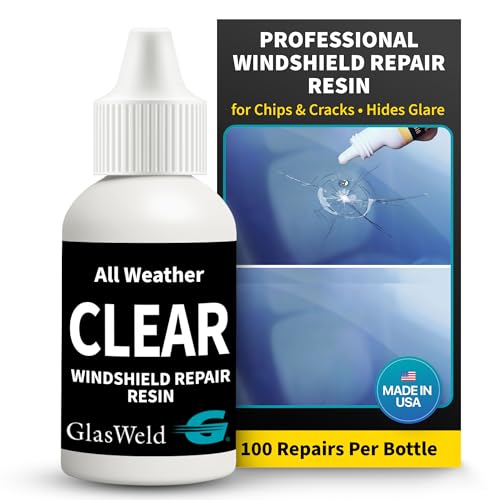
Professional-grade resin from a company that sells to glass shops. It is the best chemistry on this page and the worst value for a one-off user, because resin alone is not a repair kit.
Best for: Somebody who already owns the tools
What the maker publishes
- Type
- Windshield repair resin
- Grade
- Professional
- Includes a tool
- No - resin
- Damage limit
- Not published by the maker
- Curing
- Per the product instructions
What works
- Resin quality is what separates a repair that disappears from one that clouds, and this is the trade-grade option
- Sensible restock if you already own an injector bridge from a previous kit
What doesn't
- Several times the price of a complete consumer kit, and it is not a complete kit
- Without an injector and the rest of the hardware it cannot be used at all
- No published damage limit, because it is sold to people expected to know
Skip this if: this is your first windshield repair. Buy a complete kit; this is a refill for somebody who already did one.
Questions people actually ask
Is a DIY windshield chip repair kit worth it?
For a small chip or bullseye inside the kit's published ceiling - about 1 to 1.25 inches across - yes, and it costs around the price of a sandwich. It is not worth it if you carry comprehensive coverage that waives the deductible on a repairable chip, because a professional repair is then free and warranted.
How big a chip can a DIY kit repair?
Read the kit, because they differ. Permatex publishes bullseye damage up to 1.25 inches in diameter. Rain-X publishes round damage below 1 inch and cracks under 12 inches. J-B Weld publishes up to 1.25 inches. Anything larger is a professional job.
Does insurance cover windshield chip repair?
Commonly, yes, and often without a deductible. Progressive publishes that with comprehensive coverage a crack that is repairable and less than 6 inches long is repaired with no deductible. Terms vary by insurer and state, and a replacement rather than a repair usually brings the deductible back.
What is the difference between DIY and professional windshield repair?
Vacuum, controlled pressure cycles and controlled curing. The professional resin on this page states on its own listing that it needs an injector and UV curing lights and is not a standalone DIY repair. DIY kits inject from outside and, as Rain-X publishes, address the outer layer of the laminated glass.
Will a DIY repair be invisible?
No. Every kit here claims to minimize the appearance of the damage, not to remove it. Some distortion remains, which is why a repair in the driver's primary line of sight is better left to a professional.
How soon should you repair a windshield chip in winter?
Within days. Rain-X states repairs should be made as soon as possible and before the break is contaminated by dirt or water. In winter, water in the chip freezes and acts as a wedge, and the defroster-against-cold-glass temperature gradient is what turns a chip into a crack.