Cold Starts, Batteries & Jump Starters
Jump Starter vs Jumper Cables
One needs a stranger with a running car. The other needs you to have remembered to charge it. Which failure you can live with decides the answer.
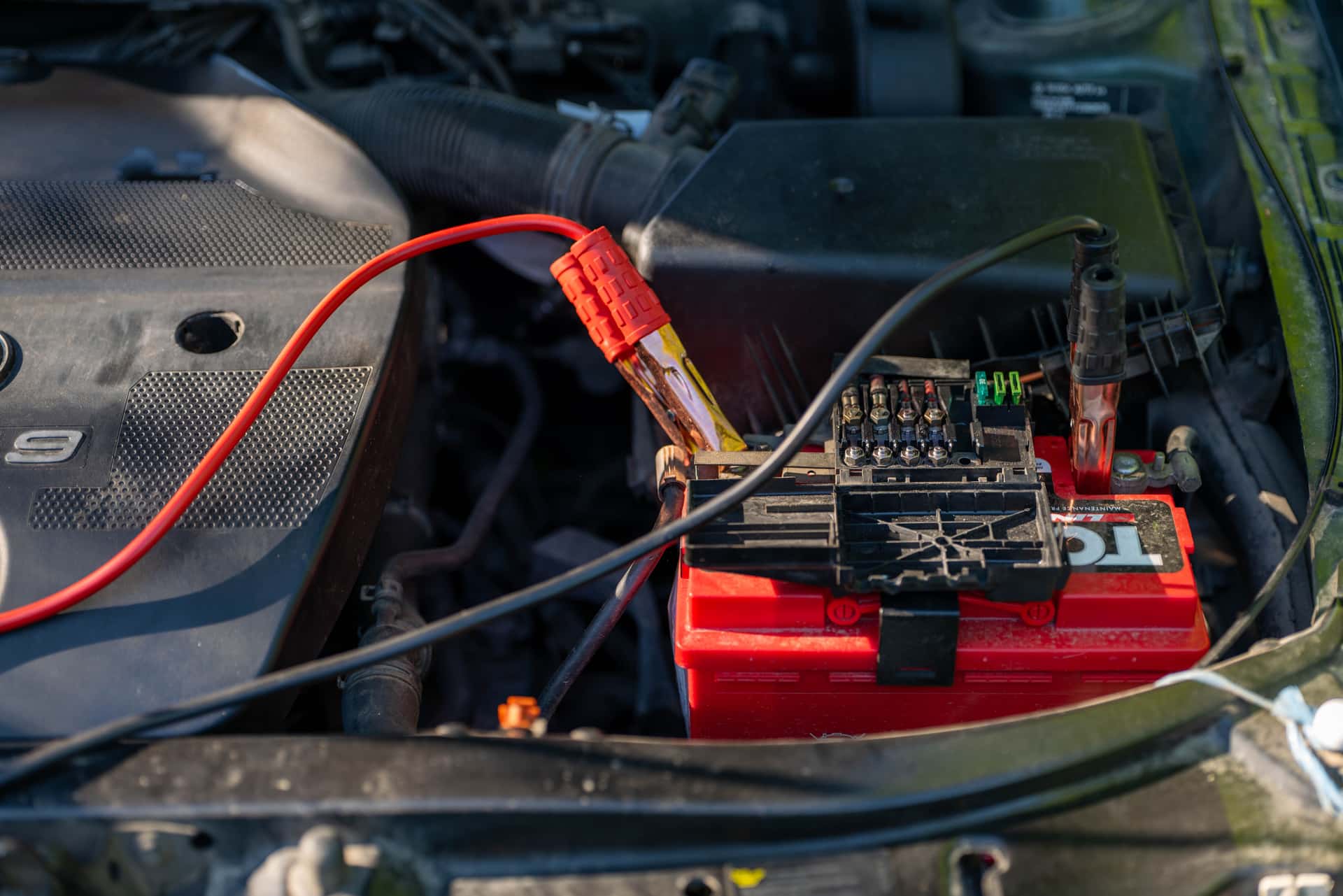
Carry a jump pack if you park alone, commute at odd hours, or would rather not ask a stranger. Carry cables if you always have somebody nearby and would rather not maintain another battery. The pack solves the situation cables cannot: an empty lot at 6am.
They fail in completely different ways
Cables have no battery, no charge state and no cold derating. Copper carries current the same at 0F as at 80F. They will work in ten years sitting in the same trunk. Their single weakness is absolute: they need a second running vehicle and a driver willing to help.
A jump pack needs nobody. Its weaknesses are that it holds a charge you have to maintain, and that lithium cells deliver less current when cold - which is the specific condition you bought it for. Neither is disqualifying, but both are real.
Side by side
If you buy cables, gauge is the only spec
Cable gauge runs backwards: a lower number means a thicker conductor. Thin cheap cables are the standard failure in this category, because they cannot carry cranking current - they get warm, drop voltage along their length, and the car turns over slowly or not at all.
- 4 or 6 AWG for a car. 6 is the practical minimum.
- 2 AWG for a truck, a large SUV or anything diesel.
- 16 to 25 ft of length. Shorter cables assume the two cars can be nose to nose, and in a parking lot they frequently cannot.
- Avoid any set that does not publish its gauge. That omission is the specification.
This is also the number to check on any bundled emergency kit, and most kits do not publish it - which is covered in the kit roundup.
The pack question you have to answer honestly
Will you keep it charged? A jump pack is only a solution if it has charge in it, and the failure mode is not dramatic - it is a pack that has been in the trunk since last October at 15 percent.
If the answer is yes, charge it in October and again mid-season, and keep it in the cabin rather than the trunk so it is warmer when you need it. If the answer is honestly no, cables are a better purchase because they cannot be neglected into uselessness.
Do notconnect the black clamp to the dead battery's negative post
The standard procedure grounds the final clamp to an unpainted metal point on the engine block, away from the battery. A charging battery vents hydrogen, and a spark at the terminal is how the rare but genuinely nasty accidents in this category happen. Modern jump packs manage this for you; cables do not.
Why plenty of people carry both
They are cheap relative to a tow. Cables cover the day you forgot to charge the pack; the pack covers the day nobody is around. Together they are still less than the cost of being late to something that mattered.
If you carry only one, make it the one that suits how you park. City street parking with people around: cables. A driveway, a rural road or an early shift: the pack. The picks for both are in the jump starter roundup.
What to buy, and what to skip
We haven't tested these
No lab, no borrowed units, no free samples. What we did do: pull every published spec into one table and work out what the numbers mean on a cold morning. Everything below traces to a published spec sheet, a manual, or a standard we can point you at - and if a figure isn't published, we say so instead of estimating it. The full method is here.
Heads up: we earn a commission if you buy through the links on this page, at no extra cost to you. It never changes a ranking - here is how we pick and how the site is funded.
1. The pack
Weego 44s 2100A 12V Lithium Car Battery Jump Starter

The only pack we have found that publishes cranking amps as well as peak amps - 440 CA against 2100 peak - which is the figure that actually predicts a start. It also publishes a weight under one pound and engine ratings of 7L gas and 3.5L diesel, so you can check it against your own car rather than trusting a headline number.
Best for: Most cars, and a glovebox
What the maker publishes
- Peak amps
- 2100A
- Cranking amps
- 440 CA, per the maker
- Gas engines
- Up to 7L, per the maker
- Diesel engines
- Up to 3.5L, per the maker
- Weight
- Under 1 lb, per the maker
- Charge retention
- Holds a charge for months, per the maker
- Protection
- Anti-spark, reverse polarity and surge protection
- Build
- Stated to resist water, dust and dirt
What works
- Publishing a cranking amps figure is almost unheard of in this category, and cranking amps is the number that decides whether a cold engine turns - peak amps has no standard behind it at all
- Under a pound means it genuinely lives in the glovebox, which is inside the heated cabin - and where a lithium pack is stored matters more than any number on the box
- Holding a charge for months addresses the real failure of these packs, which is reaching for one in January and finding it flat
What doesn't
- 3.5L diesel is a car-and-van ceiling, not a truck one, and the gas figure of 7L is mid-pack rather than generous
- Priced right at the top of the sub-$100 bracket, which buys fewer amps than the cheap packs claim
- Lithium still delivers least current when it is cold, so the published figures assume a pack that has not been sitting in a freezing trunk
Skip this if: you drive a diesel pickup. The 3.5L diesel ceiling is the number that matters and it is not close.
2. The cables
EPAuto 4 Gauge x 20 Ft Heavy Duty Booster Cables
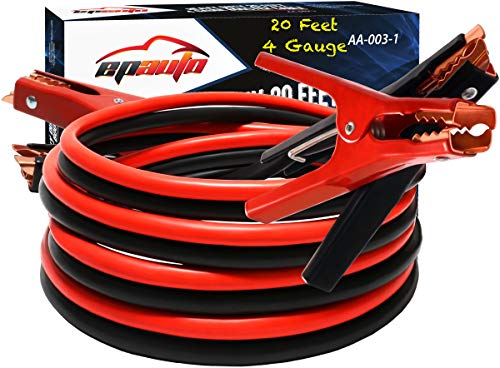
Cables have no battery to go flat and no cells to lose current in the cold. Their weakness is that they require a second car, and at 6am in an empty lot there is not one.
Best for: Never needing a charge
What the maker publishes
- Gauge
- 4 AWG - lower number is thicker; 2 AWG is the step up for a truck
- Length
- 20 ft, which is inside the useful 16 to 25 ft range
- Cold performance
- Copper does not lose capacity in cold; PVC insulation stiffens
- Charge required
- None
- Requires
- A second running vehicle
What works
- Nothing to charge, nothing to maintain, and no cold-weather derating on the conductor itself
- Far cheaper than any lithium pack
- Will still work in ten years, sitting in the same trunk
What doesn't
- Useless without a second vehicle and a willing driver
- Thin cheap cables are genuinely dangerous - they get hot and they will not carry cranking current
- Insulation stiffens in deep cold and the cables become unwieldy
Skip this if: you park alone or commute at odd hours. That is exactly the situation cables cannot solve, and it is the reason jump packs exist.
3. The thing that prevents both
Battery Tender Junior 12V, 750mA Charger and Maintainer

The cheapest intervention in this whole section. A battery that is kept topped up does not develop the cold-weather problem in the first place, and a maintainer costs a fraction of a battery.
Best for: A car that sits
What the maker publishes
- Type
- Automatic float charger
- Voltage
- 12V
- Rated output
- 750 mA
- Chemistry support
- Check it covers AGM if that is what your car has
- Requires
- Power where you park
What works
- Prevention rather than replacement, at a small fraction of a battery price
- Removes the specific failure of a car that sits unused for two cold weeks
- Modern units float automatically instead of cooking a full battery
What doesn't
- Needs an outlet where you park, which rules out most street parking
- Not every maintainer handles AGM correctly - check before you plug it into one
Skip this if: you park on the street or drive daily. This solves a storage problem, not a commuting one.
Questions people actually ask
Are jump starters better than jumper cables?
They are better in the situation cables cannot handle - an empty parking lot with no second car. Cables are better if you always have somebody nearby, because they never go flat and there is nothing to maintain.
What gauge jumper cables do I need?
4 or 6 AWG for a car and 2 AWG for a truck or diesel, in a 16 to 25 ft length. Lower gauge numbers mean thicker conductors, and thin cables cannot carry cranking current - avoid any set that does not publish its gauge.
Do jumper cables work in cold weather?
Yes, with no derating on the copper itself. The insulation stiffens in deep cold and makes them awkward to handle, but electrically they perform the same at 0F as they do in summer.
How often should I charge a jump starter?
Top it up at the start of the season and check it again mid-winter. The failure mode is not dramatic - it is a pack that has sat in the trunk since last October at 15 percent charge on the morning you finally need it.
Where should you connect the negative jumper cable?
To an unpainted metal ground point on the engine block of the dead car, away from the battery. A charging battery vents hydrogen and a spark at the terminal is how the rare serious accidents in this category happen.