Cold Starts, Batteries & Jump Starters
Jump Starter vs Battery Charger
They look adjacent and they solve opposite problems. One is a cure you carry, the other is prevention you plug in - and buying the wrong one is the most common mistake in this whole section.
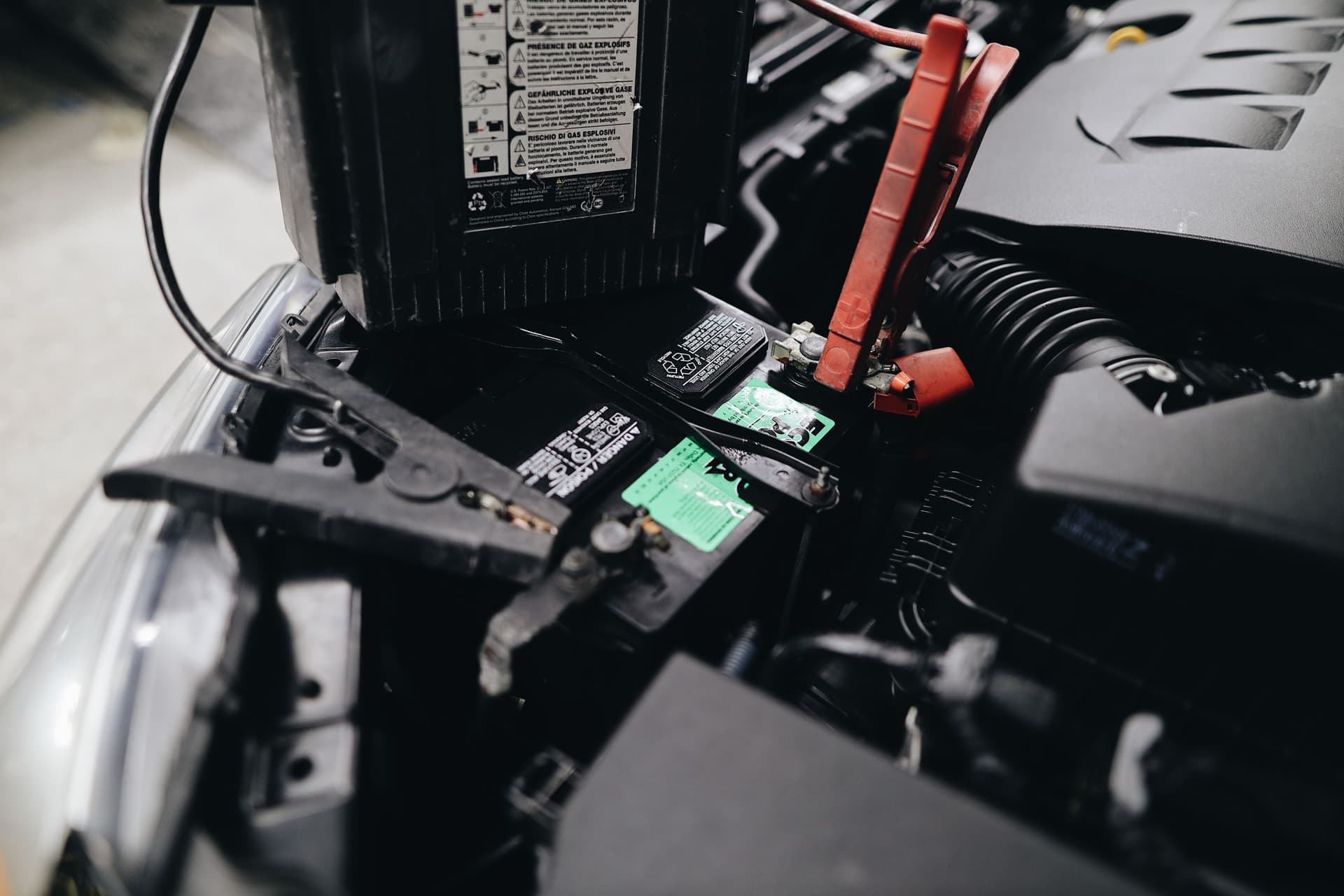
A jump starter rescues a battery that is already dead, anywhere, in about five minutes. A battery charger prevents the battery from dying, but only where there is an outlet and only over hours. If your car sits and you have power where you park, buy the charger. If your car is driven and you park away from power, buy the jump starter.
The actual difference
Both connect to the same two terminals, which is why the confusion exists. What happens next is entirely different.
Read the last two rows together. A jump starter gets the engine running and then stops being involved; the battery is still nearly flat and it is the alternator that has to recover it, which is a job the alternator does badly at idle. A charger leaves the battery genuinely full.
Why most people buy the wrong one first
Because the jump starter is the dramatic purchase. It solves the emergency you can picture: stuck somewhere, nothing happening when you turn the key. So that is what gets bought.
But the common cause of a dead battery in winter is not drama. It is a sound battery that never gets fully charged, because short trips do not replace what starting consumed, and because a car sitting for two weeks discharges quietly through its alarm and telematics. That is a charger problem. A jump pack lets you keep driving a battery that is slowly dying; a maintainer stops it from dying.
The mechanism is in car batteries in cold weather, and the reason a weekly driveway start does not substitute for either tool is in how often to start your car in winter.
Buy the charger if
- The car sits for days at a time and you have an outlet where you park.
- Your trips are short - under twenty minutes at road speed, most days.
- It is a second car, a weekend car, or anything genuinely stored.
- The battery is sound but the car keeps cranking slowly after a cold spell.
A low-output smart charger holds a healthy battery indefinitely and will slowly recover a flat one. The winter-specific feature to insist on is temperature compensation, because a battery needs a higher charging voltage when cold and a fixed-voltage unit will undercharge it in an unheated garage - the charger picks compare exactly that.
Buy the jump starter if
- You park where there is no outlet - street, apartment lot, shared driveway.
- You start early, finish late, or park somewhere with nobody around to ask.
- You drive the car regularly, so the alternator is already doing the charging job.
- You want something that also helps other people, which a charger cannot do.
Buy on the published engine rating rather than the peak amp figure, keep it in the cabin rather than the trunk, and remember it is a rescue tool - it does not leave you with a charged battery. The under-$100 picks cover the value end.
When you need both
More often than either product's marketing suggests. The two failure modes are separate and a lot of drivers have both: a car that sits during the week and gets driven at weekends, parked outside, somewhere cold.
If that is you, the sequence matters. Put the charger on first - it is cheaper, and it may remove the need for the rescue entirely. Add the pack afterwards for the mornings prevention did not happen. Buying the pack first and the charger never is how people end up jump starting the same car all winter.
Do notuse a jump starter on a battery that has frozen
A deeply discharged battery has more water and less acid in its electrolyte, which raises its freezing point. A frozen battery can rupture under heavy current. If the case is bulging or distorted after a hard freeze, it is a replacement - do not connect a jump pack or a charger to it.
When the answer is neither
If the battery is over four years old and cranking has got slower each cold snap, both tools are postponing the same outcome. A maintainer keeps a failing battery topped up until it fails anyway; a jump pack restarts it each time until the morning it will not hold anything at all. That is a replacement, not a tool purchase.
And if you park on the street with no power, the charger route is not closed entirely - a solar maintainer is the only thing that works without an outlet, with one caveat nobody mentions: snow on the panel stops it dead.
The short version
Charger for prevention, pack for rescue. Car sits plus an outlet means charger. Car drives plus no outlet means pack. Both, if your winter looks like both - and in that case buy the charger first, because it is the cheaper one and it is the one that might mean you never need the other.
What to buy, and what to skip
We haven't tested these
No lab, no borrowed units, no free samples. What we did do: pull every published spec into one table and work out what the numbers mean on a cold morning. Everything below traces to a published spec sheet, a manual, or a standard we can point you at - and if a figure isn't published, we say so instead of estimating it. The full method is here.
Heads up: we earn a commission if you buy through the links on this page, at no extra cost to you. It never changes a ranking - here is how we pick and how the site is funded.
1. The charger
NOCO GENIUS5 5A 6V/12V Smart Battery Charger and Maintainer

The one with a published reason to exist in winter: an integrated thermal sensor that adjusts the charge to ambient temperature, so it does not undercharge in the cold. That is the failure mode a dumb trickle charger has.
Best for: Most cars, most winters
What the maker publishes
- Output
- 5A
- Voltage
- 6V and 12V
- Temperature compensation
- Integrated thermal sensor adjusts charge to ambient temperature
- Recovery
- Charges from as low as 1V; Force Mode for batteries at zero volts
- Chemistry
- Lead-acid (wet, gel, AGM) and lithium LiFePO4, up to 120Ah
- Warranty
- 3 years, per NOCO
What works
- Temperature compensation is the whole point in a cold garage - a fixed-voltage charger undercharges a cold battery and overcharges a warm one
- AGM support matters because a lot of modern cars ship with AGM and a wrong-mode charge shortens their life
- Force Mode recovers a battery too flat for a normal charger to even detect, which is exactly the January situation
What doesn't
- 5A is a maintainer and a slow charger, not a jump starter - it will not get you moving in ten minutes
- Needs mains power where you park, which rules out street parking
- More expensive than a basic float charger, and if the car is driven daily you may never need it
Skip this if: the car is driven every day and the battery is healthy. This solves a sitting problem, not a driving one.
2. The jump starter
NOCO Boost GB20 500A UltraSafe Lithium Jump Starter
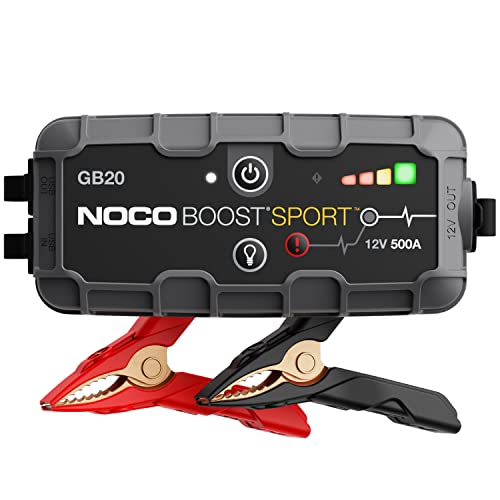
The smallest pack NOCO sells, and at 2.4 lb the only one here light enough that people genuinely keep it in the glovebox. The 4.0L gas ceiling is the whole story: fine for a four-cylinder, not enough for much else.
Best for: Small cars
What the maker publishes
- Peak amps
- 500A
- Gas engines
- Up to 4.0L, per the maker
- Diesel engines
- Not published by the maker
- Jumps per charge
- Up to 20, per the maker
- Weight
- 2.4 lb
- Recharge time
- 3 hours
- Housing
- IP65 rated, rubberized over-molding
- Flashlight
- 100 lumens, 7 modes
What works
- 2.4 lb is light enough to live in the glovebox rather than the trunk, and the glovebox is inside the heated cabin
- Up to 20 starts per charge on a pack this small is a genuinely useful published figure
- IP65 and rubberized over-molding is real protection for something that gets used in sleet
What doesn't
- 4.0L gas is a hard ceiling - a V6 is outside it, let alone a V8
- No published diesel rating at all, which on a 500A pack tells you the answer is no
- Still lithium, so it still delivers least when cold - the storage rule applies
Skip this if: you drive anything larger than a four-cylinder. The GB50 exists for exactly that reason.
3. If you have no outlet
Battery Tender 5 Watt Solar Panel 12V Battery Charger with Charge Controller, 021-1171

The only maintainer here that works without mains power, which answers the objection every other charger runs into - that a maintainer is no use if you park on the street or in an unpowered lot. It also has a winter-specific weakness the listing will not tell you about.
Best for: A car parked where there is no outlet
What the maker publishes
- Output
- 5 W, 12 V
- Controller
- Charge controller included
- Weatherproofing
- IP67, per the listing
- Mounting
- Windshield mountable
- Charge rate in winter light
- Not published by the maker
What works
- Works where no other maintainer does - street parking, a lot, a field, a driveway with no outdoor outlet
- A charge controller is included, so it floats rather than cooking the battery on a bright day
- IP67 is a real rating rather than a vague weatherproof claim, which matters for something left on the glass all winter
What doesn't
- Snow on the panel stops it completely, and a windshield-mounted panel in winter is exactly where snow lands - this is the failure mode nobody mentions
- 5 W is a peak figure in full sun. Short days, low sun angle and overcast skies all cut it, and the maker does not publish what it delivers in winter conditions
- You still have to route a cable from the glass to the battery or an accessory socket
- A 1 A wall charger does more, more predictably, for less money
Skip this if: you have an outlet where you park. This exists for the case where you do not - it is not the better product, it is the only one that works there.
Questions people actually ask
What is the difference between a jump starter and a battery charger?
A jump starter supplies cranking current directly so a dead car will start right now, anywhere. A battery charger refills the battery over hours and needs mains power. One is rescue, the other is prevention.
Do I need both a jump starter and a battery charger?
Often yes, if your car both sits during the week and gets parked away from power. Buy the charger first - it is cheaper and it may remove the need for the rescue entirely - then add the pack for the mornings prevention did not happen.
Does a jump starter charge the battery?
Barely. It supplies enough current to crank the engine and then stops being involved. The battery is still close to flat afterwards and the alternator has to recover it, which it does poorly at idle.
Is a trickle charger the same as a battery charger?
A trickle charger is a low-output charger, and modern smart maintainers float automatically rather than trickling indefinitely. For winter you want one with temperature compensation, because a cold battery needs a higher charging voltage.
Which should I buy first if I can only afford one?
If the car sits and you have an outlet, the charger - it is cheaper and it treats the cause. If you park away from power or drive daily, the jump starter, because a charger you cannot plug in is no use at all.
Can I use a battery charger at the roadside?
No. Every charger needs mains power. That single constraint is what the whole comparison comes down to, and it is why a solar maintainer is the only charging option for street parking.