Cold Starts, Batteries & Jump Starters
The Best Jump Starters Under $100
Under a hundred dollars is where this category gets interesting and where the numbers get least trustworthy. Two packs here publish both engine ceilings. One publishes a peak amp figure that beats packs costing five times as much.
Heads up: we earn a commission if you buy through the links on this page, at no extra cost to you. It never changes a ranking - here is how we pick and how the site is funded.
Quick picks
The short answer, before the detail. Tap any row to jump to that write-up, or go straight to the listing to check today's price.
| # | Product | Best for | Price |
|---|---|---|---|
| 1 |  GOOLOO GP20008.0L gas and 6.0L diesel published, at a price that undercuts every other pack with those numbers by a wide margin. If the diesel figure is what you are shopping for, this is the cheapest honest route to it. | Best overall under $100 | $49.99 - Check on Amazon-29% |
| 2 |  AstroAI S8Publishes 6.0L gas and 3.0L diesel for well under fifty dollars, and weighs less than a pound. It is also the only pack here whose own listing tells you to mind the temperature when storing it, which is the honest note the category usually omits. | Best under $50 | $44.98 - Check on Amazon-25% |
| 3 |  TOPDON JS2000ProThe only pack in this bracket that names an actual certification - UL2734 - rather than just counting its own protections. Its Boost mode is built for the case that defeats most packs: a battery too flat to be detected. | Best certified | $84.99 - Check on Amazon-15% |
| 4 | 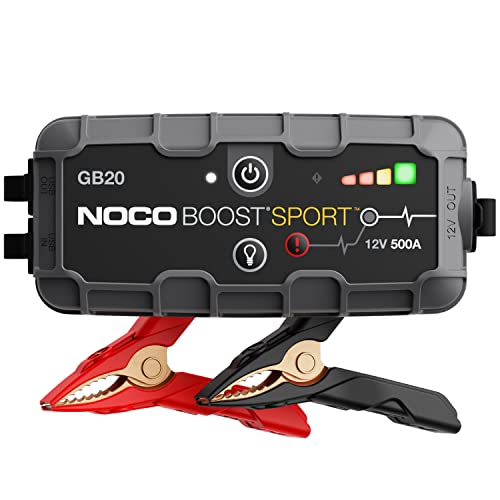 NOCO Boost GB20The smallest pack NOCO sells, and at 2.4 lb the only one here light enough that people genuinely keep it in the glovebox. The 4.0L gas ceiling is the whole story: fine for a four-cylinder, not enough for much else. | Best small-car pack | $79.95 - Check on Amazon |
| 5 |  DBPOWER Z07Advertises 5000A and 10.0L gas / 8.0L diesel for under forty-five dollars - numbers that beat a pack costing five times as much. That gap is not a bargain, it is the clearest demonstration on this page that peak amps has no standard behind it. | Skip this one | $44.80 - Check on Amazon-66% |
A hundred dollars buys a genuinely capable jump pack now. It also buys a lot of numbers that mean nothing, because the headline figure this category advertises - peak amps - has no standardized test behind it. Nobody audits it. A manufacturer can print what it likes.
So this page is ordered by the number that does carry a commitment, and the last entry is here specifically to show you what an unregulated number looks like when it gets out of hand.
How we judged these, before any ranking
- The published engine rating, gas and diesel. This is the maker stating what they will stand behind: this pack will turn an engine of this size. It is the only figure on the box that behaves like a specification.
- Whether a diesel figure is published at all. Silence is an answer. A pack that gives a gas ceiling and no diesel ceiling is telling you not to buy it for a diesel.
- Weight and size. Not comfort - physics. Lithium delivers least when it is cold, so the pack needs to live in the heated cabin. A pack that is too big for the glovebox ends up in the trunk, which is outside.
- A named safety certification. Every listing counts its own protections. Exactly one of these names a third-party standard you can look up.
Deliberately not on that list: peak amps as a ranking input. It appears in the table because you will see it on every box, not because it earned a place.
What each one publishes
Why the amp column is the least useful one
Look down that peak amps column and then at the prices. The cheapest pack on the page claims two and a half times the peak current of the most expensive one. Its battery is 74Wh. That is not a larger cell doing more work; it is a number with nothing behind it.
There is no industry test for peak amps in a consumer jump pack. There is no duration attached to it - a current that flows for a few milliseconds and a current that flows for three seconds of cranking are different things, and the figure does not distinguish them. Two makers can measure in two different ways and both print a true-ish number.
The engine rating is different because it is a promise about an outcome. That is why every pick above it is ordered on engine rating and not on amps, and it is the same reasoning used in the main jump starter roundup.
If you drive a diesel, the list is shorter
A diesel has no spark plugs. It ignites by compressing air until it is hot enough, which means the starter turns the engine against far higher compression, and glow plugs draw their own substantial current before you even crank. That is why the diesel figure on every honest pack is roughly half the gas figure.
Two packs here publish 6.0L diesel. One publishes 3.0L, which is a car diesel. One publishes nothing, which means no. The full argument is in jump starters for SUVs and trucks.
Do notstore any of these in the trunk
Every pack on this page is lithium, and lithium delivers less current the colder it gets. A pack that lives in the trunk sits at outside temperature all night, which is precisely the morning you need its full rating. The glovebox is inside the heated cabin. That is the whole reason weight is a ranking criterion here.
What a hundred dollars actually buys you
- Under $50: a real 6.0L gas rating and a pack under a pound. You give up the diesel headroom and the published jumps-per-charge.
- $50 to $75: the best value on this page - 8.0L gas and 6.0L diesel published, at a fraction of what those numbers cost from an established brand.
- $75 to $100: either a named safety certification or a well-known brand, but not both, and not a bigger engine rating than the tier below.
Above a hundred dollars you start paying for recharge speed, displays and track record rather than starting capability - which is the argument made in our Alpha85 review.
The honest alternative at this price
Heavy-gauge jumper cables cost less than every pack here, have no battery to go flat, and suffer no cold derating at all. Their weakness is absolute: they need a second vehicle and a willing driver.
If you commute at normal hours in a populated area, cables are the rational purchase and a pack is a convenience. If you park alone, start early, or drive somewhere with no traffic, the pack is the only thing that works. Jump starter vs jumper cables works through it properly.
The short version
The GOOLOO is the pick: 8.0L gas and 6.0L diesel published, at a price nothing else with those numbers gets near. The AstroAI is the one to buy if you want the smallest, lightest pack that still covers an ordinary gas engine. The TOPDON is worth the premium only if a named certification matters to you more than the money. The GB20 is a small-car pack and honest about it. And the DBPOWER is on this page as an illustration, not a recommendation.
The picks, one at a time
We haven't tested these
No lab, no borrowed units, no free samples. What we did do: pull every published spec into one table and work out what the numbers mean on a cold morning. Everything below traces to a published spec sheet, a manual, or a standard we can point you at - and if a figure isn't published, we say so instead of estimating it. The full method is here.
1. Best overall under $100
GOOLOO GP2000 Portable Car Battery Jump Starter, 2000A
8.0L gas and 6.0L diesel published, at a price that undercuts every other pack with those numbers by a wide margin. If the diesel figure is what you are shopping for, this is the cheapest honest route to it.
Best for: Diesel on a budget
What the maker publishes
- Peak amps
- 2000A
- Gas engines
- Up to 8.0L, per the maker
- Diesel engines
- Up to 6.0L, per the maker
- Weight
- 1.2 lb
- Size
- 7.4 x 3.9 x 1.5 in
- Protections
- 10, with all-metal clamps
- Jumps per charge
- Not published by the maker
What works
- A 6.0L diesel ceiling at this price is the single best spec-per-dollar figure in this list
- 1.2 lb and barely thicker than a phone, so the cabin-storage rule is easy to follow
- All-metal clamps rather than the plastic-bodied clamps that crack after a couple of winters
What doesn't
- No published jumps-per-charge figure, so you cannot tell how much reserve is left after one start
- No published cold-operating range - same silence as everything else here
- A less established name than NOCO, and the warranty terms are not stated on the listing
Skip this if: you want the longest track record rather than the best numbers. NOCO has been doing this longer.
2. Best under $50
AstroAI S8 Car Battery Jump Starter, 1500A
Publishes 6.0L gas and 3.0L diesel for well under fifty dollars, and weighs less than a pound. It is also the only pack here whose own listing tells you to mind the temperature when storing it, which is the honest note the category usually omits.
Best for: The most engine per dollar
What the maker publishes
- Peak amps
- 1500A
- Gas engines
- Up to 6.0L, per the maker
- Diesel engines
- Up to 3.0L, per the maker
- Weight
- 0.95 lb
- Size
- 7.9 x 4.5 x 3.7 in
- Protections
- 8, including reverse polarity and overcurrent
- Boost mode
- Detects a battery below 9V automatically
What works
- Both engine ceilings are published, which is the spec that actually decides whether a pack will start your car
- Under a pound and glovebox sized, so it stays in the warm part of the vehicle
- The listing itself carries a cold-storage warning - a maker being straight about lithium in winter is rare enough to count
What doesn't
- 3.0L diesel is a car diesel, not a truck diesel
- A smart boost mode that engages below 9V is useful and also means a deeply flat battery may need the manual route
- No published number of jumps per charge
Skip this if: you drive a diesel truck. The published 3.0L ceiling is the answer and it is not close.
3. Best certified
TOPDON JS2000Pro Jump Starter, 2000A
The only pack in this bracket that names an actual certification - UL2734 - rather than just counting its own protections. Its Boost mode is built for the case that defeats most packs: a battery too flat to be detected.
Best for: A safety certification you can look up
What the maker publishes
- Peak amps
- 2000A
- Gas engines
- Up to 8.0L, per the maker
- Diesel engines
- Up to 6.0L, per the maker
- Certification
- UL2734, per the maker
- Protections
- 10 built-in
- Flashlight
- 300 lumens
- Case
- Hard EVA, crush resistant
- Jumps per charge
- Not published by the maker
What works
- A named third-party certification is worth more than a self-reported protection count, and it is the only one here
- Boost mode exists for a battery so flat the pack cannot sense it, which is where cheaper packs simply refuse
- A hard EVA case means the clamps and cable are still findable in a trunk two winters later
What doesn't
- Top of this price bracket, and the GOOLOO publishes the same engine ceilings for less
- No published jumps per charge
- 300 lumens is bright, which is useful, and also drains the pack you may still need
Skip this if: you are buying on price alone. Two packs here publish the same ceilings for less money.
4. Best small-car pack
NOCO Boost GB20 500A UltraSafe Lithium Jump Starter
The smallest pack NOCO sells, and at 2.4 lb the only one here light enough that people genuinely keep it in the glovebox. The 4.0L gas ceiling is the whole story: fine for a four-cylinder, not enough for much else.
Best for: Small cars
What the maker publishes
- Peak amps
- 500A
- Gas engines
- Up to 4.0L, per the maker
- Diesel engines
- Not published by the maker
- Jumps per charge
- Up to 20, per the maker
- Weight
- 2.4 lb
- Recharge time
- 3 hours
- Housing
- IP65 rated, rubberized over-molding
- Flashlight
- 100 lumens, 7 modes
What works
- 2.4 lb is light enough to live in the glovebox rather than the trunk, and the glovebox is inside the heated cabin
- Up to 20 starts per charge on a pack this small is a genuinely useful published figure
- IP65 and rubberized over-molding is real protection for something that gets used in sleet
What doesn't
- 4.0L gas is a hard ceiling - a V6 is outside it, let alone a V8
- No published diesel rating at all, which on a 500A pack tells you the answer is no
- Still lithium, so it still delivers least when cold - the storage rule applies
Skip this if: you drive anything larger than a four-cylinder. The GB50 exists for exactly that reason.
5. Skip this one
DBPOWER Z07 Jump Starter, 74Wh
Advertises 5000A and 10.0L gas / 8.0L diesel for under forty-five dollars - numbers that beat a pack costing five times as much. That gap is not a bargain, it is the clearest demonstration on this page that peak amps has no standard behind it.
Best for: Showing why peak amps is not a spec
What the maker publishes
- Claimed peak amps
- 5000A
- Gas engines
- Stated up to 10.0L
- Diesel engines
- Stated up to 8.0L
- Battery
- 74Wh at 3.7V
- Protections
- 10
- Certification
- Not published by the maker
- Jumps per charge
- Not published by the maker
What works
- The 74Wh cell capacity is published, and capacity is a real measurable unlike peak amps
- Cheapest pack on this page by a small margin
What doesn't
- A 5000A claim on a 74Wh pack is higher than packs with the same capacity at five times the price, and no test standard is cited to support it - treat the figure as marketing, not engineering
- No named safety certification, unlike the TOPDON
- Claimed ceilings of 10.0L gas and 8.0L diesel exceed every established brand here; nothing on the listing explains how
Skip this if: you are choosing on the headline amp number. That is the number this product exists to teach you to ignore.
Questions people actually ask
What is the best jump starter under $100?
The one with the highest published engine rating you can verify, not the highest peak amps. In this bracket that means a pack publishing 8.0L gas and 6.0L diesel, which is available for well under a hundred dollars.
Are cheap jump starters any good?
Several are genuinely good, but you have to read the right number. Peak amps has no standardized test behind it and cheap packs inflate it freely. The published engine ceiling is a commitment about an outcome and is far harder to fake.
Can a jump starter under $100 start a diesel?
Some can. Look for a published diesel ceiling of at least your engine size - two packs in this bracket publish 6.0L. A pack that gives a gas figure and no diesel figure is telling you the answer is no.
Why do cheap jump starters claim such high amps?
Because nobody audits the claim. There is no industry test for consumer peak amps and no duration attached to the figure, so two makers can measure differently and both print a defensible number. Ignore it and read the engine rating.
Where should I keep a jump starter in winter?
In the cabin, not the trunk. Lithium delivers less current as it gets colder, so a pack stored outside all night is at its weakest on exactly the morning you need it. That is why weight and size matter more than they look.
Is a jump starter better than jumper cables?
Only when there is no second vehicle. Cables are cheaper, have nothing to charge and do not derate in cold. A pack earns its price in an empty parking lot at 6am, which is the situation cables cannot solve.