Emergency Kits, Traction & Recovery
Snow Socks vs Snow Chains
One of these you can fit in the dark with cold hands in about five minutes. The other will get you through conditions the first one cannot touch. The choice is usually made for you by your owner manual.
Snow socks are textile covers that pull over the tire in a few minutes and grip snow well; they wear out fast on any bare pavement and do little on sheet ice. Chains bite harder and last far longer, but they need clearance your car may not have. Check the owner manual first - for a meaningful share of cars it decides the question.
Start with the manual, not the product
Manufacturers publish one of three positions in the wheels and tires section, and it overrides everything below:
- Chains permitted, drive axle only. The common case. Both options are open to you.
- Low-profile or class S chains only. Also common. Conventional link chains are out; a chain that states class S or publishes a small clearance figure is in, and socks are in.
- No chains on this vehicle. Happens on performance trims and some EVs with minimal wheel-arch space. Socks are usually still allowed because they add almost no thickness - but confirm it, do not assume it.
That last row is the single strongest argument for socks and it is a legal and mechanical one rather than a performance one.
The two side by side
Where socks genuinely win
Three situations, and they cover a lot of drivers:
- Your manual rules out chains. Socks add the thickness of heavy fabric rather than the thickness of metal links, so they fit where chains cannot.
- You will use them two or three times a winter. Fitting chains in a blizzard when you last did it eleven months ago is genuinely difficult. Socks are close to foolproof.
- You need to cross a short chain-control stretch. A few miles of snow-covered road, then clear tarmac. Socks handle that; the wear only starts mattering if the clear stretch is long.
The honest caveat is that last point cutting the other way: drive socks on dry pavement for any distance and you are consuming them. They are a textile against asphalt and the asphalt wins.
Where chains genuinely win
Ice, and repetition. Metal cross members bite into a hard packed or icy surface in a way fabric cannot, and a set of chains that is looked after lasts years rather than seasons. If you live somewhere that a chain-control sign is a normal part of winter, chains are the economic answer as well as the capable one.
The modern designs also close a lot of the convenience gap. Self-tensioning chains take up their own slack, and some install without moving the vehicle, which removes the two steps people get wrong. The chain picks lead with the clearance figure for exactly that reason.
When neither is the answer
If your problem is one stuck wheel in a driveway rather than a road you have to drive, both of these are the wrong purchase. Traction mats go under the tire, cost less, need no fitment check at all, and address the specific case of a car that cannot get moving - which is a different problem from a car that cannot keep going. Traction mats vs snow chains sorts that out.
And if you have all-wheel drive and are assuming it substitutes for either, it does not - AWD helps you accelerate and does nothing for stopping. Do you need chains with AWD covers it.
Do notdrive either one at road speed
Both are low-speed devices and both publish a limit on the packaging - typically well under highway speeds. Exceeding it is how chains come apart and how socks shred. Fit them for the conditions, then take them off when the road clears, which for socks is not optional.
The thing that decides it in practice
Fit whichever you buy once, in daylight, on a dry day, in your own driveway. Every product in both categories has a different tensioning or seating method, and the instruction sheet is much easier to read when it is not dark, wet and 15F.
This matters more for chains than socks, and it is the reason a lot of people who own chains end up not using them: the set stays in the trunk because fitting them feels like a project. A set you have fitted once is a set you will actually use.
The short version
Socks if your manual restricts chains, if you will use them rarely, or if the snow stretch is short - accepting that bare pavement eats them and ice is not their strength. Chains if ice is the real condition, if you face it repeatedly, or if you want something that will still be in the trunk working in five years. If the manual gives you a clearance figure in inches or the phrase class S, that number decides which chain - and if it forbids chains entirely, socks are the only option left.
What to buy, and what to skip
We haven't tested these
No lab, no borrowed units, no free samples. What we did do: pull every published spec into one table and work out what the numbers mean on a cold morning. Everything below traces to a published spec sheet, a manual, or a standard we can point you at - and if a figure isn't published, we say so instead of estimating it. The full method is here.
Heads up: we earn a commission if you buy through the links on this page, at no extra cost to you. It never changes a ranking - here is how we pick and how the site is funded.
1. Easiest to fit
Textile Snow Socks for Tires
Fabric covers that slip over a tire. Far easier to fit than chains with cold hands, and far less durable - they wear out on bare pavement in miles, not seasons.
Best for: A short, slow, legal fix
What the maker publishes
- Type
- Textile tire cover
- Fitting
- Slips over the tire, no tensioning
- Speed limit
- Low - follow the specific product rating
- Durability on bare pavement
- Poor - they abrade quickly
- Legal status as a chain substitute
- Varies by state and by road sign - check locally
What works
- Genuinely easy to fit compared with chains, which matters when your hands are numb
- Light and small enough to keep in the trunk permanently
- No metal to damage a wheel or a fender liner
What doesn't
- They wear out fast on any bare pavement - drive a mile of clear road and you have used up a chunk of their life
- Whether they satisfy a chain-control requirement is a state-by-state question, not a product question - check before you rely on them
- Lower load and speed capability than chains, always
Skip this if: you are heading into a posted chain-control area. Verify what the sign requires; do not guess with a product that may not qualify.
2. Best if clearance is tight
SCC Super Z6 SZ143 Cable Tire Chain, Set of 2

The one that publishes the number the manual asks you for. Super Z6 states it needs only 0.25 in of sidewall clearance, which is what makes it fittable on cars where the owner manual rules out conventional chains.
Best for: Cars with tight wheel-well clearance
What the maker publishes
- Clearance required
- 6.35 mm (0.25 in) of sidewall clearance, per the maker
- Type
- Cable chain, low profile
- Fits
- Passenger cars, pickups and SUVs - by tire size
- Quantity
- Set of 2
- Speed limit
- Follow the product instructions - cable chains are low-speed
What works
- A published clearance figure is the single most useful spec in this category, because clearance is what decides whether you are allowed to fit chains at all
- Low-profile cable construction is what makes that clearance number possible
- Covers cars, pickups and SUVs across the size range
What doesn't
- Cable chains give less bite than heavy link chains in deep snow - the clearance advantage costs traction
- Cables wear faster than link chains on any bare pavement
- Still requires your exact tire size from the sidewall, not the door sticker
Skip this if: your vehicle has generous clearance and you want maximum traction. A link chain bites harder and lasts longer.
3. Class S, no tensioners
SCC Z-547 Z-Chain Extreme Performance Cable Tire Traction Chain, Set of 2
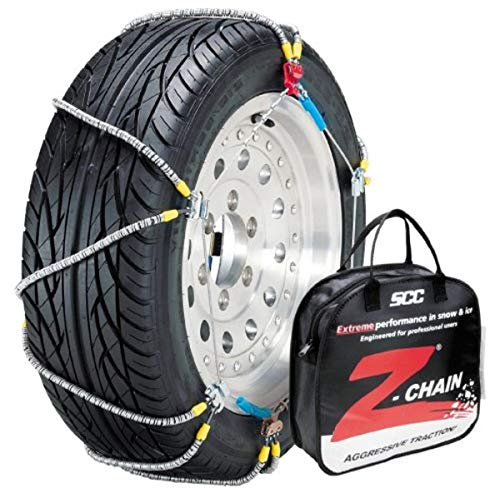
Meets class S clearance and needs no separate tensioners, which removes the two things that go wrong with chains: not being allowed to fit them, and fitting them loose. The trade is that a cable chain bites less than a link chain.
Best for: Fitting without tensioners
What the maker publishes
- Type
- Cable chain, Z pattern
- Clearance
- Meets class S clearance requirements on normal passenger cars, per the maker
- Tensioners
- None required
- Fitting
- Installs without moving the vehicle
- Cross members
- Manganese alloy
- Quantity
- Set of 2
- Included
- Illustrated instructions, gloves and a storage bag
What works
- Class S is the exact phrase most owner manuals use, so this is checkable against your manual rather than guessable
- No tensioners means nothing extra to buy, and nothing loose to scratch an alloy wheel
- Gloves in the box is a small thing that tells you the maker has fitted these in the cold
What doesn't
- A cable chain gives less bite in deep snow than a link chain - the clearance advantage costs traction
- Cables wear faster than link chains on any bare pavement
- A set of 2 covers the drive axle only; if your manual asks for four you need two sets
Skip this if: your vehicle has generous clearance and you want maximum bite. A link chain does more where it fits.
4. Best bite for a car
SCC 0155005 Auto-Trac Tire Traction Chain, Set of 2
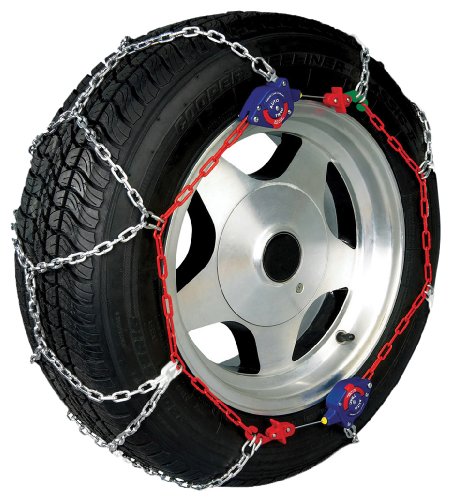
The same self-tightening Auto-Trac design cut for car tire sizes. For a sedan that sees a chain-control road two or three times a winter, this is the sensible version.
Best for: Passenger cars
What the maker publishes
- Fitting
- No jacking required, per the maker
- Tightening
- Ratcheting self-tightening system
- Fits
- Passenger car tire sizes - check the chart
- Quantity
- Set of 2
- Clearance required
- Not published - check your owner manual
What works
- Self-tightening, same as the SUV version, without paying for truck-sized chain
- Set of 2 is the normal fitment for a front- or rear-drive car
What doesn't
- Does not publish a clearance figure the way the Super Z6 does, so the manual is your only check
- Link chains are bulkier to store than cables
Skip this if: your owner manual specifies a minimum clearance you cannot confirm this chain meets. Buy the Super Z6, which publishes its figure.
Questions people actually ask
Are snow socks as good as snow chains?
In loose snow they are close, and they fit in a fraction of the time. On sheet ice chains bite harder, and on bare pavement socks wear out rapidly while chains survive it. Socks trade durability and ice grip for fitment and ease.
Can I use snow socks if my car cannot take chains?
Usually yes, because socks add the thickness of fabric rather than metal links, so they fit in wheel wells that cannot clear a chain. Confirm it against your owner manual rather than assuming it.
How long do snow socks last?
A season or two of occasional use if you keep them on snow. Driving them on clear pavement consumes them quickly - they are a textile against asphalt, and the asphalt wins.
Do snow socks work on ice?
Less well than chains. Fabric grips loose snow well but cannot bite into a hard icy surface the way metal cross members do. If ice rather than snow is your normal condition, chains are the right purchase.
How fast can you drive with snow socks or chains?
Both publish a low speed limit on the packaging, well below highway speed. Exceeding it is how chains come apart and socks shred. Remove either as soon as the road is clear.
Are snow socks legal where chains are required?
It varies by jurisdiction and by the specific chain-control level in force, so check the local rule rather than assuming an equivalence. Some areas accept approved textile devices and some require metal.