Emergency Kits, Traction & Recovery
The Best Traction Mats for Snow
A mat that gives you less than one wheel revolution of grip usually gives you nothing. Here is the arithmetic, and which mats publish enough to check it.
Heads up: we earn a commission if you buy through the links on this page, at no extra cost to you. It never changes a ranking - here is how we pick and how the site is funded.
Quick picks
The short answer, before the detail. Tap any row to jump to that write-up, or go straight to the listing to check today's price.
| # | Product | Best for | Price |
|---|---|---|---|
| 1 |  JOJOMARK 39 in matsTwo 39 in tracks is the sensible default. Length is what matters: a short mat gives one wheel rotation of grip, which is often one rotation short. | Best overall | $69.99 - Check on Amazon |
| 2 |  VEVOR 10-ton boardsPublishes a 10-ton rating and a material. In a category full of unrated plastic, a printed load figure is the reason to choose one board over another. | Best load rating | $50.31 - Check on Amazon-10% |
| 3 |  M-AUTO 32 in coilableCoils up instead of stacking, and publishes a 7.7 ton load figure. If rigid boards will not fit your trunk, this is the compromise that keeps a real rating. | Best for storage | $28.89 - Check on Amazon |
| 4 | 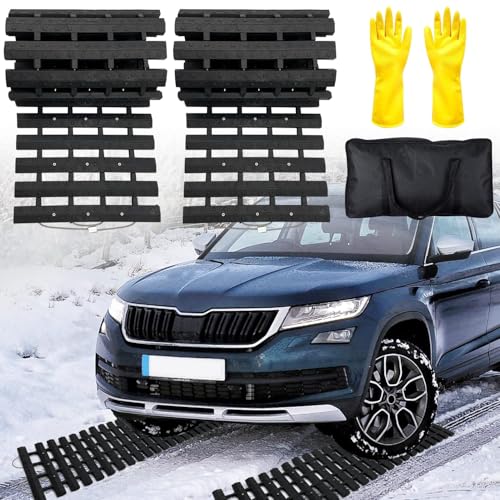 EVTIME 39.3 in matsBoth numbers are on the listing - 39.3 in long and 10.8 in wide - which is rarer in this category than it should be. Length is what buys you more than one wheel revolution of grip, and width is what stops the tire walking off the side. | Best published width | $69.99 - Check on Amazon |
| 5 |  TACMOLLE boardsShips with a mounting kit, which solves the real problem with full-size boards: they are filthy after one use and nobody wants them back inside the car. | Best if you can mount them outside | $129.00 - Check on Amazon |
| 6 |  MLG 22.2 in folding matThe three-fold design packs small, and that is the entire case for it. At 22.2 in long it gives you roughly a quarter of one wheel revolution, which is a nudge rather than a recovery. | Skip this one | $19.99 - Check on Amazon |
Buy mats at least 39 in long, in pairs, and prefer any that publishes a load rating. A typical car tire covers roughly 78 in of ground per revolution, so a 39 in mat gives you about half a turn of grip - enough to reach ground that holds. A 13 in mat gives you a nudge.
The arithmetic nobody does
A traction mat works by giving the tire something with grip to push against long enough to build momentum. So the question is not whether the mat has grip - they all do - but whether it is long enough for the tire to still be on it when the car is moving.
A common passenger tire is around 25 in in diameter, which makes its circumference roughly 78 in. That is how far the car travels in one full turn of the wheel.
Buy them in pairs. A normal front- or rear-wheel-drive car needs one under each driven wheel, and a single mat under one wheel means an open differential sends the power to the other one anyway.
Load rating, and who publishes it
The second specification worth having is a load rating, because it is what separates a board that bridges a rut from one that folds into it under the weight of the car.
Two of the products here publish a figure - 10 ton and 7.7 ton respectively - and the rest do not publish anything. That is the whole reason those two rank where they do. In a category full of unmarked plastic, a printed number is the differentiator.
Rigid boards against flexible mats
- Rigid boards. Bridge a rut rather than sinking into it, which is exactly what you want in a deep hole. They are bulky and they are a permanent trunk commitment.
- Flexible mats. Roll or coil for storage, so they fit in a footwell. They conform to the ground rather than bridging it, which means in a deep rut they sink with you.
- The choice: if you get stuck on a flat suburban street under snow, flexible is fine and stores better. If you get stuck in ruts, ice or off pavement, rigid is the one that works.
Using them without hurting anybody
- Clear snow from in front of the driven wheels first. The mat needs to sit against the tire, not on top of six inches of snow.
- Push each mat as far under the tire as you can, textured side up, angled slightly so the tire climbs onto it rather than pushing it away.
- Straighten the steering. Angled front wheels shove mats sideways.
- Pull away gently in the highest gear that will move the car. Low gear plus throttle spins the tire and fires the mat backwards.
- Do not stop as soon as you are moving. Keep going to ground that grips - that is the whole point of the momentum.
- Go back for the mats. They will be somewhere behind the car.
Do notstand behind a wheel that is on a traction mat
A spinning tire fires a mat backwards with real force. Everybody who is not driving stands well clear and to the side, never in line with the wheel. This is the one genuine injury risk in this whole guide.
Mats, socks or chains
Different tools for different problems. Mats are a recovery tool - you use them once to get moving and then pick them up. Snow socks and chains are driving aids you fit and keep on.
If your problem is getting out of a driveway once a winter, mats. If it is driving a mountain road under a chain-control sign, mats are not what the sign is asking for - see traction mats vs snow chains.
Why the small combo is ranked last
The 13 by 6 in mat-and-scraper is genuinely handy and it is the only traction product here that fits in a cabin. It is also a sixth of a wheel revolution. It buys you a nudge onto ground you could probably have reached anyway.
It is a fine supplement to real mats. As your only traction aid it is the product most likely to leave you still stuck, having believed you were prepared.
The picks, one at a time
We haven't tested these
No lab, no borrowed units, no free samples. What we did do: pull every published spec into one table and work out what the numbers mean on a cold morning. Everything below traces to a published spec sheet, a manual, or a standard we can point you at - and if a figure isn't published, we say so instead of estimating it. The full method is here.
1. Best overall
JOJOMARK Tire Traction Mats, 2-Pack, 39 in
Two 39 in tracks is the sensible default. Length is what matters: a short mat gives one wheel rotation of grip, which is often one rotation short.
Best for: Most stuck cars
What the maker publishes
- Length
- 39 in each
- Quantity
- 2
- Surfaces
- Snow, ice, mud, sand
- Load rating
- Not published by the maker
- Material
- Not published by the maker
What works
- 39 in gives more than one wheel revolution of grip, which is usually the difference between moving and digging deeper
- Two mats covers the two driven wheels, which is what you need on a normal front- or rear-drive car
- Works in mud and sand too, so it is not a three-month-a-year purchase
What doesn't
- No published load rating, and load rating is what stops a mat folding under a heavy vehicle
- No published material
- Mats fire out backwards under a spinning wheel - stand clear, always
Skip this if: you drive something heavy. Buy mats that publish a load rating.
2. Best load rating
VEVOR Traction Boards, 10 Ton Rated, Pair
Publishes a 10-ton rating and a material. In a category full of unrated plastic, a printed load figure is the reason to choose one board over another.
Best for: Heavy vehicles
What the maker publishes
- Load rating
- 10 ton, per the maker
- Material
- PP (polypropylene)
- Quantity
- Pair
- Extras
- Storage bag
- Length
- Described as long - see the listing
What works
- A published load rating is the single most useful spec here and most competitors omit it
- Rated for trucks, SUVs and RVs rather than just cars
- Comes with a bag, which sounds trivial until you put a muddy board in a clean trunk
What doesn't
- Full-size recovery boards are bulky - this is a permanent trunk commitment
- More board than a front-drive sedan on a suburban street will ever need
Skip this if: you drive a car and get stuck in your own driveway. The 39 in mats do that job in a fraction of the space.
3. Best for storage
M-AUTO Coilable Snow Tire Traction Mats, 32 in, 7.7 Ton
Coils up instead of stacking, and publishes a 7.7 ton load figure. If rigid boards will not fit your trunk, this is the compromise that keeps a real rating.
Best for: Storing flat
What the maker publishes
- Length
- 32 in
- Load rating
- 7.7 ton, per the maker
- Storage
- Coilable, with a bag
- Surfaces
- Mud, snow, ice, sand
- Material
- Not published by the maker
What works
- A published load rating in a flexible mat, which is unusual
- Coiling means it stores in a footwell rather than eating the trunk floor
What doesn't
- Flexible mats conform to a rut rather than bridging it, which is exactly the wrong behavior in a deep hole
- 32 in is on the short side
Skip this if: you get stuck in deep ruts. A rigid board bridges; a flexible mat sinks with you.
4. Best published width
EVTIME Tire Traction Mats, 39.3 x 10.8 in, Set of 2
Both numbers are on the listing - 39.3 in long and 10.8 in wide - which is rarer in this category than it should be. Length is what buys you more than one wheel revolution of grip, and width is what stops the tire walking off the side.
Best for: Published dimensions
What the maker publishes
- Length
- 39.3 in
- Width
- 10.8 in
- Quantity
- 2 mats
- Grip surface
- Tungsten steel studs on the ground-facing side, per the maker
- Includes
- Carry bag and a plastic glove
- Load rating
- Not published by the maker
What works
- Publishes length and width, so you can check it against the roughly 78 in a tire travels in one revolution
- Tungsten studs on the underside are the part that stops the mat sliding instead of the tire
- A bag matters more than it sounds - these come back covered in the mud you just escaped
What doesn't
- No published load rating, which is the spec that separates a board that bridges a rut from one that folds into it
- 39.3 in is a little over half a wheel revolution, so this is a nudge to better ground rather than a ramp
- Steel studs will mark a soft driveway surface
Skip this if: you need to bridge a genuine hole or carry a loaded truck. Buy a rated recovery board.
5. Best if you can mount them outside
TACMOLLE Traction Boards with Mounting Kit, 2-Pack
Ships with a mounting kit, which solves the real problem with full-size boards: they are filthy after one use and nobody wants them back inside the car.
Best for: Mounting them outside the vehicle
What the maker publishes
- Quantity
- 2
- Mounting
- MOLLE panel mounting kit included
- Surfaces
- Sand, mud, snow
- Load rating
- Not published by the maker
- Dimensions
- Not published by the maker
What works
- External mounting keeps a muddy board out of the cabin, which is why so many boards end up unused
- Two boards out of the box
What doesn't
- External mounting means a rack or a bed, so it does not apply to most cars
- No published load rating or dimensions
- Mounted outside, they are visible and stealable
Skip this if: you drive a sedan. There is nowhere to mount these and they will live in your trunk covered in mud.
6. Skip this one
MLG Tools Foldable Auto Traction Mat, 22.2 x 7.1 in, Set of 2
The three-fold design packs small, and that is the entire case for it. At 22.2 in long it gives you roughly a quarter of one wheel revolution, which is a nudge rather than a recovery.
Best for: Nothing we would recommend it for
What the maker publishes
- Length
- 22.2 in
- Width
- 7.1 in
- Thickness
- 0.4 in
- Quantity
- 2 mats
- Material
- PP, three-fold design
- Load rating
- Not published by the maker
What works
- Folds into three, so it genuinely fits where a 39 in board does not
- Cheap enough to be an impulse purchase rather than a decision
What doesn't
- 22.2 in is the shortest mat here by a wide margin - against roughly 78 in of ground travel per wheel revolution, that is about a quarter turn
- 7.1 in wide is narrower than a passenger car tire, so the tire can walk straight off the side of it
- 0.4 in of folding PP is thin for the job, and no load rating is published to argue otherwise
Skip this if: you are buying traction mats at all. Spend the small difference on the 39.3 in pair - length is the product.
Questions people actually ask
Do traction mats really work in snow?
Yes, if they are long enough. A mat needs to keep the tire on it long enough to build momentum, and a typical car tire travels about 78 in per revolution - so a 39 in mat gives you roughly half a turn of grip and a 13 in one gives you a nudge.
How long should traction mats be?
At least 39 in, bought in pairs so there is one under each driven wheel. Shorter mats work on firm ground under thin snow, but the whole point is having grip for long enough to reach a surface that holds.
Are traction boards better than traction mats?
Rigid boards bridge a rut instead of sinking into it, which matters in a deep hole or off pavement. Flexible mats store far better and are fine on a flat street under snow. The right answer depends on where you actually get stuck.
How do you use traction mats to get unstuck?
Clear snow from in front of the driven wheels, push each mat firmly against the tire with the textured side up, straighten the steering, then pull away gently in the highest gear that will move the car. Do not stop until you reach ground that grips.
Is it dangerous to use traction mats?
The one real risk is standing behind a driven wheel. A spinning tire fires a mat backwards with considerable force, so anybody not driving should stand well clear and to the side, never in line with the wheel.
Sources
- Amazon listing - JOJOMARK traction mats, 2 x 39 in
- Amazon listing - VEVOR traction boards, 10 ton rated
- Amazon listing - M-AUTO coilable traction mats, 7.7 ton
- Amazon listing - EVTIME traction mats, 39.3 x 10.8 in
- Amazon listing - TACMOLLE traction boards with mounting kit
- Amazon listing - MLG Tools foldable traction mat, 22.2 x 7.1 in