Emergency Kits, Traction & Recovery
AutoSock HP697 Review
It is a textile sleeve that goes over a tire, it costs about as much as a set of chains, and in the places chains are mandatory it is often the only fabric device accepted. Both of those facts need explaining.
The HP697 is the right buy if you need a traction device you can fit in two minutes on a slushy roadside, your car cannot take chains, or you drive where a specific approval is demanded. If none of those is true, a sock at half the price does the same job on the same number of snowy mornings, and a set of chains does more.
We rank the HP697 first in the snow sock roundup, and it is the most expensive thing on that page by a distance. A roundup entry has room for a verdict and a spec table. This page is for the question that verdict leaves open: what exactly are you paying double for?
What it is, physically
A pair of fabric sleeves that pull over the driven wheels. There is no metal in them, no tensioner, no chain links. The textile grips snow and ice mechanically by wicking the thin water film that makes ice slippery, and the fit is a stretch fit - the sock is sized to the tire, not adjusted to it.
That is the whole design, and it explains both the appeal and the limits. Nothing rigid means nothing to foul a tight wheel arch, which is the reason a sock is often the only option on a car whose manual prohibits chains. It also means nothing to bite into packed ice the way a link chain does.
The HP number is the size, and it matters more than the brand
This is the part that goes wrong most often. AutoSock does not sell one product with size options; it sells a family of part numbers, each cut for a range of tire sizes. HP697 is one of several passenger-car codes - HP685, HP695, HP698 and others exist alongside it, and the commercial AL-series is a different range again for trucks.
You cannot buy the popular one and hope. The code has to match the tire size written on your sidewall - the 225/45R17-style string, not the wheel diameter and not the model of the car. Fit a code that is too small and it will not go on with cold hands; too large and it moves on the tire.
Every one of the passenger codes is listed at the same price, which is useful: there is no cost penalty for buying the correct size, so there is no excuse for guessing.
What the money actually buys
- A standards claim you can point at. Its listing is the only one in the category that states the product has met or surpassed traction laws internationally. The honest limit of that claim is that it names no certification number you could go and look up. Our socks versus chains page covers why that matters more than the traction difference for most drivers.
- Fitting speed, which is the real-world advantage. A sock goes over the top of the tire, you roll the car forward a few feet, and you pull the rest over. Two minutes per wheel, standing up, no tensioning, no lying in slush. Chains are a different experience in the dark.
- Bulk and weight that fit a trunk. A pair packs down to about the size of a folded jacket. Chains for the same car are heavy, sharp and want a box.
- Nothing rigid near the bodywork. On a car with limited clearance this is not a preference, it is the only legal option - and it is the first thing to check in the manual, as the chains page says at length.
The limits, stated plainly
- Speed is capped low. These are a get-you-there device for the snowy section, not something to drive a highway on. The limit is printed on the packaging rather than in the listing - read it and treat it as a rule.
- Dry pavement destroys them. Fabric on tarmac wears fast. Every mile of clear road you drive on a fitted sock is a mile off its life, which is the practical difference between a sock and a chain you forgot to remove.
- Deep ruts and packed ice favor chains. Textile grip is good on snow and surprisingly good on smooth ice. It does not dig.
- Driven wheels only, in pairs. A pair is two socks, not four, and on an all-wheel-drive car the question of which axle to fit is a manual question - the AWD page goes into it.
- They are a consumable. Budget for replacing them after a few real deployments, not for owning them forever.
Do notbuy a sock as an alternative to winter tires
A traction device is for a specific bad stretch of road - a hill, a pass, an unplowed side street. Winter tires change how the car behaves everywhere, all season, including braking, which no sock or chain does. If your winters are consistently severe the tires are the purchase and the socks go in the trunk behind them.
When to buy something else instead
The honest case against the HP697 is the ISSE sock, which we rank second in the roundup at roughly half the money. If nobody is going to ask you for an approval, and your use case is two or three bad mornings a winter on a suburban hill, the cheaper sock covers it. The spec sheets in this category are closer than the prices suggest, something we found uncomfortably literally when writing that page.
The other case is chains. If your manual permits them, if you face packed ice and ruts rather than snow, and if you do not mind fitting them, a set of cable chains gives more bite for less money. That trade is laid out in full on socks versus chains.
The verdict
The HP697 earns its place at the top of the roundup on approval and on fitting speed, not on grip per dollar. If you need a device that is accepted where devices are required, or your car cannot take chains, or you would rather spend two minutes standing than ten minutes kneeling in slush, this is the one to buy - in the part number that matches your sidewall, which is the only decision on this page you can get wrong for free.
What to buy, and what to skip
We haven't tested these
No lab, no borrowed units, no free samples. What we did do: pull every published spec into one table and work out what the numbers mean on a cold morning. Everything below traces to a published spec sheet, a manual, or a standard we can point you at - and if a figure isn't published, we say so instead of estimating it. The full method is here.
Heads up: we earn a commission if you buy through the links on this page, at no extra cost to you. It never changes a ranking - here is how we pick and how the site is funded.
1. Reviewed here
AutoSock HP697 Snow Socks for Passenger Vehicles, Pack of 2

The only sock here whose listing makes a road-standards claim - it states that AutoSock has met or surpassed traction laws internationally. In a category whose entire purpose is being allowed where chains are required, that is the spec that matters most.
Best for: Chain-control roads
What the maker publishes
- Quantity
- Pack of 2
- Fits
- Sold by exact tire size - the listing publishes its compatible sizes
- Standards
- Stated to meet American and European road standards, per the maker
- Installation
- 3-step, stated as minutes
- Storage
- Folds flat, reusable
- Metal parts
- None
What works
- A published road-standards claim is the one thing that decides whether you can legally use a sock where chains are posted - nothing else here makes that claim
- The listing publishes its exact compatible tire sizes rather than asking you to read a chart elsewhere
- Folds flat, so it takes a fraction of the trunk space a set of chains does
What doesn't
- The most expensive passenger option on this page, and by a clear margin over the cheapest
- Standards claims are stated generally rather than naming a specific certification number you could look up
- Textile against bare pavement wears fast - this is a snow-only device whatever the brand
Skip this if: you never face a chain-control sign. If this is purely about getting up your own driveway, cheaper socks do that job.
2. The cheaper alternative
ISSE Classic Snow Socks for Tires, Textile Chain Replacement
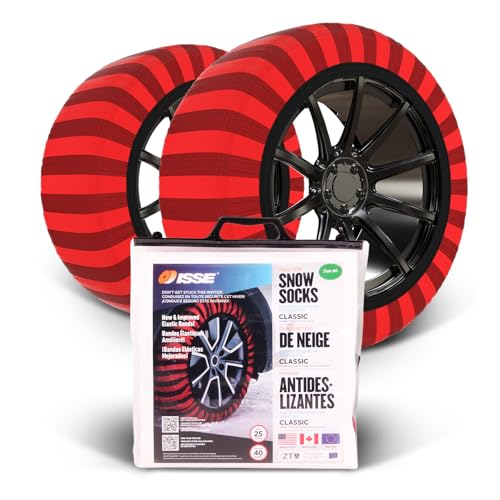
Publishes a two-year guarantee and a three-minute install, and costs substantially less than products carrying word-for-word identical specifications. On the evidence of the listings themselves, this is the value buy in the category.
Best for: The most sock for the money
What the maker publishes
- Guarantee
- 2 years, per the maker
- Fabric
- Tribologic braiding, stated as 8x stronger than iron
- Installation
- 3 minutes, no tools or assistance needed
- Metal parts
- None - quiet, no vibration
- Fits
- Sold by exact tire size - the listing publishes its fitment list
- Road-standards claim
- Not published by the maker
What works
- A published two-year guarantee is unusual on a consumable traction device
- Substantially cheaper than other brands publishing identical specifications, which is the clearest value signal available here
- No metal parts at all, so no vibration, no noise and nothing to mark an alloy wheel
What doesn't
- Makes no road-standards or legal-acceptance claim, which matters if you face posted chain controls
- The 8x stronger than iron figure is a fabric-filament comparison, not a statement about the finished sock
- Stock tends to be thin on individual sizes, so the size you need may not be the one in stock
Skip this if: you need a device accepted where chains are required. Buy the one that makes the standards claim.
3. If chains are allowed
SCC Super Z6 SZ143 Cable Tire Chain, Set of 2
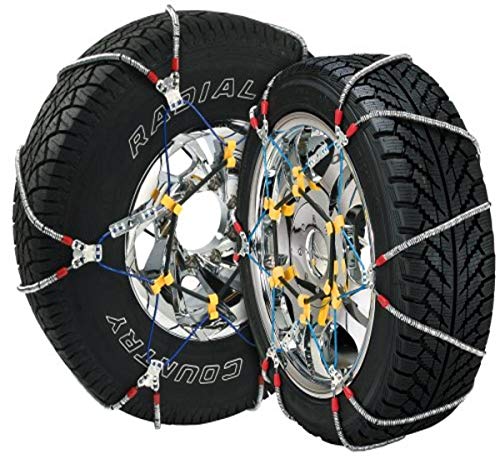
The one that publishes the number the manual asks you for. Super Z6 states it needs only 0.25 in of sidewall clearance, which is what makes it fittable on cars where the owner manual rules out conventional chains.
Best for: Cars with tight wheel-well clearance
What the maker publishes
- Clearance required
- 6.35 mm (0.25 in) of sidewall clearance, per the maker
- Type
- Cable chain, low profile
- Fits
- Passenger cars, pickups and SUVs - by tire size
- Quantity
- Set of 2
- Speed limit
- Follow the product instructions - cable chains are low-speed
What works
- A published clearance figure is the single most useful spec in this category, because clearance is what decides whether you are allowed to fit chains at all
- Low-profile cable construction is what makes that clearance number possible
- Covers cars, pickups and SUVs across the size range
What doesn't
- Cable chains give less bite than heavy link chains in deep snow - the clearance advantage costs traction
- Cables wear faster than link chains on any bare pavement
- Still requires your exact tire size from the sidewall, not the door sticker
Skip this if: your vehicle has generous clearance and you want maximum traction. A link chain bites harder and lasts longer.
Questions people actually ask
Is the AutoSock HP697 worth the money?
It is if you need a traction device accepted where devices are required, your car prohibits chains, or fitting speed matters to you - two minutes a wheel standing up, no tensioning. If none of those applies, a sock at roughly half the price covers the same few snowy mornings.
How do I know which AutoSock size I need?
Match the part number to the tire size string on your sidewall, not to the car model or the wheel diameter. HP697 is one of several passenger-car codes, and they are all listed at the same price - so there is no cost reason to guess.
How fast can you drive with snow socks on?
Slowly. Snow socks are a low-speed device for the bad stretch of road rather than a highway run, and the limit is printed on the packaging rather than in the listing - read it before you set off. Every mile on clear pavement also wears the fabric noticeably.
Do snow socks work on ice?
Better than people expect on smooth ice, because the textile wicks away the thin water film that makes ice slippery. What they cannot do is dig into packed ice and ruts the way a link chain does.
How long do AutoSocks last?
Treat them as a consumable rather than a permanent purchase. Snow is gentle on them and dry pavement is not, so the life depends almost entirely on how much clear road you drive with them fitted.
Do snow socks go on all four wheels?
They are sold in pairs and fit the driven wheels. On an all-wheel-drive car which axle to use is a question for your owner manual, and it is worth answering before the morning you need them.