De-Icers, Washer Fluid & Wipers
The Best Winter Washer Fluid
One number decides this entire category, and it is printed on the jug. Everything else is packaging.
Heads up: we earn a commission if you buy through the links on this page, at no extra cost to you. It never changes a ranking - here is how we pick and how the site is funded.
Quick picks
The short answer, before the detail. Tap any row to jump to that write-up, or go straight to the listing to check today's price.
| # | Product | Best for | Price |
|---|---|---|---|
| 1 |  Prestone AS253 de-icer fluidPrints a rated melt temperature on the label, which is the whole decision in this category and something most fluids never print. Read the figure off the jug in front of you - published ratings for this line have not been consistent between listings, so the label is the authority, not us. | Best overall | $19.94 - Check on Amazon |
| 2 |  Splash -20F washThe everyday winter fluid sold by the gallon in every parts aisle. Rated around -20F, which covers most of the country most of the time. | Best value | $13.81 - Check on Amazon |
| 3 | 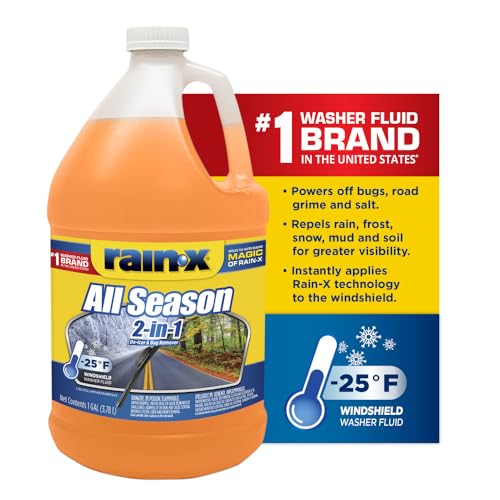 Rain-X -25F 2-in-1The only fluid here that leaves a water-repellent film behind, which is what makes it worth more than a plain winter jug on a wet highway. Sold by the case, so it is a season-at-a-time purchase. | Best for road spray | $59.99 - Check on Amazon |
| 4 | 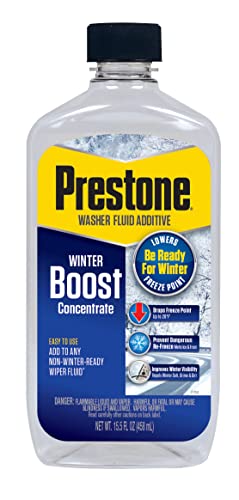 Prestone AS240 boosterThe answer to the specific problem of a reservoir full of the wrong fluid in October. You cannot easily drain a washer reservoir; you can pour a booster into it. Prestone now sells it only by the case, which changes the arithmetic: cheaper per bottle, eleven spare bottles to store. | Best for a full reservoir | $65.99 - Check on Amazon |
| 5 | VariousNo photo Concentrate tabletsTablets dissolve into a reservoir of water and take up almost no shelf space. Read the freeze rating carefully before winter: many are cleaning concentrates with no cold rating at all. | Skip this one | Check price on Amazon |
Buy washer fluid with a printed rated temperature at least 20F below the coldest night you park through. The rating is the only comparable specification in this aisle. Everything else on the label - blue, streak-free, all-season - is packaging.
What goes wrong, and what it costs
Summer washer fluid is mostly water. Water expands when it freezes, and in a winter car it is sitting in three places that all mind: a plastic reservoir, a small electric pump, and thin nylon lines running to the nozzles.
The reservoir is usually the cheapest of the three and often the one that survives. The pump is the one that dies. People replace washer pumps every winter for the sake of a jug of fluid that costs less than a sandwich, and the pump is buried behind a wheel liner, so the labor is worse than the part.
There is a second failure that is more immediate and more dangerous: fluid that freezes on contact with a cold windshield. You pull out behind a salt truck, hit the washer, and the glass goes opaque instead of clear. That happens with under-rated fluid at highway speed, and it happens at the worst possible moment.
Reading the rating
Two practical notes. First, the rating degrades in service: rain and snowmelt find their way into a reservoir and dilute what is in it, so a fluid rated exactly at your typical low will not stay rated there. That is why we suggest 20F of margin rather than matching your coldest night.
Second, a de-icer washer fluid rating is a melt figure, not a magic number. It describes the temperature at which the fluid still clears ice from the glass. It is comparable between products, which is what makes it useful.
Changing over without draining anything
You cannot easily drain a washer reservoir on most cars, and you do not need to. The reservoir holds a few quarts, so the practical method is dilution:
- In September or October, run the reservoir as low as you reasonably can by actually using the washers.
- Top up with a rated winter fluid. Repeat over a couple of weeks and the mix moves steadily toward the winter rating.
- If a hard freeze is forecast and the reservoir is still full of summer fluid, a de-icer booster additive is the fast route - it is what that product exists for.
- Keep a spare jug in the trunk from November. A frozen reservoir in January cannot be fixed with a jug in the garage.
Why the tablets are ranked last
Concentrate tablets are genuinely appealing: a small box replaces a shelf of gallon jugs and there is nothing to carry home. They are also the one product in this section that can leave you meaningfully worse off than doing nothing.
A cleaning tablet dissolved in plain water gives you a reservoir of water with detergent in it. Water freezes at 32F. Unless the specific product is explicitly rated for freezing temperatures - and many are not, and many listings do not say either way - you have just filled your washer system with something that will freeze on the first cold night.
If you want to use tablets, use them in summer. In winter, buy fluid with a number printed on the jug.
Do nottop up a winter reservoir with plain water
It is tempting when the fluid runs low and the store is shut. It is also how a reservoir cracks, and adding water to a rated fluid destroys the rating you paid for. If you have nothing else, drive without washers rather than filling with water.
While you are under the hood
Washer fluid and wiper blades fail together, because they are the same system doing the same job. If the fluid is being replaced because visibility is bad, the blades are usually the other half of the problem - the winter wiper blade picks are here, and winter vs all-season fluid goes deeper on whether the changeover is worth it at all.
And if you came here after searching for de-icer and are not certain this is the product you meant, de-icer spray vs de-icer washer fluid sorts the two apart - they share a name and almost nothing else.
The picks, one at a time
We haven't tested these
No lab, no borrowed units, no free samples. What we did do: pull every published spec into one table and work out what the numbers mean on a cold morning. Everything below traces to a published spec sheet, a manual, or a standard we can point you at - and if a figure isn't published, we say so instead of estimating it. The full method is here.
1. Best overall
Prestone AS253 De-Icer Winter Windshield Washer Fluid, 1 Gallon
Prints a rated melt temperature on the label, which is the whole decision in this category and something most fluids never print. Read the figure off the jug in front of you - published ratings for this line have not been consistent between listings, so the label is the authority, not us.
Best for: The one number that matters
What the maker publishes
- Rated temperature
- Printed on the label - check the jug, reported figures vary between listings
- Volume
- 1 gallon
- Type
- Pre-mixed de-icer washer fluid
- Active ingredient
- See the product label and SDS
- Water-repellent additive
- None claimed
What works
- A published rated temperature is the only spec in this aisle worth comparing, and this one prints it
- Pre-mixed, so there is no dilution mistake to make in a cold garage
- Whatever the jug prints, a rated winter fluid sits well below the point where summer blue fluid turns to slush and splits a reservoir
What doesn't
- A printed rating is not a guarantee at any temperature - if your nights go past what the jug says, this is not your fluid
- A gallon jug is heavy and awkward to pour into a cold engine bay without a funnel
Skip this if: your winters are mild and your existing fluid has never frozen. All-season fluid is cheaper and does the same job above freezing.
2. Best value
Splash Original Blue Windshield Wash, -20F, 1 Gallon
The everyday winter fluid sold by the gallon in every parts aisle. Rated around -20F, which covers most of the country most of the time.
Best for: Ordinary cold, at the lowest price
What the maker publishes
- Rated temperature
- -20F, printed on the jug
- Type
- Pre-mixed, 1 gallon
- Brand
- Splash
- Active ingredient
- See the product label and SDS
- Repellent film
- Usually none
What works
- Cheapest way to get a genuine winter rating into the reservoir
- Widely stocked, so restocking mid-season is easy
What doesn't
- A freeze rating is not a de-icing claim - this clears the reservoir side of the problem, not ice already bonded to the glass
- No repellent film, so water still sheets across the glass the way it always did
Skip this if: you park outside somewhere that regularly beats -20F. Buy the rated de-icer fluid instead.
3. Best for road spray
Rain-X All Season -25F 2-in-1 De-Icer and Bug Remover Washer Fluid, 1 Gallon, 6 Pack
The only fluid here that leaves a water-repellent film behind, which is what makes it worth more than a plain winter jug on a wet highway. Sold by the case, so it is a season-at-a-time purchase.
Best for: Road spray and a repellent film
What the maker publishes
- Rated temperature
- -25F, printed on the jug
- Quantity
- 1 gallon x 6
- Repellent film
- Applies Rain-X water beading technology, per the maker
- Also removes
- Bugs and road grime
- Ice performance
- Stated as removing light snow and ice
- Availability note
- Not for sale in California, Texas or Maricopa County, Arizona, per the maker
What works
- The repellent film is the genuine differentiator - water beads and clears instead of sheeting across your eyeline
- -25F is a real printed rating rather than a vague winter claim
- Six gallons covers a whole season of road spray, which is what actually empties a reservoir
What doesn't
- A six-gallon case is a lot of shelf space and a lot of money at once
- Light snow and ice is the maker's own limit - this is a fluid, not a substitute for de-icer on bonded ice
- Not sold in California, Texas or Maricopa County, Arizona, so a large share of readers cannot buy it at all
Skip this if: you live in one of the states it is not sold in, or you want a single jug. Buy the rated de-icer fluid instead.
4. Best for a full reservoir
Prestone AS240 Washer Fluid Booster De-Icer Additive with Dirt Blocker, 15.5 oz, 12 Pack
The answer to the specific problem of a reservoir full of the wrong fluid in October. You cannot easily drain a washer reservoir; you can pour a booster into it. Prestone now sells it only by the case, which changes the arithmetic: cheaper per bottle, eleven spare bottles to store.
Best for: A reservoir already full of summer fluid
What the maker publishes
- Type
- Additive concentrate, not a standalone fluid
- Size
- 15.5 oz per bottle, 12 per case
- Freeze point
- Lowered by at least 20 degrees, per the maker
- Active ingredient
- A blend of ice-melting alcohols, per the maker
- Dosing
- Per the bottle instructions
What works
- Solves the real problem - a full reservoir of summer fluid and a frost warning tonight
- Each bottle is small enough to keep in the trunk as insurance, and by the case it costs less per bottle than the single used to
- The maker does publish a figure for what it does: at least 20 degrees off the freeze point of whatever is already in the tank
What doesn't
- Only sold as a case of twelve now, so the entry cost is many times one bottle and the other eleven have to live somewhere
- That 20 degree figure is relative, not absolute - the freeze point you end up with still depends on what is already in your reservoir, so there is no rated temperature to quote
- Dosing by eye into a half-full tank is guesswork, and this is a category where guesswork is what freezes the pump
Skip this if: your reservoir is nearly empty. Just fill it with a rated winter fluid and skip the arithmetic.
5. Skip this one
Washer Fluid Concentrate Tablets
Tablets dissolve into a reservoir of water and take up almost no shelf space. Read the freeze rating carefully before winter: many are cleaning concentrates with no cold rating at all.
Best for: Storage space
What the maker publishes
- Type
- Solid concentrate, dissolved in water
- Rated temperature
- Varies - many are not rated for freezing at all
- Storage
- Minimal, versus gallon jugs
- Active ingredient
- See the product label
- Dosing
- Per the packet
What works
- Takes a shelf of gallon jugs down to a small box
- No jug to haul home every few weeks
What doesn't
- A tablet dissolved in plain water freezes at roughly the freezing point of water unless the product is specifically rated otherwise, and that is the exact failure that cracks a reservoir
- The freeze rating is the spec that matters and it is frequently absent from the listing
Skip this if: it gets below freezing where you park. This is the one product in this section that can genuinely leave you worse off than doing nothing.
Questions people actually ask
What is the best windshield washer fluid for winter?
One with a printed rated temperature comfortably below your coldest night. Aim for about 20F of margin, because the fluid dilutes through the season as rain and snowmelt get into the reservoir and the rating drops with it.
Can I use summer washer fluid in winter?
No. Summer fluid is largely water, and water expands when it freezes. That cracks reservoirs and kills washer pumps, and it can also freeze on contact with cold glass at highway speed, which turns your windshield opaque at the worst moment.
What temperature washer fluid do I need?
Take your typical coldest overnight temperature and subtract about 20F. That margin covers the dilution that happens naturally over a season and the fact that a windshield at speed is colder than the ambient reading.
Are washer fluid tablets any good in winter?
Usually not. A tablet dissolved in plain water freezes at roughly the freezing point of water unless the specific product is explicitly rated otherwise, and many listings do not state a rating at all. Use them in summer and buy rated fluid for winter.
How do I switch to winter washer fluid?
Run the reservoir down by using the washers, then top up with rated winter fluid, and repeat over a couple of weeks so the mix moves toward the winter rating. If a freeze is imminent and the tank is full, a de-icer booster additive is the fast route.