De-Icers, Washer Fluid & Wipers
Winter vs All-Season Washer Fluid
All-season sounds like it covers winter. Whether it does depends entirely on whether there is a number printed on the jug, and often there is not.
All-season fluid is only a winter fluid if it prints a low-temperature rating on the jug. Many do not. If the label has no number on it, treat it as a summer fluid and change over before the first hard freeze - the printed rating is the only comparable specification in this category.
What is actually in each
Washer fluid is water, an alcohol, a surfactant to lift road film, and dye. What separates a summer fluid from a winter one is the proportion of alcohol, because that is what depresses the freezing point of the mixture.
- Summer or bug-remover fluid. Mostly water, heavier on surfactants for insect residue. It freezes at or near the freezing point of water and it is the product that cracks reservoirs.
- All-season fluid. A middle formulation, and the label is the only way to know where it sits. Some print a rating and are genuinely usable in a mild winter. Some print nothing, and the absence of a number is your answer.
- Winter or de-icer fluid. Higher alcohol content, a printed rating, and usually additives intended to help release ice from the glass rather than only resist freezing.
The comparison
The price gap between the two is small enough that it is not really the deciding factor. The deciding factor is that one of them has a number you can check.
What under-rated fluid actually costs
Two failures, one slow and one sudden.
- The slow one: fluid freezes in the reservoir, expands, and cracks the tank or kills the pump. The pump is usually behind a wheel liner, so the labor is worse than the part, and people pay for this every winter to save a few dollars on a jug.
- The sudden one: fluid that has not frozen in the tank freezes on contact with cold glass at speed. You pull out behind a salt truck, hit the washer, and the windshield goes opaque instead of clear. That is the failure that matters.
Changing over without draining
Most cars have no drain for the washer reservoir and you do not need one. Dilution does the job:
- In September or October, run the reservoir low by actually using the washers rather than waiting for it to empty.
- Top up with rated winter fluid and keep doing that. Over a couple of weeks the mix moves steadily toward the winter rating.
- If a freeze is forecast and the tank is full of summer fluid, a de-icer booster additive is the fast route - it exists for exactly this.
- Keep a spare jug in the trunk from November. Fluid in the garage does not help at a rest stop.
One caveat on the booster route: the resulting freeze point depends on what is already in the reservoir, so there is no rated number to quote afterwards. It is a save, not a plan.
Why you want margin, not a match
Fluid dilutes in service. Rain and snowmelt find their way into a reservoir, and every top-up with a slightly different fluid shifts the mix. A fluid rated exactly at your typical low will not stay rated there through February.
A windshield at highway speed is also colder than the ambient thermometer reading, so the fluid meets a colder surface than the forecast suggests. Twenty degrees of margin covers both effects and costs nothing.
The verdict
If your nights go below freezing, buy fluid with a number on the jug. All-season is a marketing category, not a specification, and in this one aisle the specification is right there on the label for anyone who reads it. The picks are in the winter washer fluid roundup.
What to buy, and what to skip
We haven't tested these
No lab, no borrowed units, no free samples. What we did do: pull every published spec into one table and work out what the numbers mean on a cold morning. Everything below traces to a published spec sheet, a manual, or a standard we can point you at - and if a figure isn't published, we say so instead of estimating it. The full method is here.
Heads up: we earn a commission if you buy through the links on this page, at no extra cost to you. It never changes a ranking - here is how we pick and how the site is funded.
1. The rated option
Prestone AS253 De-Icer Winter Windshield Washer Fluid, 1 Gallon

Prints a rated melt temperature on the label, which is the whole decision in this category and something most fluids never print. Read the figure off the jug in front of you - published ratings for this line have not been consistent between listings, so the label is the authority, not us.
Best for: The one number that matters
What the maker publishes
- Rated temperature
- Printed on the label - check the jug, reported figures vary between listings
- Volume
- 1 gallon
- Type
- Pre-mixed de-icer washer fluid
- Active ingredient
- See the product label and SDS
- Water-repellent additive
- None claimed
What works
- A published rated temperature is the only spec in this aisle worth comparing, and this one prints it
- Pre-mixed, so there is no dilution mistake to make in a cold garage
- Whatever the jug prints, a rated winter fluid sits well below the point where summer blue fluid turns to slush and splits a reservoir
What doesn't
- A printed rating is not a guarantee at any temperature - if your nights go past what the jug says, this is not your fluid
- A gallon jug is heavy and awkward to pour into a cold engine bay without a funnel
Skip this if: your winters are mild and your existing fluid has never frozen. All-season fluid is cheaper and does the same job above freezing.
2. The everyday winter option
Splash Original Blue Windshield Wash, -20F, 1 Gallon

The everyday winter fluid sold by the gallon in every parts aisle. Rated around -20F, which covers most of the country most of the time.
Best for: Ordinary cold, at the lowest price
What the maker publishes
- Rated temperature
- -20F, printed on the jug
- Type
- Pre-mixed, 1 gallon
- Brand
- Splash
- Active ingredient
- See the product label and SDS
- Repellent film
- Usually none
What works
- Cheapest way to get a genuine winter rating into the reservoir
- Widely stocked, so restocking mid-season is easy
What doesn't
- A freeze rating is not a de-icing claim - this clears the reservoir side of the problem, not ice already bonded to the glass
- No repellent film, so water still sheets across the glass the way it always did
Skip this if: you park outside somewhere that regularly beats -20F. Buy the rated de-icer fluid instead.
3. If you cannot drain the tank
Prestone AS240 Washer Fluid Booster De-Icer Additive with Dirt Blocker, 15.5 oz, 12 Pack
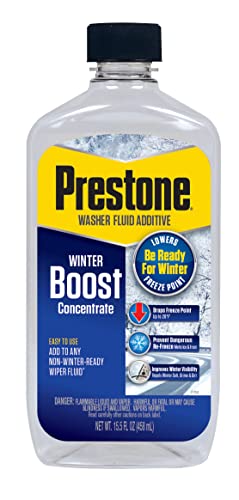
The answer to the specific problem of a reservoir full of the wrong fluid in October. You cannot easily drain a washer reservoir; you can pour a booster into it. Prestone now sells it only by the case, which changes the arithmetic: cheaper per bottle, eleven spare bottles to store.
Best for: A reservoir already full of summer fluid
What the maker publishes
- Type
- Additive concentrate, not a standalone fluid
- Size
- 15.5 oz per bottle, 12 per case
- Freeze point
- Lowered by at least 20 degrees, per the maker
- Active ingredient
- A blend of ice-melting alcohols, per the maker
- Dosing
- Per the bottle instructions
What works
- Solves the real problem - a full reservoir of summer fluid and a frost warning tonight
- Each bottle is small enough to keep in the trunk as insurance, and by the case it costs less per bottle than the single used to
- The maker does publish a figure for what it does: at least 20 degrees off the freeze point of whatever is already in the tank
What doesn't
- Only sold as a case of twelve now, so the entry cost is many times one bottle and the other eleven have to live somewhere
- That 20 degree figure is relative, not absolute - the freeze point you end up with still depends on what is already in your reservoir, so there is no rated temperature to quote
- Dosing by eye into a half-full tank is guesswork, and this is a category where guesswork is what freezes the pump
Skip this if: your reservoir is nearly empty. Just fill it with a rated winter fluid and skip the arithmetic.
Questions people actually ask
Is all-season washer fluid good for winter?
Only if it prints a low-temperature rating on the jug, and many do not. Where there is no number, treat it as a summer fluid and change over before the first hard freeze. The printed rating is the only comparable specification here.
What happens if washer fluid freezes?
It expands, which can crack the reservoir and destroy the washer pump - a part usually buried behind a wheel liner, so the labor costs more than the component. Fluid can also freeze on contact with cold glass at speed, which is the more dangerous failure.
Can I mix winter and all-season washer fluid?
Yes, and dilution is exactly how most people change over. The catch is that the resulting freeze point sits somewhere between the two ratings and there is no way to know precisely where, so keep topping up with winter fluid until the mix is dominated by it.
How much colder should washer fluid be rated than the temperature outside?
About 20F of margin. Fluid dilutes through the season as rain and snowmelt enter the reservoir, and a windshield at highway speed is colder than the ambient reading, so a rating that exactly matches your coldest night will not hold.