Cold Starts, Batteries & Jump Starters
The Best Coolant Testers
Everyone knows weak coolant is a problem. Almost nobody knows that topping up with straight concentrate every autumn creates a different problem - and only one tester here will tell you about it.
Heads up: we earn a commission if you buy through the links on this page, at no extra cost to you. It never changes a ranking - here is how we pick and how the site is funded.
Quick picks
The short answer, before the detail. Tap any row to jump to that write-up, or go straight to the listing to check today's price.
| # | Product | Best for | Price |
|---|---|---|---|
| 1 | 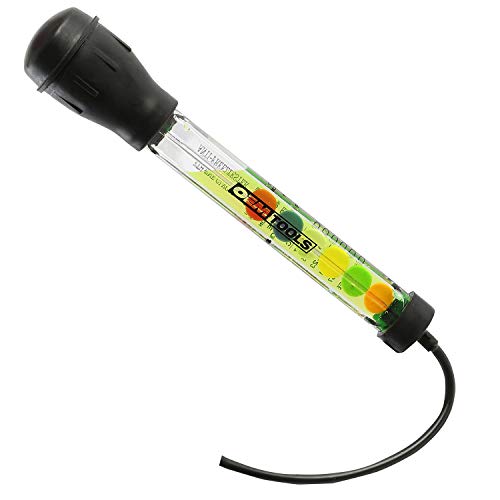 OEMTOOLS ProfessionalThe only tester here that reports the failure nobody expects. Five floating discs means correct protection; a sixth disc tells you the mix is too strong - and too much glycol lowers freeze protection and moves heat worse than a correct mix does. | Best overall | $13.05 - Check on Amazon-10% |
| 2 |  TRZ refractometerPublishes its measuring ranges, which none of the float testers do: ethylene glycol to -84F, propylene glycol to -60F, plus DEF concentration and battery specific gravity. Four jobs, one tool, one drop of fluid. | Best accuracy | $21.90 - Check on Amazon |
| 3 |  ATD Tools 1106Does one job for about twelve dollars and states the compatibility that matters on a GM: all ethylene glycol coolants including Dex-Cool. The shatter-resistant housing is the reason to pick it over the identical-looking bulb testers. | Best value | $12.40 - Check on Amazon |
| 4 |  Robinair test stripsThe only product here that answers the second question. Every float tester tells you the freeze point; these strips read freeze point and pH, and pH is what tells you the corrosion inhibitors are spent - which is what actually destroys a cooling system. | Best for coolant condition | $38.75 - Check on Amazon |
| 5 |  Prestone testerSix dollars from a brand whose de-icer we already recommend, and a listing that publishes nothing at all - no range, no coolant compatibility, no reading method. At this price that may be a fair trade; it is not a tool you can check before buying. | Skip this one | $6.00 - Check on Amazon |
A twelve-dollar tester tells you whether your coolant will still protect the engine at the lowest temperature your winter reaches. Buy a disc tester that also flags an over-rich mix, or a refractometer if you want a number instead of a band - and if the coolant is more than a few years old, test its pH rather than just its freeze point.
Coolant is the only fluid in the car whose failure mode in winter is catastrophic rather than inconvenient. A weak battery costs you a morning. Coolant that freezes in the block cracks the block, and that is the end of the engine.
The good news is that this is the cheapest check on the whole car. The tool costs less than a tank of fuel and the test takes two minutes with the hood open - and unlike the battery test on the battery tester page, you do not need anybody to turn the key.
Why more antifreeze is not better antifreeze
Here is the part that surprises people. Pure ethylene glycol is not the most freeze-proof thing you can put in a cooling system. A roughly even mix of glycol and water protects to far lower temperatures than either liquid on its own, and as you push the concentration past about 70 percent glycol the protection gets worse again, not better.
It also moves heat worse. Water is a far better coolant than glycol; the glycol is there for freeze protection, corrosion inhibition and a higher boiling point. A cooling system running very rich in glycol runs hotter in summer and freezes sooner in winter - the opposite of what the person who topped it up with concentrate intended.
That is why the OEMTOOLS tester leads this page. Five floating discs means correct protection; a sixth disc appears when the mix is too strong. No other tester here reports that at all, and topping up with concentrate is exactly what a careful owner does in autumn.
Three tools, three different questions
A float tester is the fastest and crudest: squeeze the bulb, draw a sample, count what floats. A refractometer puts a drop of coolant on a prism and gives you a number off a scale, which is the most precise reading available at this price. Strips are the only option that reads pH, and pH is the spec that tells you the coolant is chemically finished even though its freeze point still looks fine.
How we judged these
- Does it publish a measuring range? One product here publishes ethylene glycol to -84F and propylene glycol to -60F. Two publish nothing at all, which for a measuring instrument is the whole problem.
- Which coolant chemistries does it cover? Most float testers are ethylene glycol only. If your car uses a propylene glycol coolant, one of these tools is simply the wrong tool and its listing may not say so.
- Does it flag over-protection? The mistake careful owners make, caught by exactly one tester on this page.
- Does it say anything about coolant condition? Freeze point and inhibitor health are different questions and old coolant can pass one while failing the other.
- Will it survive a drawer? This is a tool used twice a year. A shatter-resistant housing is worth more than a tenth of a degree.
How to test it properly
- Test at the reservoir, with the engine cool enough to open safely. Never open a pressurised hot system. The disc-type tester in first place is accurate hot or cold, but you still have to get the cap off without scalding yourself.
- Draw the sample from the mixed coolant in the car, not from the jug. Concentrate reads off the top of every scale and tells you nothing about the engine.
- Compare the reading with your actual winter, not with a round number. Protection to -20F is ample in most of the country and marginal in parts of it.
- Look at the sample as well as the reading. Rust color, oil sheen or floating sediment are findings in their own right, and every clear-bodied tester here lets you see them.
- If it is over-rich, fix it with water, not with more coolant. Draining some and topping up with distilled water moves the mix back toward the middle.
Do notmix chemistries to fix a reading
Coolants are not interchangeable. Pouring a different technology into a system to correct a concentration - an orange long-life into a green conventional, say - can drop the inhibitor package out of suspension and leave you with sludge rather than protection. Adjust concentration with distilled water or with the same coolant you already have.
Freeze point is not the same as healthy
Glycol does not wear out. The additive package that stops it eating the aluminum, the solder and the gaskets absolutely does, typically over a few years, and when it is gone the coolant still tests perfectly on freeze point while quietly corroding the engine from the inside.
That is the argument for test strips, and it is why they are on this page despite costing three times what a float tester does. A strip that reads pH alongside freeze point answers the question you should be asking about five-year-old coolant, which is not whether it will freeze but whether it should be replaced.
The short version
Buy the OEMTOOLS Professional if you want one tool that catches both failures a mix can have - too weak and too strong - and publishes how to read it. Buy the refractometer if you would rather have a number, if your coolant might be propylene glycol, or if reading DEF and battery specific gravity from the same tool appeals. Buy the ATD if twelve dollars and a housing that survives the drawer is the whole specification you need. Buy the strips instead if the coolant is old and the real question is whether to change it. And skip the six-dollar tester whose listing publishes no range, no compatibility and no reading method, because a measuring instrument that will not tell you what it measures is not cheap, it is unusable.
The picks, one at a time
We haven't tested these
No lab, no borrowed units, no free samples. What we did do: pull every published spec into one table and work out what the numbers mean on a cold morning. Everything below traces to a published spec sheet, a manual, or a standard we can point you at - and if a figure isn't published, we say so instead of estimating it. The full method is here.
1. Best overall
OEMTOOLS Professional Series Ethylene Glycol Antifreeze Tester
The only tester here that reports the failure nobody expects. Five floating discs means correct protection; a sixth disc tells you the mix is too strong - and too much glycol lowers freeze protection and moves heat worse than a correct mix does.
Best for: Most drivers
What the maker publishes
- Type
- Floating disc
- Reads
- Coolant freezing point
- Overprotection
- 6th disc indicates too rich a mix, per the maker
- Engine temperature
- Accurate hot or cold, per the maker
- Chart
- Printed on the tester body
- Coolant types
- Ethylene glycol - automotive, diesel, RV, marine
What works
- Overprotection detection is genuinely rare and genuinely useful - people who top up with straight concentrate every autumn end up with a mix that freezes sooner than 50/50, and no other tester here will tell them
- Being accurate hot or cold means you can test without waiting for the engine to cool, which is why the test actually gets done
- Counting discs against a chart printed on the tool needs no interpretation and nothing to remember
What doesn't
- Ethylene glycol only - the wrong tool if your car uses a propylene glycol coolant
- Disc testers read in steps, not degrees, so you get a band rather than a number
- Tells you nothing about whether the coolant's corrosion inhibitors are still working
Skip this if: you want a number rather than a band, or your coolant is propylene glycol. The refractometer covers both.
2. Best accuracy
TRZ 4-in-1 Antifreeze Refractometer, Ethylene and Propylene Glycol
Publishes its measuring ranges, which none of the float testers do: ethylene glycol to -84F, propylene glycol to -60F, plus DEF concentration and battery specific gravity. Four jobs, one tool, one drop of fluid.
Best for: Reading an actual number
What the maker publishes
- Type
- Optical refractometer
- Ethylene glycol range
- -84F to 32F, 0-70% by volume
- Propylene glycol range
- -60F to 32F, 0-63% by volume
- DEF
- Urea concentration 30-35%
- Battery
- Specific gravity 1.100-1.400
- Scale units
- Fahrenheit only, per the maker
What works
- Reads both glycol chemistries, so it is the only tester here that cannot be the wrong tool for your coolant
- Publishes its ranges - you can check before buying that it covers the temperatures you care about, which the float testers do not let you do
- Also reads DEF concentration and battery specific gravity, which is two more winter checks from one $20 tool
What doesn't
- Needs a light source and a moment to read the scale, which is more faff than counting floating discs
- Fahrenheit scale only, per the maker - awkward if you think in Celsius
- Like every tester here it reports concentration, not whether the inhibitor package is exhausted
Skip this if: you want a ten-second answer in a dark driveway. A disc tester is cruder and faster.
3. Best value
ATD Tools 1106 Professional Antifreeze and Coolant Tester
Does one job for about twelve dollars and states the compatibility that matters on a GM: all ethylene glycol coolants including Dex-Cool. The shatter-resistant housing is the reason to pick it over the identical-looking bulb testers.
Best for: A cheap tool that survives the drawer
What the maker publishes
- Type
- Float / bulb hydrometer
- Coolant types
- All ethylene glycol coolants including GM Dex-Cool
- Housing
- Shatter-resistant clear plastic
- Reads
- Antifreeze and coolant condition
- Published range
- Not published by the maker
- Overprotection detection
- No
What works
- Names Dex-Cool specifically, which removes the one compatibility question GM owners actually have
- Shatter-resistant housing matters for a tool that lives loose in a drawer and gets used twice a year
- Cheap enough that having one is a decision you make once
What doesn't
- Publishes no measuring range, so you cannot check in advance that it covers your climate
- No overprotection indication - a too-rich mix reads as fine
- Bulb testers need a reasonably full reservoir to draw a clean sample
Skip this if: you top up with concentrate. Without overprotection detection you will not see the mistake this page exists to catch.
4. Best for coolant condition
Robinair 75134 Econo-Clean Coolant Test Strips, 50 Pack
The only product here that answers the second question. Every float tester tells you the freeze point; these strips read freeze point and pH, and pH is what tells you the corrosion inhibitors are spent - which is what actually destroys a cooling system.
Best for: Deciding whether to replace the coolant
What the maker publishes
- Type
- Dip test strip
- Reads
- Freeze point and pH
- Coolant types
- Propylene glycol and ethylene glycol automotive coolants
- Quantity
- 50 strips
- Interpretation
- Color-coded key on the bottle label
- Vehicles
- Cars, trucks, SUVs, vans, motorcycles, ATVs, snowmobiles
What works
- pH is the spec that separates coolant that is cold-safe from coolant that is still cold-safe but has stopped protecting the metal - no float tester sees it
- Works on both glycol chemistries, so there is nothing to check before you buy
- 50 strips covers every vehicle you own for years, and a strip needs no technique
What doesn't
- Most expensive option here per household, and 50 strips is far more than one car needs
- Consumable - when they are gone the tool is gone, unlike a hydrometer
- Reads a color band, so the freeze point is less precise than a refractometer's number
Skip this if: your coolant is newish and you only want the freeze point. That is a twelve-dollar question, not a forty-dollar one.
5. Skip this one
Prestone Antifreeze and Coolant Tester
Six dollars from a brand whose de-icer we already recommend, and a listing that publishes nothing at all - no range, no coolant compatibility, no reading method. At this price that may be a fair trade; it is not a tool you can check before buying.
Best for: The cheapest possible yes-or-no
What the maker publishes
- Type
- Float tester
- Published range
- Not published by the maker
- Coolant compatibility list
- Not published by the maker
- Reading method
- Not published by the maker
- Overprotection detection
- Not published by the maker
- pH reading
- No
What works
- Cheapest route to any coolant reading at all, and a rough reading beats the guess most people make instead
- Brand you can find in any auto parts aisle if you would rather buy it off a shelf
- Small enough to live in the glovebox with the de-icer
What doesn't
- The listing publishes no specification whatsoever, which for a measuring instrument is the whole problem - you cannot confirm it covers your climate or your coolant
- No overprotection indication and no pH, so it answers the easiest question only
- Twice this money buys a tester that publishes what it does
Skip this if: you are making a decision on the result. For six more dollars the OEMTOOLS tester publishes its method and catches a too-rich mix.
Questions people actually ask
How do I test my car coolant for winter?
Draw a sample of the mixed coolant from the reservoir with the engine cool enough to open safely, and read it with a float tester, a refractometer or a test strip. Compare the result with the lowest temperature your winter actually reaches rather than with a round number.
Can you have too much antifreeze in a car?
Yes, and it is the mistake careful owners make. Past roughly 70 percent glycol the freeze protection gets worse again, not better, and the mixture also carries heat away less well. One tester on this page has a dedicated sixth disc to show an over-rich mix.
Is a refractometer better than a float tester for coolant?
It is more precise and it reads both ethylene and propylene glycol, so it cannot be the wrong tool for your coolant. A float tester is faster and cruder - it gives you a band rather than a number, which is often all the decision needs.
What does a coolant test strip tell you that a hydrometer does not?
pH. Glycol does not wear out but the corrosion inhibitors in it do, and when they are gone the coolant still passes a freeze-point test while attacking the metal in the engine. Strips read freeze point and pH together.
What freeze protection should my coolant have?
Enough to cover the coldest morning your area gets, with margin. Protection to about -20F is ample across most of the country and marginal in the coldest states, which is why the answer is your local winter rather than a single figure.
How often should I check coolant concentration?
Once in autumn is the useful habit, at the same time as the battery test, and again any time you have topped up or had cooling work done. Concentration only changes when something adds or removes liquid.
Sources
- Amazon listing - OEMTOOLS Professional Series Ethylene Glycol Antifreeze Tester
- Amazon listing - TRZ 4-in-1 Antifreeze Refractometer
- Amazon listing - ATD Tools 1106 Professional Antifreeze and Coolant Tester
- Amazon listing - Robinair 75134 Econo-Clean Coolant Test Strips
- Amazon listing - Prestone Antifreeze and Coolant Tester