Emergency Kits, Traction & Recovery
Should You Add Air to Your Tires in Winter?
Yes, but you are not adding extra - you are putting back what the cold took out. About one PSI per ten degrees, measured cold, back up to the number on the door jamb.
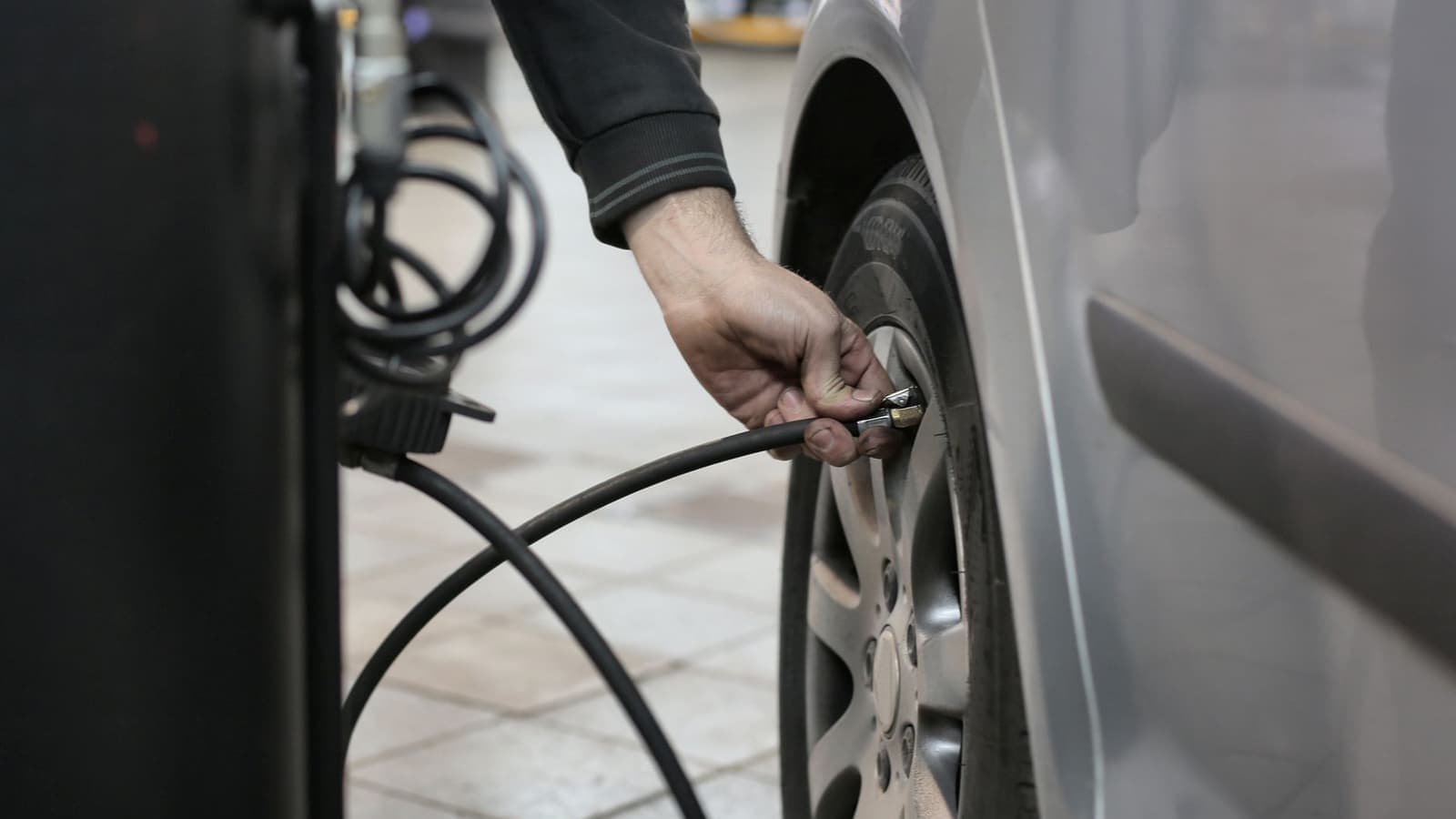
Yes - add air, but not extra air. Tire pressure falls about 1 PSI for every 10F drop in temperature, so an autumn-to-winter swing of 40 to 50 degrees costs roughly 4 to 5 PSI, and the job is putting that back. Inflate to the number on the driver's door jamb, measured on cold tires, never to the number on the tire sidewall and never above the placard figure.
This is the most common winter car question with a precise, checkable answer, and most people get one half of it right and the other half wrong. They know the light comes on when it gets cold. They then either ignore it, or - worse - decide to run a few PSI extra "for winter".
Why it drops, and by how much
Air contracts as it cools. The volume inside a tire is fixed by the tire, so cooling shows up as a drop in pressure rather than a drop in volume. Nothing has leaked.
The rate is consistent enough to be a rule. AAA states that "tire pressure decreases about 1 PSI for every 10-degree Fahrenheit drop in temperature". Michelin publishes the same figure: "on average, tires lose about 1 PSI for every 10F drop in temperature". Consumer Reports works the example through - from a 70F day, a 40 to 50 degree winter drop means "you can expect your tire pressure to drop by 4 to 5 PSI".
Look at the bottom rows. A car set correctly on a mild October afternoon is 6 to 7 PSI down on a hard January morning - which on a 35 PSI placard is 20 percent low. That is not a rounding error; it is a measurable loss of braking, handling and fuel economy, and it is why this is on the winter checklist.
The number to inflate to, and the number to ignore
Inflate to the vehicle placard - the sticker inside the driver's door jamb, which on some cars is on the door edge, the B-pillar or inside the fuel filler flap. AAA: use "the recommended PSI on the placard inside the driver's-side door jamb". Michelin: "follow your vehicle manufacturer's recommended pressure, listed on the driver's door jamb or in the owner's manual".
Ignore the number molded into the tire sidewall. That is the tire's maximum, not your car's recommendation, and it is often 10 to 15 PSI higher. AAA notes that inflating to the sidewall figure can mean "a harsher ride, reduced traction, uneven tread wear, or even a tire blowout".
And do not add a "winter margin" on top of the placard. The placard figure is already a cold-inflation specification - that is what "cold tire pressure" means on the sticker. Setting it correctly when cold is the whole instruction.
"Cold" has a specific meaning here
It does not mean outdoor temperature. It means the tires have not been driven. AAA is precise: "it's best to check pressure when tires are 'cold,' meaning the vehicle hasn't been driven for at least three hours".
Driving heats the air inside a tire and the reading climbs. Two consequences follow, and the second one catches people out constantly:
- Check in the morning, before you drive anywhere. First thing, on the driveway, is the correct condition. A reading taken after a commute is not comparable to the placard number.
- Never bleed warm tires down to the cold figure. Tire Rack makes this point directly: warm tires read higher than they will once they cool, so letting air out to hit the placard number leaves the tire underinflated once it cools. If you must set pressures after driving, set them a couple of PSI above the placard and recheck cold.
Do notlet air out of your tires for snow traction
This is a persistent myth and Consumer Reports tested the reasoning: "keeping your tires at the vehicle manufacturer's recommended pressure is your best bet", and you "should always stick with the manufacturer's tire pressure recommendation". Lowering pressure reduces braking and handling, hurts fuel economy, and risks the tire separating from the wheel. Whatever a forum post says about airing down for a beach, your winter commute is not that.
Why the dashboard light is not your pressure gauge
The TPMS warning is a low-pressure alarm with a wide margin, not a monitor you can tune by. AAA: the light "typically doesn't alert you until a tire is already about 25 percent below the recommended PSI".
On a 35 PSI placard that is roughly 26 PSI. By the arithmetic in the table above, the cold alone will not usually get you there - so a TPMS light in winter usually means the cold drop plus a real leak, and the correct response is to check all four with a gauge rather than to top up the one that complained.
It also means the reverse: no light does not mean correct pressure. A car can sit 4 or 5 PSI low all winter without ever triggering anything.
How we judged the tools
Two separate purchases and they are not interchangeable: something to measurewith and something to inflate with. The gauge is the one that matters, costs almost nothing, and is the one most people do not own.
- Published accuracy, in the units you are working in. You are chasing a 4 to 5 PSI change. A gauge that publishes plus or minus 0.5 PSI tells you something; one that publishes nothing does not.
- Does it name a calibration standard? A stated accuracy with no standard behind it is a claim about a claim. One gauge below names ANSI B40.7.
- Readable and usable in the dark, in gloves. This job gets done at 7am in a driveway in December or it does not get done at all.
- For inflators: where the power comes from. A 12V-only unit needs the car running; a dual-power or cordless one does not. That decides more than the PSI rating does.
The inflator picks here are the two from the full inflator roundup that suit this specific job - a seasonal top-up at home - rather than a roadside flat. If you want the whole category compared on duty cycle and cold performance, that is the page.
The routine, start to finish
- Find your placard figure and write it down. It may differ front to rear.
- Check all four tires plus the spare, first thing in the morning, before driving.
- Inflate each to the placard figure. Not the sidewall figure, not the placard plus two.
- Recheck monthly through the winter - AAA recommends at least monthly and before any long trip, and more often during seasonal transitions.
- If one tire is consistently lower than the others, that is a leak rather than the weather, and it needs a shop rather than a compressor.
Two minutes a month, with a seven-dollar tool. It is the cheapest safety item in the whole trunk, and the only one that also pays you back in fuel.
What to buy, and what to skip
We haven't tested these
No lab, no borrowed units, no free samples. What we did do: pull every published spec into one table and work out what the numbers mean on a cold morning. Everything below traces to a published spec sheet, a manual, or a standard we can point you at - and if a figure isn't published, we say so instead of estimating it. The full method is here.
Heads up: we earn a commission if you buy through the links on this page, at no extra cost to you. It never changes a ranking - here is how we pick and how the site is funded.
1. Best gauge - half-PSI accuracy
Accutire MS-4021B Digital Tire Pressure Gauge, 5-150 PSI

Publishes half-PSI accuracy in half-pound increments and backs it with a five-year warranty - the best published numbers of any gauge we found, on a tool that has been sold essentially unchanged for years.
Best for: The most accurate reading in the category, for twelve dollars
What the maker publishes
- Range
- 5-150 PSI, in 0.5 lb increments
- Accuracy
- Plus or minus 0.5 PSI
- Units
- PSI, Bar, kPa, kg/cm2
- Display
- Large backlit LCD
- Head
- Angled, rubber-coated handle
- Auto-off
- Yes
- Batteries
- LR44 coin cells, replaceable, included
- Warranty
- 5 years parts and labor
- Calibration standard
- Not published by the maker
What works
- Half-PSI accuracy in half-PSI increments is the resolution you need to act on a one-PSI-per-ten-degrees change rather than guess at it
- A five-year warranty on a twelve-dollar tool says something about the expected failure rate
- The angled head reaches a valve stem behind a wheel cover without you having to flatten your hand against a cold tire
What doesn't
- Does not publish the calibration standard behind the stated accuracy, which the cheaper AstroAI does
- LR44 coin cells are the kind of battery nobody has spare in January
- No nozzle light, so you still need a hand free in the dark
Skip this if: you check pressures in an unlit driveway and value the nozzle light more than the half PSI. That is a real trade and it goes the other way.
2. Best cheap gauge, lit nozzle
AstroAI Digital Tire Pressure Gauge, 150 PSI
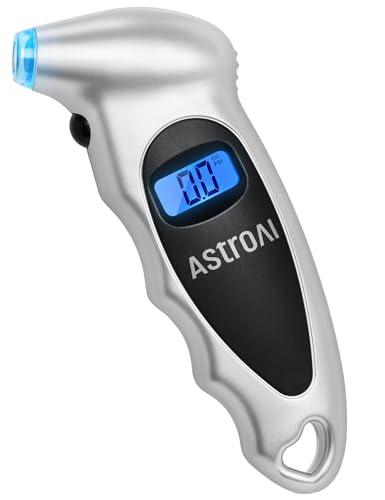
Seven dollars, calibrated to a named standard, with a lit nozzle as well as a lit screen. The nozzle light sounds like a gimmick until you are feeling for a valve stem behind a frozen wheel cover at 6am.
Best for: Checking four tires in a dark driveway in January
What the maker publishes
- Range
- 0-150 PSI
- Accuracy
- Plus or minus 1 PSI, factory calibrated
- Calibration standard
- ANSI B40.7, per AstroAI
- Units
- PSI, Bar, Kgf/cm2, kPa
- Display
- Backlit LCD plus illuminated nozzle
- Auto-off
- 30 seconds
- Batteries
- 2 x AAA, included
- Warranty
- 1-year manufacturer
What works
- Names the calibration standard it was built to, which is rare under ten dollars and is the only way a stated accuracy means anything
- The illuminated nozzle solves the actual winter problem - finding the valve stem in the dark without a third hand for a flashlight
- Replaceable AAA cells rather than a sealed coin cell, so a flat gauge is a two-minute fix
What doesn't
- Plus or minus 1 PSI is twice the error of the better gauges, and you are chasing a 4 to 5 PSI seasonal change
- Auto-off at 30 seconds is brisk when you are working around a car with cold hands
- No bleed valve, so correcting an over-inflated tire means a separate tool or a careful thumb
Skip this if: you want the tightest reading you can buy. A half-PSI gauge costs five dollars more and is the better tool for seasonal checks.
3. Best inflator if you have no outlet at home
AstroAI Tire Inflator Portable Air Compressor, 12V DC / 120V AC, 150 PSI

Runs from the car socket or a wall outlet, which is the difference between inflating in a cold driveway and inflating in a warm garage. It also publishes real inflation rates rather than just a PSI ceiling.
Best for: Winter tire-pressure top-ups
What the maker publishes
- Power
- 12V DC and 120V AC
- Max pressure
- 150 PSI
- Inflation rate
- 0 to 36 PSI in about 5 minutes; 30 to 36 PSI in about 1 minute, per the maker
- Motor
- Dual metal motors
- Gauge
- Digital, with auto shut-off
What works
- Published inflation times, which almost nothing in this category gives you - a PSI ceiling alone tells you nothing about how long you stand there
- AC power means you can top the tires up indoors in January instead of kneeling on a frozen driveway
- Metal motors handle the duty cycle of doing four tires back to back better than all-plastic units
What doesn't
- Bigger and heavier than the 12V-only models, so it is a garage tool more than a glovebox one
- 150 PSI is far beyond what a car tire needs - that headline number is for bike and sports gear
Skip this if: you want something to live in the trunk permanently. The smaller 12V-only units are the ones that fit.
4. Best for a driveway with no power
AstroAI Cordless Tire Inflator, 160 PSI, Battery and 12V Dual Supply
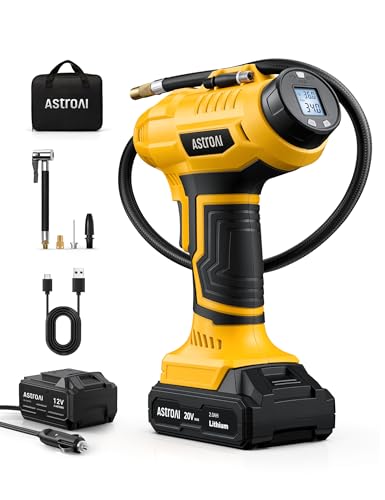
Cordless with a 12V lead as backup. Genuinely useful for a tire you cannot park next to - but it is a lithium battery, and lithium in a cold trunk is the same story as a jump pack.
Best for: Reaching a tire away from the car
What the maker publishes
- Power
- Rechargeable battery plus 12V DC adapter
- Max pressure
- 160 PSI
- Gauge
- Digital, with auto shut-off
- Cold performance of the battery
- Not published by the maker
- Flow rate
- Not published by the maker
What works
- No cord at all for a quick top-up, and the 12V lead is there when the battery is flat
- Highest pressure ceiling here, which is only relevant if you also inflate sports or bike gear
What doesn't
- Lithium loses deliverable output in the cold, which is the exact condition winter tire top-ups happen in - keep it indoors, same rule as a jump pack
- Another thing to remember to charge
- No published flow rate or cold rating
Skip this if: it will live in the car. A corded 12V unit has no battery to be flat or cold when you need it.
Questions people actually ask
Should you add air to your tires in winter?
Yes - to put back what the cold took out, not to add extra. Tire pressure drops about 1 PSI for every 10F fall in temperature, so inflate back up to the figure on the driver's door jamb placard. Do not exceed that figure, and do not use the maximum pressure molded into the tire sidewall.
How much tire pressure do you lose in cold weather?
About 1 PSI for every 10F drop, per AAA and Michelin. Consumer Reports gives the worked example: a 40 to 50 degree drop from a 70F day costs roughly 4 to 5 PSI. From a mild autumn setting to a 0F morning the loss can reach 6 to 7 PSI.
Should you overinflate tires in winter?
No. The placard figure is already specified as a cold inflation pressure, so there is no winter margin to add on top. Overinflating costs you contact patch and ride quality and gains nothing.
When should you check tire pressure in winter?
When the tires are cold - AAA defines that as not having driven the vehicle for at least three hours, so first thing in the morning is ideal. Driving heats the air inside the tire and inflates the reading, and never let air out of warm tires to reach the cold placard figure.
Does the TPMS light mean my tires are low?
It means one is at least about 25 percent below the recommended pressure, which is well past merely low. On a 35 PSI placard that is around 26 PSI. Because cold alone rarely drops a tire that far, a winter TPMS light usually means the cold drop plus a genuine leak - check all four with a gauge.
Should you lower tire pressure for snow traction?
No. Consumer Reports is explicit that keeping tires at the manufacturer's recommended pressure is the best bet, and that lowering pressure reduces braking and handling, hurts fuel economy and risks the tire separating from the wheel.
What pressure should my tires be in winter?
The same as the rest of the year: the figure on the driver's door jamb placard, set when the tires are cold. There is no separate winter number. What changes in winter is how often you have to put air back in to stay at it.
Sources
- AAA - How temperature changes affect your tire pressure
- Michelin - Winter tire timing and PSI tips
- Consumer Reports - Should you lower tire pressure to gain traction in snow?
- Tire Rack - What to do when your tire pressure light is on
- Amazon listing - Accutire MS-4021B digital tire pressure gauge
- Amazon listing - AstroAI digital tire pressure gauge 150 PSI
- Amazon listing - AstroAI dual-power tire inflator
- Amazon listing - AstroAI cordless tire inflator