Cold Starts, Batteries & Jump Starters
The Best Diesel Anti-Gel Additives
A gas engine fails at the battery. A diesel fails at the fuel filter, and it does it at temperatures a gas car shrugs off. The bottle that prevents it costs less than the tow.
Heads up: we earn a commission if you buy through the links on this page, at no extra cost to you. It never changes a ranking - here is how we pick and how the site is funded.
Quick picks
The short answer, before the detail. Tap any row to jump to that write-up, or go straight to the listing to check today's price.
| # | Product | Best for | Price |
|---|---|---|---|
| 1 | 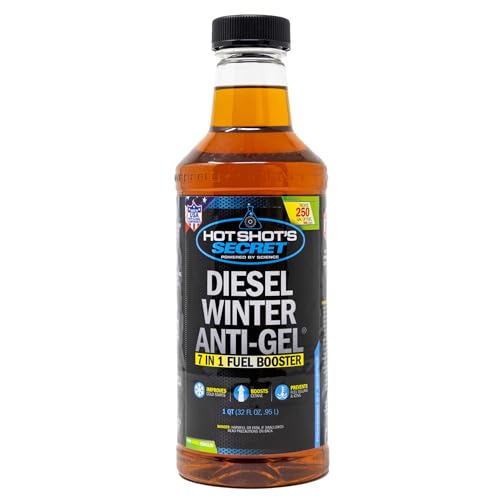 Hot Shot's Secret Winter Anti-GelThe only bottle here that publishes both a temperature and the dose rate that achieves it - 4 oz per 31 gallons, protection to -65F. Every other label either gives you a number with no dose or a dose with no number. | Best overall | $23.39 - Check on Amazon |
| 2 |  STA-BIL Diesel WinterPublishes the number that actually predicts a no-start - it lowers the cold filter plugging point by as much as 36 degrees - and treats 250 gallons per bottle. That combination is the best value in the category. | Best value | $22.74 - Check on Amazon |
| 3 |  Howes Diesel TreatThe cheapest bottle here and the one that makes a point of what it leaves out: it removes water without the alcohols and solvents that other anti-gels use to carry moisture through the system. What it does not do is publish a temperature. | Best without alcohol | $13.99 - Check on Amazon-21% |
| 4 |  Power Service Diesel 9-1-1Not an anti-gel and does not pretend to be. This is the bottle that reliquefies fuel that has already turned and de-ices a frozen filter - the one you want in the truck when prevention did not happen. Buying it instead of an anti-gel is the most common mistake in this category. | For fuel already gelled | $23.38 - Check on Amazon |
| 5 |  Lucas Anti-GelTwice the volume for less money than the 32 oz bottles, and the reason is visible in the listing: it claims to lower the cold filter plugging point without saying by how much, to what temperature, or at what dose. In a category where two competitors publish real numbers, that is the whole argument against it. | Skip this one | $15.99 - Check on Amazon |
Buy an anti-gel that publishes both a protection temperature and the dose that achieves it, add it at the pump before the cold arrives, and keep a bottle of Diesel 9-1-1 in the truck for the morning you forgot. Those are two different products and buying one instead of the other is the most common mistake in this category.
Diesel does not freeze. What it does is worse for your morning: the paraffin wax dissolved in it starts to crystallize, and those crystals collect on the fuel filter until fuel stops passing through. The engine may crank perfectly and still not run, because it is being starved by a filter that looks like a candle.
The temperature at which that happens is not a mystery number. It is called the cold filter plugging point, and untreated winter-blend pump diesel in the US is typically somewhere in the range of 0F to 10F - which is exactly the range where our cold no-start guide says a gas car is still starting fine. That gap is the whole reason this page exists.
The one spec that decides this
Anti-gel additives work by changing how those wax crystals form: smaller crystals, or crystals that stay dispersed instead of clumping, both keep fuel moving through a filter that would otherwise block. Every bottle on this page does some version of that.
What separates them is whether they tell you how far down they take the cold filter plugging point, and at what dose. A bottle that says it protects to a fearsome temperature without stating the dose is not giving you a specification - a heavy enough dose of almost anything moves the number, and the dose is the part that costs you money.
Two of the five publish a temperature. One of the five publishes the dose that produces it. That is the ranking on this page, and it is not a close call.
How we judged these
- Does it publish a protection temperature? Without one you cannot match the product to your climate, and the whole purchase is an act of faith.
- Does it publish the dose for that temperature? A number without a dose is marketing. Treat ratios in this category vary by a factor of four between products.
- Does it remove water or carry it? Water is the other half of the problem - an iced filter and a waxed filter fail identically. Demulsifiers drop water out so it can be drained; some alcohol-based products carry it through instead.
- Is it a preventive or a rescue? Two different jobs, sold in bottles of the same size on the same shelf.
- What does it cost per treated gallon? Not per bottle. A 64 oz bottle at a heavy dose rate can be dearer than a 32 oz bottle at a light one.
The two bottles are not interchangeable
Power Service Diesel 9-1-1 is on this page because a lot of people buy it thinking it is an anti-gel. It is not. Its own listing is clear about what it does: it reliquefies fuel that has already gelled and de-ices a frozen fuel filter. That is a rescue product for a truck that is already stopped.
Pouring it in every autumn as prevention wastes money and leaves you unprotected. Carrying it in the cab while an anti-gel goes in the tank is exactly right - and it is the cheapest roadside insurance a diesel owner can buy, in the same category of thinking as the winter emergency kit you already keep in the trunk.
Do notassume the pump did it for you
Winter-blend diesel is real and stations in cold states do switch over, but the blend is set for the region and for a normal winter, not for the cold snap that closes schools. Nothing at the pump tells you which blend you just bought or what its cold filter plugging point is. Treating the tank is the only part of this you control.
How to actually use it
- Add it before the cold, not during it. An anti-gel changes how wax crystals form. Once they have already formed, prevention has nothing left to prevent - that is what the rescue bottle is for.
- Add it at the pump, into fuel that is flowing. Pouring additive into a full tank in a cold driveway mixes badly. Pour it in first and then fill, or pour it in partway through the fill.
- Dose by the gallons you are adding, not the tank size. Half a tank of untreated fuel plus a full-tank dose is not a full-tank treatment.
- Treat every fill while it is cold. Additive already in the tank does nothing for the forty gallons you just pumped on top of it.
- Change the fuel filter in autumn. A filter with a season of crud on it plugs earlier than a fresh one, whatever is in the tank. This belongs on the winter checklist alongside the battery test.
The water problem nobody mentions
Condensation puts water in every fuel tank, and in a diesel it collects because the fuel sits on top of it. At freezing point that water turns to ice crystals in exactly the place the wax crystals are heading, and the filter blocks for a reason that has nothing to do with gelling.
This is why the listings talk about water at all, and why the distinction between the words matters. A demulsifier makes water separate out so it drops to the bottom of the tank or the filter bowl, where a water separator can catch it and you can drain it. An emulsifier - typically alcohol-based - mixes water into the fuel so it goes through the system in suspension. Both stop the filter icing. Only one of them keeps the water out of your injection pump.
Howes makes a point of its formula containing no alcohol for that reason, and it is a fair point even though the bottle will not tell you a temperature. If your truck has a water-separating filter with a drain, you want water dropping out where you can get at it.
The short version
Buy the Hot Shot's Secret if you want the only bottle here that publishes a temperature and the dose that reaches it, and keep it indoors because its own label says to. Buy the STA-BIL if you would rather have a published number at the best cost per treated gallon. Buy the Howes if keeping alcohol out of the tank matters more to you than a printed figure - a defensible choice, just make it knowingly. Keep a bottle of Diesel 9-1-1 in the cab regardless of which of those you chose. And skip the cheapest jug, because claiming to lower the cold filter plugging point without saying by how much, to what, or at what dose is three blanks where the only real spec belongs.
The picks, one at a time
We haven't tested these
No lab, no borrowed units, no free samples. What we did do: pull every published spec into one table and work out what the numbers mean on a cold morning. Everything below traces to a published spec sheet, a manual, or a standard we can point you at - and if a figure isn't published, we say so instead of estimating it. The full method is here.
1. Best overall
Hot Shot's Secret Diesel Winter Anti-Gel Fuel Treatment, 32 oz
The only bottle here that publishes both a temperature and the dose rate that achieves it - 4 oz per 31 gallons, protection to -65F. Every other label either gives you a number with no dose or a dose with no number.
Best for: Cold that actually gets dangerous
What the maker publishes
- Size
- 32 oz
- Published protection
- -65F, guaranteed, per the maker
- Dose for that figure
- 4 oz per 31 gallons, per the maker
- How it works
- Minimizes wax crystal size so fuel still moves
- Also claims
- Demulsifies water, cleans injectors, improves cold starts
- Minimum storage temp
- 32F, per the maker
What works
- Publishes the dose that produces the published temperature, which is the only way a number on a bottle means anything - a -65F claim at an unstated dose is not a specification
- Demulsifies water rather than emulsifying it, so moisture drops out and can be drained instead of being carried into the injectors
- Names the mechanism - smaller wax crystals - rather than just asserting a result
What doesn't
- Its own label says to store the bottle above 32F, which means the additive cannot live in the truck bed you need it in
- Most expensive per treated gallon of the bottles here
- The guarantee is the maker's own; there is no published third-party test method behind it
Skip this if: you are treating a fleet. The per-gallon cost is the highest here and the cheaper bottles publish real numbers too.
2. Best value
STA-BIL Diesel Winter Anti-Gel Fuel Treatment, 32 oz
Publishes the number that actually predicts a no-start - it lowers the cold filter plugging point by as much as 36 degrees - and treats 250 gallons per bottle. That combination is the best value in the category.
Best for: Most drivers
What the maker publishes
- Size
- 32 oz
- Published protection
- Prevents gelling down to -40F, per the maker
- CFPP improvement
- Lowers cold filter plugging point as much as 36 degrees, per the maker
- Treats
- 250 gallons
- Also claims
- Removes water, cleans injectors
- Dose for the published figure
- Not published by the maker
What works
- The cold filter plugging point is the spec that decides whether your filter passes fuel on a cold morning, and this is one of only two labels here that quotes a CFPP change at all
- 250 gallons per 32 oz bottle is roughly ten fill-ups of a 3/4-ton pickup - the lowest cost per treated gallon of the bottles that publish a temperature
- Widely stocked, so a refill in January is not a special order
What doesn't
- Does not state the dose rate that produces the -40F figure, so you have to read the bottle rather than the listing to treat correctly
- A 36-degree CFPP improvement is relative to whatever your fuel started at, which the pump does not tell you
- No published storage temperature limit either way
Skip this if: you park somewhere that gets past -40F. Buy the bottle that publishes a lower number and the dose that reaches it.
3. Best without alcohol
Howes Diesel Treat Anti-Gel and Diesel Fuel Lubricator, 32 oz
The cheapest bottle here and the one that makes a point of what it leaves out: it removes water without the alcohols and solvents that other anti-gels use to carry moisture through the system. What it does not do is publish a temperature.
Best for: Anyone avoiding alcohol in the tank
What the maker publishes
- Size
- 32 oz
- Published protection temperature
- Not published by the maker
- Water handling
- Removes water rather than emulsifying it, per the maker
- Alcohol
- Formulated without alcohol, per the maker
- Also claims
- Adds lubricity for ULSD, prevents injector deposits
- CFPP improvement
- Not published by the maker
What works
- The no-alcohol position is a real technical difference, not marketing - alcohol carries water through the filter instead of dropping it out, and water is what actually ices a filter
- Cheapest bottle in the category by a wide margin
- Adds lubricity, which matters because ultra-low-sulfur diesel lost much of the lubricity the old fuel had
What doesn't
- Publishes no protection temperature and no CFPP figure - you are buying a reputation rather than a specification
- The listing describes the additive as tested and proven in the coldest weather without saying by whom or to what temperature
- Being the benchmark product for decades is not itself a number you can plan around
Skip this if: you need to know how cold you are protected to. Two bottles on this page publish that; this one does not.
4. For fuel already gelled
Power Service Diesel 9-1-1, 32 oz
Not an anti-gel and does not pretend to be. This is the bottle that reliquefies fuel that has already turned and de-ices a frozen filter - the one you want in the truck when prevention did not happen. Buying it instead of an anti-gel is the most common mistake in this category.
Best for: Fuel that has already gelled
What the maker publishes
- Size
- 32 oz
- Job
- Reliquefies gelled fuel, de-ices frozen fuel filters
- Preventive use
- Not its purpose - buy an anti-gel for that
- Also claims
- Prevents fuel filter icing, contains Slickdiesel Lubricator
- Fuel compatibility
- All diesel fuels including ULSD and biodiesel blends
- Published protection temperature
- Not published by the maker
What works
- It solves the problem the other four bottles only prevent, which makes it the one worth carrying rather than the one worth pouring
- De-icing the filter matters as much as thinning the fuel - a filter iced by water will stop an engine that has perfectly fluid fuel behind it
- Explicitly rated for biodiesel blends, which gel at higher temperatures than straight diesel
What doesn't
- Using it as a routine anti-gel wastes money and does not give you the winter protection you think you bought
- Publishes no temperature figure, because that is not what it is for
- Once fuel has gelled you may also need to change the filter, and no bottle fixes that
Skip this if: you are shopping for winter prevention. This is the rescue bottle - pair it with one of the anti-gels above rather than choosing between them.
5. Skip this one
Lucas Oil Anti-Gel Cold Weather Diesel Additive, 64 oz
Twice the volume for less money than the 32 oz bottles, and the reason is visible in the listing: it claims to lower the cold filter plugging point without saying by how much, to what temperature, or at what dose. In a category where two competitors publish real numbers, that is the whole argument against it.
Best for: Nothing on this page, at this price
What the maker publishes
- Size
- 64 oz
- Published protection temperature
- Not published by the maker
- CFPP improvement
- Claimed, figure not published
- Water handling
- Contains water dispersants, per the maker
- DPF
- No harmful effect on diesel particulate filters, per the maker
- Dose rate
- Not published by the maker
What works
- Cheapest per ounce on the page, and the DPF-safe statement is worth having on a modern truck
- Water dispersants address the other half of the winter problem
- Sold in the large bottle size, which suits a farm or a fleet where dose precision matters less
What doesn't
- No published protection temperature, no published CFPP change, no published dose - three blanks where the decisive spec should be
- Dispersing water is not the same as demulsifying it; dispersed water still travels to the filter
- The 64 oz bottle encourages generous dosing, which is exactly what an unpublished dose rate should discourage
Skip this if: you want to know what you bought. Spend the same money on a bottle that prints a temperature and a dose.
Questions people actually ask
At what temperature does diesel fuel gel?
There is no single number - it depends on the blend you bought. Untreated winter-blend pump diesel in the US typically plugs a fuel filter somewhere around 0F to 10F, and summer blend does it well above that. Nothing at the pump tells you which you got, which is why treating the tank is the part you control.
What is the best diesel anti-gel additive?
The one that publishes both a protection temperature and the dose rate that achieves it, because a temperature claim at an unstated dose is not a specification. Of the five here only one prints both - a guaranteed -65F at 4 oz per 31 gallons.
Is Diesel 9-1-1 an anti-gel?
No, and this is the most common mistake in the category. Diesel 9-1-1 reliquefies fuel that has already gelled and de-ices a frozen filter - it is a rescue product. Carry it, but put a real anti-gel in the tank before the cold arrives.
Does winter blend diesel mean I do not need an additive?
Winter blend helps and is set for a normal winter in your region, not for an unusual cold snap. The pump does not tell you which blend you bought or what its cold filter plugging point is, so treating the tank is the only certainty available to you.
What is cold filter plugging point?
The temperature at which wax crystals in diesel collect on the fuel filter fast enough to stop fuel passing through. It is the number that actually predicts a no-start, which is why an additive that quotes a CFPP improvement is telling you something useful.
Can I use an anti-gel after the fuel has already gelled?
No. An anti-gel changes how wax crystals form, so once they have formed there is nothing left for it to prevent. At that point you need a reliquefying product, and possibly a new fuel filter.
Should I add anti-gel to every tank in winter?
Yes, if you want the protection to mean anything. Additive already in the tank does nothing for the fuel you pump on top of it, so dose by the gallons you are adding at each fill rather than by the size of the tank.